


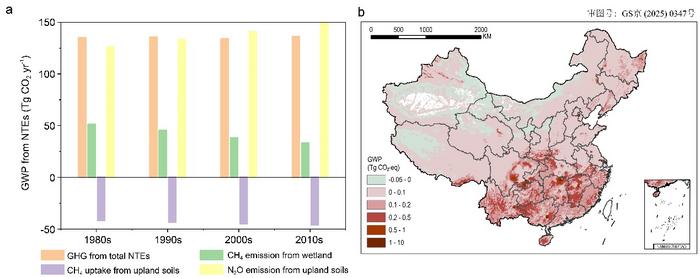
China’s natural terrestrial ecosystems (NTEs) are critical players in the global climate narrative, significantly influencing the fluxes of potent greenhouse gases, methane (CH₄) and nitrous oxide (N₂O). The past four decades have witnessed a broad spectrum of research aimed at understanding the dynamics of these ecosystems and their contribution to the atmospheric burden of greenhouse gases. A pivotal study led by Dr. Tingting Li from the Chinese Academy of Sciences sheds light on the multifaceted nature of CH₄ and N₂O emissions, providing crucial insights into their temporal and spatial distribution across these ecosystems.
The research is framed within the context of how China’s diverse natural ecosystems—encompassing forests, grasslands, wetlands, and shrubs—serve not only as sources of greenhouse gas emissions but also as sinks that can potentially counteract some of these emissions. The implications of the findings presented in this study are profound, as they reveal the intricate interplay between greenhouse gas dynamics and ecosystem health in the face of climate change and human intervention.
In examining the temporal trends of greenhouse gas emissions from China’s NTEs from 1980 to 2020, the study reveals a cumulative global warming potential (GWP) of approximately 5.55 Pg CO₂-equivalent. This substantial figure is indicative of the broader implications for global climate targets and underscores the importance of continuing research in this field. The study employed a multi-model approach, leveraging advanced methodologies to dissect the contributions of various ecosystems to CH₄ emissions and uptake. It was found that wetlands, owing to their inherent processes, are significant sources of CH₄ emissions. Meanwhile, forests, grasslands, and shrublands demonstrate a remarkable ability to sequester CH₄, acting to moderate some of the emissions that arise from wetter regions.
Despite this balancing act, the overarching warming effect in China’s NTEs remains predominantly driven by rising N₂O emissions. The study posits that atmospheric nitrogen deposition, spurred by agricultural activities and industrial practices, has led to increased emissions of this greenhouse gas. Additionally, the patterns of CH₄ and N₂O emissions reveal distinct geographical discrepancies—a finding that emphasizes the necessity for region-specific strategies tailored to address the unique challenges posed by greenhouse gas dynamics.
The role of climate change itself within this framework cannot be understated. Rising temperatures have exacerbated the emission rates of CH₄ from wetlands, which are now more vulnerable to the influences of both shifting climatic conditions and changes in land use. This connection between climate and land-use practices is critically important, as it highlights how anthropogenic activities such as the conversion of wetlands to agricultural land or the expansion of forested areas can modulate greenhouse gas fluxes.
The findings prompt important considerations for future policy-making and environmental management. With implications for biodiversity conservation and habitat restoration, Dr. Li and her research team advocate for the prioritization of grassland restoration in regions like Inner Mongolia and the Tibetan Plateau. These areas have shown potential for enhancing CH₄ uptake, which not only contributes to mitigation efforts but also fosters diverse ecosystems vital for maintaining the ecological balance.
Furthermore, the study suggests that not all restoration efforts should aim at maximizing carbon sequestration. For example, initiatives targeting wetland restoration should carefully consider areas exhibiting low CH₄ fluxes, such as coastal wetlands. This holistic approach to ecosystem restoration balances the intricacies of greenhouse gas emissions alongside the provision of important ecosystem services, including water purification and flood control.
As one delves deeper into the findings of Dr. Li’s study, the necessity for an integrated approach to land management becomes evident. Policymakers are urged to consider these dynamics when implementing land-use practices and restoration projects, thereby ensuring that efforts to mitigate greenhouse gas emissions are comprehensive and nuanced. The research not only contributes to the existing body of knowledge but also offers actionable insights for sustainable development goals in China and beyond.
The study’s insights offer a critical foundation for understanding the ongoing and future role of China’s NTEs in the global greenhouse gas context. As such, this research is anticipated to resonate widely, influencing both scientific thought and public policy as nations grapple with the urgent need to address climate change. The shifting baselines of greenhouse gas emissions and the complexity of ecological interactions call for continued vigilance in monitoring and managing these vital ecosystems.
In conclusion, this investigation into the CH₄ and N₂O emissions from China’s natural terrestrial ecosystems stands as a testament to the intricate relationship between our changing climate and the land that sustains us. The findings underscore an urgent need for concerted global efforts to mitigate greenhouse gas emissions while fostering the resilience of natural ecosystems. As we move towards a more sustainable future, the insights from Dr. Li’s work will undoubtedly shape the conversation on land management and climate action for years to come.
Keywords
Greenhouse gases, methane, nitrous oxide, China, terrestrial ecosystems, climate change, environmental management, ecosystem restoration, global warming potential.
Cite Scienmag News
Bethany Barker. (April 7, 2025). Exploring China’s Terrestrial Ecosystems: Key Contributors and Absorbers of Methane and Nitrous Oxide. Scienmag. https://scienmag.com/exploring-chinas-terrestrial-ecosystems-key-contributors-and-absorbers-of-methane-and-nitrous-oxide/
Bethany Barker. "Exploring China’s Terrestrial Ecosystems: Key Contributors and Absorbers of Methane and Nitrous Oxide." Scienmag, 7 April 2025, https://scienmag.com/exploring-chinas-terrestrial-ecosystems-key-contributors-and-absorbers-of-methane-and-nitrous-oxide/. Accessed 5 September 2026.
Bethany Barker. "Exploring China’s Terrestrial Ecosystems: Key Contributors and Absorbers of Methane and Nitrous Oxide." Scienmag. April 7, 2025. https://scienmag.com/exploring-chinas-terrestrial-ecosystems-key-contributors-and-absorbers-of-methane-and-nitrous-oxide/


