


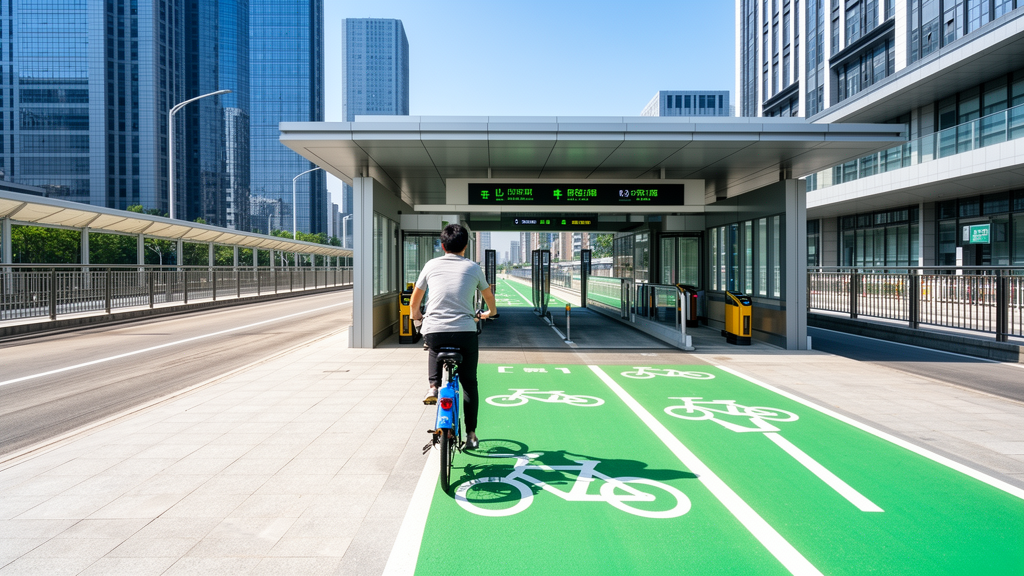
In the Chinese megacity of Tianjin, the same street can encourage someone to cycle the last mile to a metro station or push them toward walking, a bus, or a private car. A new study argues that the difference often comes down to precise, measurable thresholds in the built environment — and that the factors driving how many people bike to the metro are not the same factors driving how large a share of metro riders bike there at all.
The study, published in Frontiers in Public Health, was led by Lei Pang of the University of Jinan, with colleagues at Fuzhou University, Southwest Jiaotong University, and Nanyang Institute of Technology. It takes Tianjin — a city of more than 13 million residents with a storied cycling culture — as its laboratory. By December 2020, the city operated six metro lines with 143 stations, 123 of which fell within the service coverage of dockless bike-sharing operated by Meituan and Qingju. The researchers drew on bike-sharing trip records from May 22 to 26, 2023, metro smart card data from December 14 to 18, 2020, mobile phone signaling data used to estimate where people live, and a suite of geospatial datasets covering points of interest, building footprints, road networks, and bus stops.
A central methodological question was how to decide which bike-sharing trips actually counted as metro feeder trips. Because bike-sharing rentals and metro swipes are recorded in separate systems, direct linkage is impossible. The team generated rings of buffers at 20-meter intervals around station entrances and exits, up to 200 meters, and tracked how the number of bike unlocks and locks changed as the radius grew. The increments rose sharply and then stabilized at 100 meters — roughly a one-to-two-minute walk — so trips ending within that zone were treated as feeder connections. The authors caution that this is a proxy based on spatial proximity rather than confirmed transfers, but they argue that residual misclassification would add random noise rather than systematically inflate their estimates.
Two outcome variables anchored the analysis. The first, connection frequency, measures the average daily number of bike-sharing trips connecting to each station — essentially the volume of feeder cycling. The second, modal share, expresses feeder bike trips as a proportion of total metro station ridership, capturing how competitive the bicycle is against walking, buses, and cars. The researchers delineated a 1,500-meter cycling catchment around each station, clipped overlapping zones with Thiessen polygons, and measured roughly twenty built environment indicators within each catchment, organized along an extended “5D plus node” framework spanning density, diversity, design, destination accessibility, distance to transit, and network attributes.
Greenery entered the picture through the Green View Index, or GVI. The team collected 1.86 million Baidu Street View panoramic images in September 2021, sampling every 50 meters along road centerlines and capturing four directional views at each point. A deep learning segmentation model, PSPNet, calculated the proportion of green vegetation pixels in each image, and station-level GVI was averaged across all sampling points within a catchment. Importantly, the authors stress that this GVI is a station-catchment proxy for potential street-level green exposure, not a measurement of the greenery cyclists actually saw on their individual routes, because the bike-sharing data contained trip origins and destinations but not complete trajectories.
To model the relationships, the researchers chose LightGBM, a gradient-boosted decision tree method, paired with SHAP values, a game-theoretic technique that decomposes each prediction into per-feature contributions. Unlike spatial regression models such as GWR, which assume smoothly varying linear coefficients, tree-based models can capture thresholds and abrupt changes in direction. The data were split 70/30 into training and held-out test sets, with hyperparameter tuning confined to the training set via five-fold cross-validation. The connection frequency model achieved a test-set R-squared of 0.72, while the modal share model reached only 0.40 — a gap the authors attribute to the fact that trip generation tracks physical surroundings more directly than mode choice, which is also shaped by individual habits, socioeconomic characteristics, and real-time conditions.
The contribution rankings revealed a striking divergence. Connection frequency was dominated by governmental POI density, which alone accounted for 39.8 percent of the model’s explanatory contribution, followed by commercial POI density at 11.5 percent and cultural-educational POI density at 9.4 percent — a profile the authors describe as commuting- and daily-activity-oriented. Modal share told a different story: healthcare POI density led with 27.0 percent, followed by distance to the city center at 15.0 percent and bus stop density at 10.0 percent, pointing to mechanisms of accessibility and inter-modal competition. The authors suggest that travel tied to hospitals involves older adults and patients who are especially sensitive to cycling safety and comfort, and who may find bike-sharing a practical complement where parking is difficult and bus coverage thin.
Perhaps the most consequential findings are the thresholds. Governmental POI density exerted a negative effect on connection frequency below 30 POIs per square kilometer and turned positive beyond it, a shift the authors interpret as the point at which job agglomeration generates enough commuter demand for bike-sharing’s feeder advantage to emerge. The Green View Index showed a similar pattern on its 0-to-400 scale: below 90, the effect on connection frequency was negative, with monotonous streetscapes and pronounced heat island conditions potentially discouraging riding; above 90, tree canopy and shading enhanced comfort and boosted feeder cycling, though the benefit leveled off past 150. Bus stop density flipped from complementarity to competition at 4 stops per square kilometer — below that, bike-sharing supplements sparse bus service; above it, the two modes vie for the same short trips. Floor area ratio displayed an inverted U-shaped effect on modal share, positive between 0.5 and 2.1 and negative on either side, suggesting that moderate development intensity best supports cycling’s share of feeder trips.
Space itself told a story of mismatch. High connection frequencies concentrated in the city center, following a concentric decay outward that mirrors land use intensity and employment density. High modal shares, by contrast, clustered in suburban ring zones roughly 5 to 9 kilometers from downtown, where station spacing is wider, bus coverage thinner, and feeder distances moderate enough to favor cycling. In the dense core, short trips favor walking; in the outer suburbs, distances grow too long and bike supply too thin. The authors frame this divergence as spatial unevenness in access to bike-sharing as a green feeder mode — a planning-equity concern, though they are careful to note that no health outcomes were measured and that these patterns reflect potential, not demonstrated, health inequities.
The study carries explicit caveats. Only weekday data were available, so weekend and holiday patterns remain unexamined. The bike-sharing and metro datasets are separated by roughly two and a half years, a gap the authors justify by documenting that Tianjin’s core network saw no station closures and that the shared-bike fleet cap of 340,000 vehicles held steady, but they acknowledge that December 2020 metro ridership was likely suppressed by roughly 10 to 15 percent due to pandemic-era conditions, which would inflate the reported modal share — making it an upper-bound estimate whose cross-station patterns, rather than absolute levels, are the primary contribution. The GVI is a catchment-level proxy, street greenery benefits walkers as well as cyclists, and the health-equity framing is explicitly interpretive rather than causal.
Even with those limits, the practical implications are concrete. The authors propose differentiated transit-oriented development guidance targeting the FAR window of 0.5 to 2.1, ring-specific service strategies that prioritize bicycle deployment and parking in the suburban rings, and coordinated bus–bike governance that positions bike-sharing to fill coverage gaps where bus stop density exceeds the 4-per-square-kilometer competition threshold. They also suggest a planning target of GVI at or above 90 for major feeder roads within 800 meters of metro stations, with priority for low-GVI suburban and lower-income areas — a recommendation they frame as a hypothesis for improving potential green exposure under heatwave conditions, not a verified health intervention. As cities worldwide grapple with how to make the first and last miles of transit trips greener, the Tianjin evidence suggests that the answer lies less in blanket investment than in knowing exactly where, on the curve, each street sits.
Subject of Research: Nonlinear effects of the built environment on metro-feeder bike-sharing connection frequency and modal share in Tianjin, China
Article Title: Nonlinear effects of built environment on metro-feeder bike-sharing as a dynamic green exposure pathway: a dual perspective of connection frequency and modal share
Article References: Pang, L., Qiu, C., Sun, H., Ren, X., & Sun, Z. (2026). Nonlinear effects of built environment on metro-feeder bike-sharing as a dynamic green exposure pathway: a dual perspective of connection frequency and modal share. Frontiers in Public Health, 14, Article 1951162. https://doi.org/10.3389/fpubh.2026.1951162
Image Credits: AI Generated
DOI: 10.3389/fpubh.2026.1951162
Keywords: bike-sharing, metro feeder, built environment, Tianjin, LightGBM-SHAP, Green View Index, modal share, connection frequency, nonlinear thresholds, transit-oriented development, active mobility, urban planning
Cite Scienmag News
Ophelia Keating. (October 27, 2026). Built Environment Thresholds Shape Bike-Sharing Feeder Trips in Tianjin. Scienmag. https://scienmag.com/built-environment-thresholds-shape-bike-sharing-feeder-trips-in-tianjin/
Ophelia Keating. "Built Environment Thresholds Shape Bike-Sharing Feeder Trips in Tianjin." Scienmag, 27 October 2026, https://scienmag.com/built-environment-thresholds-shape-bike-sharing-feeder-trips-in-tianjin/. Accessed 27 October 2026.
Ophelia Keating. "Built Environment Thresholds Shape Bike-Sharing Feeder Trips in Tianjin." Scienmag. October 27, 2026. https://scienmag.com/built-environment-thresholds-shape-bike-sharing-feeder-trips-in-tianjin/


