


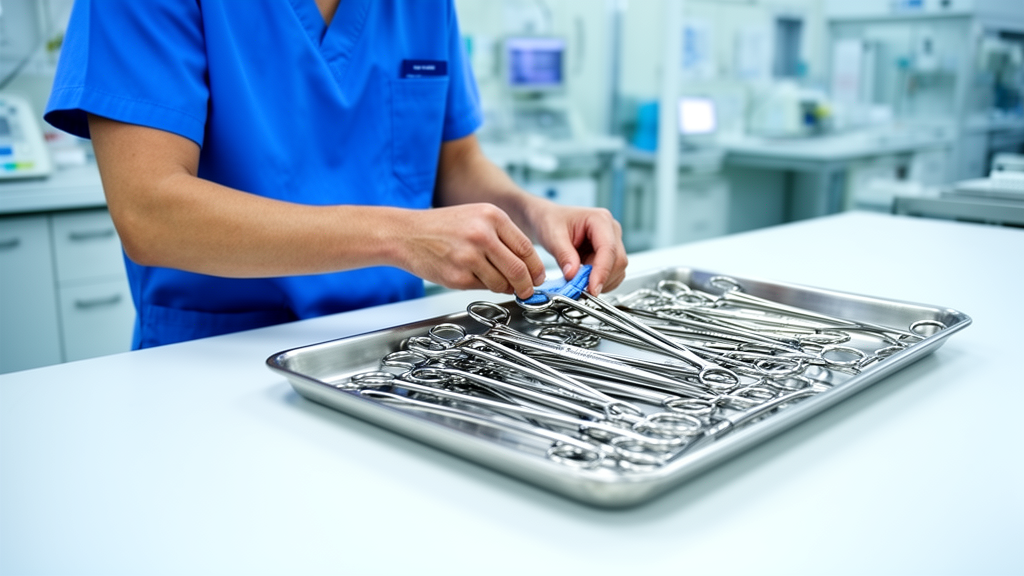
A quality improvement program built on the Joanna Briggs Institute (JBI) model of evidence-based healthcare substantially improved how surgical instruments are preprocessed at a Chinese hospital, according to a study published in Frontiers in Public Health. After the intervention, the rate of surgical instruments returned to the decontamination area for initial re-cleaning fell from 0.67% to 0.09%, a statistically significant drop reported with a chi-square value of 3512.527 and p < 0.001.
The authors note that inadequate preprocessing can leave biofilm residue on instruments, creating potential risks during reprocessing and increasing the risk of healthcare-associated infections, which compromises patient safety and healthcare quality.
Guided by the JBI model of evidence-based healthcare, the research team summarized the best available evidence for surgical instrument preprocessing, analyzed barriers to implementation in clinical practice, and formulated standardized audit criteria and intervention strategies. The aim was to develop a standardized preprocessing protocol based on evidence-based practice and to validate its effectiveness in improving instrument preprocessing quality, increasing staff compliance with preprocessing criteria, and raising CSSD staff knowledge of nosocomial infection prevention and control.
To evaluate the protocol, the researchers used a one-group pretest-posttest design, assessing compliance with audit criteria in preprocessing procedures, the rate of instruments returned for initial re-cleaning, and staff knowledge scores. This design has inherent limitations: without a concurrent control group, changes over time cannot be definitively attributed to the intervention alone, and the findings come from a single department at one hospital.
The results showed measurable gains across all three outcomes. Ten of the twenty audit criteria achieved a 100% compliance rate after the evidence was applied in practice. The absolute risk difference in the re-cleaning rate was 0.58%, with a 95% confidence interval of 0.56% to 0.60%, and the risk ratio was 7.93, with a 95% confidence interval of 7.31 to 8.60, indicating that instruments were nearly eight times more likely to be returned for initial re-cleaning before the intervention than after it.
Staff knowledge also improved markedly. CSSD staff mean scores for knowledge of nosocomial infection prevention and control rose from 58.06 ± 9.097 to 95.83 ± 3.930, a difference the authors report as statistically significant (t = 22.520, p < 0.001). The study was published under the section Infectious Diseases: Epidemiology and Prevention and was received on 07 July 2026 and accepted on 12 October 2026.
According to the authors, the intervention, based on the JBI evidence-based model, could standardize instrument preprocessing procedures, reduce the proportion of surgical instruments returned to the decontamination area for initial re-cleaning, and improve CSSD staff theoretical knowledge of instrument preprocessing. They position the work as evidence to support quality control in surgical instrument preprocessing and as a contribution to the prevention and control of nosocomial infections.
The findings relate to the role of instrument preprocessing in the surgical safety chain. Instruments that arrive in the decontamination area with residual biological material must be sent back for initial re-cleaning, adding workload and delay, and biofilm residue left by inadequate preprocessing is described by the authors as a potential infection risk during reprocessing.
Because the study is a one-group pretest-posttest evaluation in a single hospital department, the authors’ conclusions should be read as evidence of feasibility and local effectiveness rather than as proof of impact on surgical site infections or patient outcomes, which the study did not measure directly. Nevertheless, the reported combination of near-universal compliance on half of the audit criteria, a large relative reduction in re-cleaning returns, and substantial knowledge gains offers a concrete template that other sterile supply departments could adapt, test, and audit within their own quality control systems.
Subject of Research: An evidence-based quality improvement program for surgical instrument preprocessing in a hospital central sterile supply department.
Article Title: Evidence-based preprocessing improvement bundle for surgical instruments: reducing surgical infection risks via quality improvement
Article References: Hu, R., Pan, W., Yi, L., Hu, J., Zhang, H., & Chen, Y. (2026). Evidence-based preprocessing improvement bundle for surgical instruments: reducing surgical infection risks via quality improvement. Frontiers in Public Health, 14, 1930642. https://doi.org/10.3389/fpubh.2026.1930642
Image Credits: AI Generated
DOI: 10.3389/fpubh.2026.1930642
Keywords: surgical instruments, preprocessing, central sterile supply department, evidence-based practice, Joanna Briggs Institute, quality improvement, nosocomial infections, healthcare-associated infections, decontamination, audit criteria, biofilm, patient safety
Cite Scienmag News
Ophelia Keating. (October 27, 2026). Evidence-Based Bundle Cuts Re-Cleaning of Surgical Instruments in Hospital Sterile Supply Study. Scienmag. https://scienmag.com/evidence-based-bundle-cuts-re-cleaning-of-surgical-instruments-in-hospital-sterile-supply-study/
Ophelia Keating. "Evidence-Based Bundle Cuts Re-Cleaning of Surgical Instruments in Hospital Sterile Supply Study." Scienmag, 27 October 2026, https://scienmag.com/evidence-based-bundle-cuts-re-cleaning-of-surgical-instruments-in-hospital-sterile-supply-study/. Accessed 27 October 2026.
Ophelia Keating. "Evidence-Based Bundle Cuts Re-Cleaning of Surgical Instruments in Hospital Sterile Supply Study." Scienmag. October 27, 2026. https://scienmag.com/evidence-based-bundle-cuts-re-cleaning-of-surgical-instruments-in-hospital-sterile-supply-study/


