


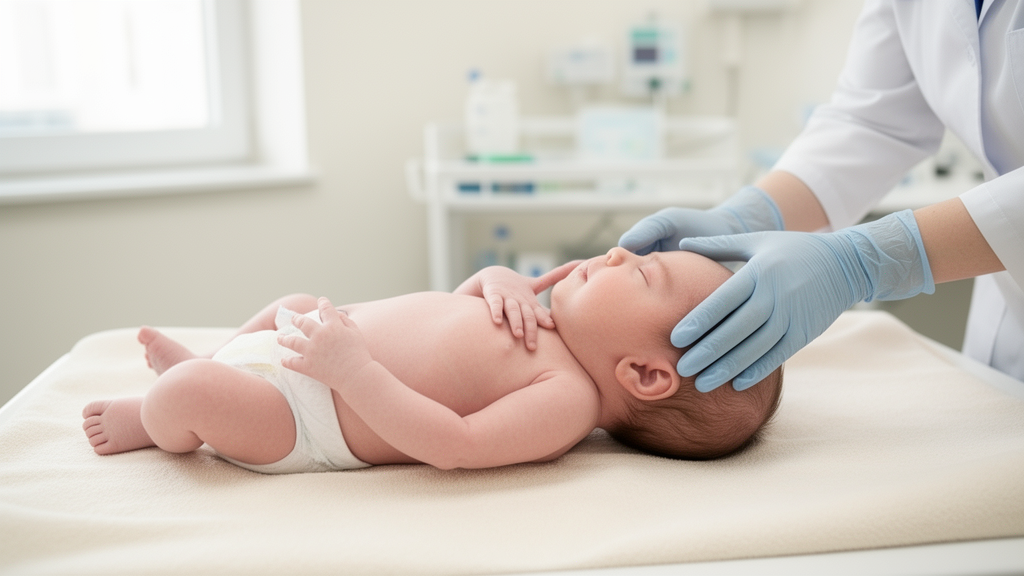
Infants born small for gestational age who show positional cranial deformation scored lower on standardized developmental tests than peers with normally shaped heads, according to a cross-sectional study conducted at Shanghai Children’s Hospital. The analysis, published in Frontiers in Public Health, found that the presence of cranial deformation was associated with reduced developmental quotient scores in two specific domains: fine motor skills and adaptive behavior. The associations survived statistical correction for multiple comparisons, while exploratory analyses of individual head-shape subtypes did not.
Positional cranial deformation is one of the most common skull abnormalities in infancy, encompassing plagiocephaly, brachycephaly, and scaphocephaly. Since the “Back to Sleep” campaign encouraged parents to place infants on their backs to reduce sudden infant death syndrome, the condition has been reported more frequently, and some cases persist into adolescence. It is often perceived as a cosmetic concern, with craniofacial asymmetry or occipital flattening as the most visible signs, but severe cases may co-occur with musculoskeletal problems such as torticollis, visual abnormalities such as strabismus, or ear, nose, and throat issues. Beyond the physical manifestations, previous observational studies have suggested links with early developmental differences: infants younger than four months with the condition have shown lower scores on the Test of Infant Motor Performance, and school-age children who previously had moderate-to-severe deformation have been reported to show poorer academic performance and persistently lower cognitive and motor scores. The study’s authors emphasize that these observational findings do not establish cranial deformation as a cause of later developmental difficulties.
Small for gestational age is generally defined as a birth weight below the 10th percentile for gestational age and sex. It is a size-at-birth classification that includes both constitutionally small infants and those whose small size may reflect impaired fetal growth. As a group, these infants face increased risk of less favorable postnatal growth and neurodevelopmental outcomes, although outcomes vary considerably within this heterogeneous population. Direct evidence that the classification independently increases the occurrence of cranial deformation remains limited, but lower birth weight has been associated with positional plagiocephaly in healthy term infants, and head positional preference and attainment of fewer early motor milestones have also been linked to the condition. Because small-for-gestational-age infants may have vulnerabilities in early growth and motor development that overlap with these factors, the researchers conceptualized cranial deformation as a clinical feature of developmental vulnerability within this population rather than an established independent risk factor.
The study drew on a clinical follow-up cohort maintained at Shanghai Children’s Hospital, including infants assessed between September 2021 and April 2026. Of 1,027 small-for-gestational-age infants who underwent cranial scanning during the study period, 216 completed the Gesell Developmental Schedules evaluation, and 156 of those also had complete three-dimensional cranial morphology data and met all other eligibility criteria. Inclusion required a birth weight below the 10th percentile according to the INTERGROWTH-21st international standards, parental informed consent, available 3D scan data, and completion of the Gesell assessment. Infants with major genetic disorders, congenital or neonatal conditions known to affect neurodevelopment, confirmed craniosynostosis, severe sensory impairments, or recent acute illness were excluded. The upper eligibility limit was 18 months of age, but assessments were concentrated in early infancy, with median ages of 6.36 months at cranial scanning and 6.90 months at developmental assessment.
Cranial morphology was captured with the SmartSoc system, a 3D imaging platform that uses computer vision to convert two-dimensional video from a smartphone into digital geometries. Trained technicians followed a standardized protocol, and head shape was classified into five categories based on the cranial index and the cranial vault asymmetry index: brachycephaly was defined as a cranial index above 90, plagiocephaly as a cranial vault asymmetry index of at least 3.5 percent, and scaphocephaly as a cranial index of 78 or below; infants meeting criteria for both brachycephaly and plagiocephaly were classified as asymmetric brachycephaly, and the rest as normal. Among the 71 infants with cranial deformation, plagiocephaly was the most common subtype at 46.5 percent, followed by brachycephaly at 23.9 percent, asymmetric brachycephaly at 18.3 percent, and scaphocephaly at 11.3 percent. Qualified assessors administered the Gesell Developmental Schedules, generating developmental quotient scores across five domains: gross motor, fine motor, language, adaptive behavior, and personal-social behavior. For infants born preterm, assessments were based on corrected age, and developmental delay was defined as a developmental quotient of 75 or below.
In multiple linear regression models adjusted for infant sex, gestational age at birth, age at Gesell assessment, maternal education level, and pregnancy complications, cranial deformation was associated with lower fine motor scores (a coefficient of −4.97 developmental quotient points, 95 percent confidence interval −8.71 to −1.24) and lower adaptive behavior scores (−4.91 points, 95 percent confidence interval −8.96 to −0.86), both remaining significant after false discovery rate correction. A marginal association was observed in the gross motor domain (−3.82 points, 95 percent confidence interval −7.93 to 0.30), while language and personal-social domains showed no significant associations. The between-group comparison revealed one notable baseline difference: gestational age at birth was lower in the deformation group (median 37.00 versus 37.57 weeks), driven mainly by a higher proportion of infants born before 34 weeks in that group (23.9 percent versus 7.1 percent), which is why gestational age was adjusted for in all subsequent analyses. No significant differences were detected in sex, assessment ages, maternal education, pregnancy complications, birth-weight-for-gestational-age percentile, or SGA severity.
Subtype-specific analyses suggested similar negative associations for brachycephaly and plagiocephaly in the fine motor and adaptive behavior domains before correction—for example, brachycephaly was associated with −5.91 points in fine motor and −6.60 points in adaptive behavior, and plagiocephaly with −5.76 and −7.27 points respectively. However, none of the subtype-specific associations remained significant after false discovery rate correction across all 20 subtype-domain contrasts, and no clear associations were observed for scaphocephaly or asymmetric brachycephaly. When the cranial index and cranial vault asymmetry index were analyzed as continuous predictors, no significant linear associations with developmental scores survived correction; a higher cranial index was nominally associated with lower language scores, and higher asymmetry showed marginal negative trends with fine motor and adaptive scores, but these did not reach significance. The authors suggest that developmental vulnerability may emerge only after cranial deviation exceeds a certain threshold rather than increasing proportionally with severity, though they note this hypothesis requires validation in larger cohorts.
A complementary threshold-based analysis of clinically defined developmental delay (a developmental quotient of 75 or below) showed that the abnormal head-shape group had a higher observed proportion of gross motor delay than the normal group (12.7 percent versus 3.5 percent, crude odds ratio 3.97), but this association did not remain significant after false discovery rate correction. Numerically higher delay rates were also observed in the abnormal group for fine motor (9.9 percent versus 5.9 percent), adaptive behavior (14.1 percent versus 5.9 percent), language (14.1 percent versus 8.2 percent), and personal-social domains (9.9 percent versus 7.1 percent), although none reached statistical significance. Four sensitivity analyses examined the stability of the main findings: excluding infants whose mothers had pregnancy complications, restricting to infants born at 34 weeks or later, restricting to complete cases with no missing covariates, and additionally adjusting for the birth-weight-for-gestational-age z-score. The fine motor and adaptive behavior associations remained significant after correction in all scenarios except the complete-case analysis, where the point estimates remained negative but lost significance, which the authors attribute most plausibly to reduced statistical power in the smaller sample of 108 infants.
The authors caution that the cross-sectional design restricts any causal interpretation, and that cranial deformation and developmental performance may partly reflect shared underlying vulnerabilities such as neuromotor immaturity, altered muscle tone, postural preference, or other neonatal and developmental factors that were not directly assessed. Because this was a clinical follow-up cohort at a tertiary hospital rather than a population-based sample, the analytic sample was enriched for infants with greater perinatal risk, limiting generalizability to lower-risk populations, and the observed proportion of deformation should not be interpreted as a prevalence estimate. Detailed characterization of neonatal clinical history, including intensive care admission and postnatal complications, was limited, so residual confounding cannot be excluded, and systematic neuroimaging was not performed, meaning subtle intracranial abnormalities or unrecognized conditions could underlie both features. Longitudinal outcomes were not examined, so the persistence of the associations remains unclear. Nevertheless, the authors suggest that cranial morphology may serve as an accessible, early observable indicator during routine small-for-gestational-age follow-up, helping identify infants who warrant closer developmental monitoring in the fine motor and adaptive behavior domains, and they call for multicenter prospective studies recruiting consecutive infants to validate the findings and clarify their long-term developmental implications.
Subject of Research: Associations between positional cranial deformation and domain-specific neurodevelopment in small-for-gestational-age infants
Article Title: Positional cranial deformation and domain-specific neurodevelopment in small-for-gestational-age infants: a cross-sectional study
Article References: Zhu, J., Wu, D., Chen, L., Zhu, D., Chen, Y., Tachibana, M., Hong, X., Hirano, Y., & Chen, J. (2026). Positional cranial deformation and domain-specific neurodevelopment in small-for-gestational-age infants: a cross-sectional study. Frontiers in Public Health, 14, Article 1936897. https://doi.org/10.3389/fpubh.2026.1936897
Image Credits: AI Generated
DOI: 10.3389/fpubh.2026.1936897
Keywords: positional cranial deformation, small for gestational age, plagiocephaly, brachycephaly, neurodevelopment, Gesell Developmental Schedules, fine motor, adaptive behavior, cross-sectional study, developmental quotient, infant follow-up, cranial morphology
Cite Scienmag News
Ophelia Keating. (October 27, 2026). Cranial flattening in small-for-gestational-age infants linked to lower developmental scores. Scienmag. https://scienmag.com/cranial-flattening-in-small-for-gestational-age-infants-linked-to-lower-developmental-scores/
Ophelia Keating. "Cranial flattening in small-for-gestational-age infants linked to lower developmental scores." Scienmag, 27 October 2026, https://scienmag.com/cranial-flattening-in-small-for-gestational-age-infants-linked-to-lower-developmental-scores/. Accessed 27 October 2026.
Ophelia Keating. "Cranial flattening in small-for-gestational-age infants linked to lower developmental scores." Scienmag. October 27, 2026. https://scienmag.com/cranial-flattening-in-small-for-gestational-age-infants-linked-to-lower-developmental-scores/


