


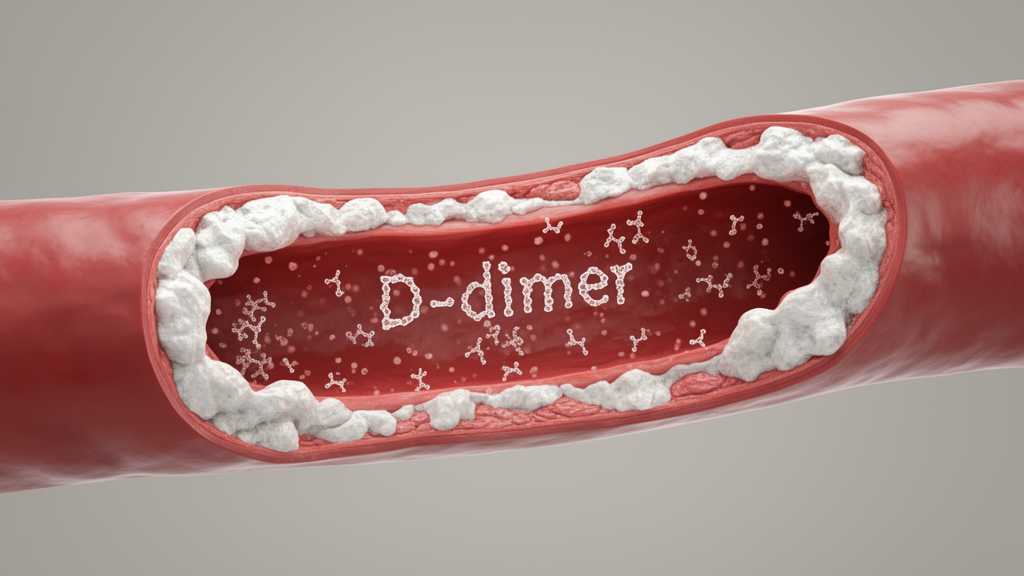
Patients who spend years on hemodialysis often accumulate calcium in their arteries, a process that stiffens blood vessels and drives the cardiovascular disease that remains the leading cause of death in this population. A new cross-sectional study from Wuxi People’s Hospital Affiliated to Nanjing Medical University, published in Frontiers in Medicine, reports that D-dimer—a routine blood test that measures the breakdown of cross-linked fibrin clots—was independently associated with visible calcification of the aortic arch in 346 maintenance hemodialysis patients. For every 100 micrograms per liter increase in D-dimer, the odds of having radiographically detectable vascular calcification rose by 9.5 percent, even after the researchers accounted for age, dialysis duration, blood pressure, body mass index, and a panel of laboratory variables.
The study enrolled adult outpatients who had been on maintenance hemodialysis for at least three months and screened between October 2023 and October 2024. Patients with severe infection in the preceding month, active malignancy, or cachexia were excluded, as were anyone missing key study data. All participants were ambulatory community-dwelling patients attending regular dialysis sessions, and fasting blood samples were drawn from the vascular access before a dialysis session following the long interdialytic interval. Because only patients with complete data were analyzed, no statistical imputation for missing values was needed.
Vascular calcification was graded from posteroanterior chest x-rays using the criteria described by Symeonidis and colleagues: grade 0 means no visible calcification, grade 1 a small punctate or single thin calcified lesion, grade 2 thick or circular calcification covering up to half of the aortic arch area, and grade 3 circular calcification involving more than half of that area. Two radiologists blinded to the clinical data reviewed every image independently, with disagreements resolved by consensus. For the regression analyses the outcome was collapsed into a binary variable—no calcification versus any of grades 1 through 3. The authors acknowledge that chest x-ray detects mainly overt, macroscopic calcification and is less sensitive than computed tomography for early or diffuse disease, so the findings reflect radiographically evident calcification rather than the full systemic calcification burden.
D-dimer levels climbed steadily across the calcification grades. Patients with grade 0 had a median D-dimer of 172 micrograms per liter, compared with 266 in grade 1, 321 in grade 2, and 322 in grade 3, a difference that was highly statistically significant.
In the multivariable logistic regression model, five clinically relevant core variables—D-dimer, age, dialysis time, calcium, and phosphorus—were forced into the analysis regardless of their univariate significance, while the remaining candidates were screened by univariate regression with a liberal entry threshold. D-dimer was rescaled by dividing by 100 before model fitting, so its odds ratio describes the change in odds per 100 micrograms per liter. The adjusted odds ratio was 1.095 with a 95 percent confidence interval of 1.014 to 1.182 and a P value of 0.020. Age was the strongest contributor, with each additional year raising the odds of calcification by 5.6 percent. Hemoglobin and calcium-based phosphate binder use were also independently and positively associated with calcification, the latter with an odds ratio of 3.440, although the authors note that binder use was sparse among patients without calcification, so that estimate carries uncertainty. C-reactive protein showed a marginal association and alkaline phosphatase a similar trend that just missed significance, while dialysis time, calcium, phosphorus, diastolic blood pressure, body mass index, and serum creatinine were not independently associated.
Because D-dimer levels tend to rise with age, the researchers performed a separate age-adjusted analysis; D-dimer remained significantly associated with calcification, with an odds ratio of 1.073 per 100 micrograms per liter. A formal test for a D-dimer-by-age interaction was not significant, indicating that the association did not differ meaningfully across age groups. The authors also caution that the positive hemoglobin association likely reflects treatment-related or nutritional factors—such as erythropoiesis-stimulating agent use and iron status—rather than a direct pro-calcific effect, and that the lower body mass index and diastolic pressure seen in more heavily calcified patients fit the malnutrition-inflammation complex and reverse epidemiology well described in dialysis populations.
From these variables the team built a nomogram, a graphical scoring tool that converts routinely available clinical and laboratory measurements into an individual probability of prevalent aortic arch calcification. Age and D-dimer contributed most prominently to the total point score. A SHAP interpretability analysis of the same full model confirmed that age was the most influential variable, followed by D-dimer and dialysis time, with higher values of age and D-dimer generally pushing the estimated probability of calcification upward. The model is intended as a screening and stratification aid rather than a diagnostic test, to be applied at the time of routine chest x-ray follow-up without additional testing or cost; a high predicted probability could prompt intensified cardiovascular risk management and prioritization for CT-based calcification scoring when resources permit.
Performance statistics tell a nuanced story. The full model achieved an apparent area under the receiver operating characteristic curve of 0.802, with a 95 percent confidence interval of 0.754 to 0.849, and an apparent Brier score of 0.162. Internal validation used 1,000 bootstrap resamples in which the entire model-development process, including variable screening, was repeated each time; the optimism-corrected AUC was 0.770, with a corrected calibration slope of 0.84 and a corrected Brier score of 0.176. A D-dimer-only model managed an AUC of just 0.649, significantly worse than both the full model and the model without D-dimer. Critically, adding D-dimer to the multivariable model raised the apparent AUC only from 0.787 to 0.802—a difference of 0.015 that did not reach statistical significance by the DeLong test, though D-dimer did significantly improve the model likelihood. In decision curve analysis the full model outperformed treat-all and treat-none strategies across the plausible threshold range, with its advantage over the D-dimer-free model concentrated at thresholds above roughly 0.51.
The authors interpret this pattern carefully: a variable can retain independent statistical significance in regression while adding little to global discrimination when the base model already contains strong predictors such as age. They suggest D-dimer’s clinical contribution may lie in complementing routine assessment and supporting individualized risk stratification rather than in materially improving the area under the curve. Whether using the model actually changes downstream clinical decisions or improves outcomes has not been established by this cross-sectional study and requires prospective evaluation.
Several limitations frame the findings. The cross-sectional design precludes any inference about causality or temporal sequence, and the association should not be read as evidence that D-dimer predicts future calcification progression or plays a direct mechanistic role. External validation was not performed, so generalizability to other hemodialysis populations remains uncertain. Residual confounding cannot be excluded: vascular access type, anticoagulant treatment, vitamin D analog use, calcimimetic therapy, dialysis prescription, residual kidney function, and physical activity were not captured, and a small number of patients with clinically quiescent systemic lupus erythematosus or vasculitis were included. The authors call for multicenter prospective studies to validate the model and clarify whether D-dimer genuinely earns a place in calcification risk stratification for the hemodialysis population.
Subject of Research: The association between D-dimer blood levels and vascular calcification in maintenance hemodialysis patients
Article Title: Association of D-dimer levels with vascular calcification in patients undergoing maintenance hemodialysis: a cross-sectional study
Article References: Zhang, Z., Zhang, X., An, W., Shan, W., Mao, J., Xue, J., Li, W., & Wang, L. (2026). Association of D-dimer levels with vascular calcification in patients undergoing maintenance hemodialysis: a cross-sectional study. Frontiers in Medicine, 13, Article 1986142. https://doi.org/10.3389/fmed.2026.1986142
Image Credits: AI Generated
DOI: 10.3389/fmed.2026.1986142
Keywords: D-dimer, vascular calcification, hemodialysis, aortic arch calcification, cross-sectional study, chronic kidney disease, cardiovascular risk, nomogram, logistic regression, nephrology, biomarker, chest x-ray
Cite Scienmag News
Jerry Hayes. (October 27, 2026). Blood Clot Marker D-dimer Linked to Artery Calcification in Dialysis Patients. Scienmag. https://scienmag.com/blood-clot-marker-d-dimer-linked-to-artery-calcification-in-dialysis-patients/
Jerry Hayes. "Blood Clot Marker D-dimer Linked to Artery Calcification in Dialysis Patients." Scienmag, 27 October 2026, https://scienmag.com/blood-clot-marker-d-dimer-linked-to-artery-calcification-in-dialysis-patients/. Accessed 27 October 2026.
Jerry Hayes. "Blood Clot Marker D-dimer Linked to Artery Calcification in Dialysis Patients." Scienmag. October 27, 2026. https://scienmag.com/blood-clot-marker-d-dimer-linked-to-artery-calcification-in-dialysis-patients/


