


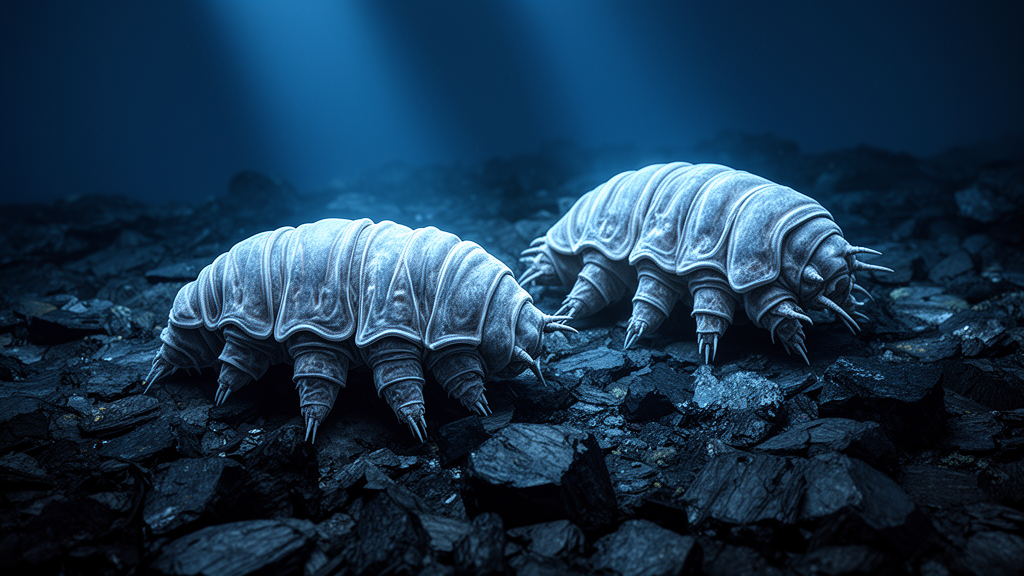
Deep beneath the surface of the Eastern Tropical Atlantic, on the summit plateau of an underwater mountain called Senghor Seamount, scientists have catalogued a remarkably diverse community of marine tardigrades, including two species entirely new to science. The finding, published in the journal ZooKeys, documents twenty distinct tardigrade taxa from the seamount’s biogenic sands, while a nearby deep-sea reference site yielded just two. The work also introduces two newly described armoured tardigrades from the family Stygarctidae: Megastygarctides hekatae sp. nov., notable for rare genital spines, and Parastygarctus potercha sp. nov., which displays a strikingly paedomorphic body plan.
The specimens were not collected recently. Sediment samples were gathered in September 2009 during cruise M79/3 of the research vessel Meteor in the Cabo Verde (Cape Verde) region, using a multiple corer. The researchers examined material from the summit plateau of Senghor Seamount and from one of two deep-sea reference sites, the analysed one lying roughly 100 kilometres north of the seamount. The summit sediment is composed mainly of coarse carbonate material of organic origin, including fragments of corals, echinoderms, bryozoans and molluscs, whereas the reference site sediment consists mainly of fine ooze. The upper five centimetres of each core were fixed with formaldehyde, and meiofaunal organisms were extracted by density gradient centrifugation using colloidal silica, then sieved and stained with Rose Bengal to ease sorting.
In total, 219 marine tardigrade individuals were recovered and analysed from eight selected samples. Of these, 212 specimens came from the Senghor Seamount summit; three of them, from station 865, core 4, were too deteriorated to identify beyond the class Heterotardigrada. The seamount fauna comprises twenty taxa in all. Three could be determined to species level: Chrysoarctus briandi, Quisarctus armatus and Raiarctus colurus. Fifteen further taxa were recorded at coarser resolution, including Angursa sp., Batillipes sp., Dipodarctus aff. subterraneus, Halechiniscus cf. perfectus, Raiarctus aff. variabilis and Tholoarctus cf. natans natans, among others. The remaining two are the new species described in the study.
The family-level breakdown reveals where the diversity is concentrated. Halechiniscidae is the most abundant family on the seamount, covering 52.6 percent of the tardigrade fauna, with representatives including unidentified halechiniscids, Dipodarctus species, Florarctinae, Chrysoarctus species, Halechiniscidae gen. A sp. A, Halechiniscus cf. perfectus and Quisarctus armatus. Styraconyxidae constitutes 26.3 percent, represented by unidentified styraconyxids, Angursa sp., Raiarctus species, Raiarctus colurus and Tholoarctus cf. natans natans. Tanarctidae covers 13.9 percent and is represented by Tanarctus sp., while Batillipedidae makes up just 0.5 percent with a single Batillipes sp. specimen. The new stygarctids together account for 6.7 percent of the fauna.
By contrast, the deep-sea reference area, characterised by fine ooze sediments, yielded only seven individuals across two taxa: six specimens of Angursa abyssalis and a single Angursa sp. The authors are careful about what this contrast means. Given the unequal sample sizes, they note, it is not possible to draw statistically significant conclusions from the observation. Nevertheless, the pattern fits a broader hypothesis that Atlantic seamounts act as hotspots, or oases, for meiofauna, characterised by higher abundance, biodiversity and the presence of endemic taxa compared with surrounding deep-sea areas. Previous surveys on Atlantic seamounts such as Faroe Bank, Condor Seamount, Great Meteor Seamount and Princess Alice Bank have likewise yielded numerous species records and newly described marine tardigrades.
The first new species, Megastygarctides hekatae sp. nov., is an armoured tardigrade whose cuticle is divided into a cephalic plate, three body plates, three accessory plates and a caudal plate. The holotype is a mature female measuring 193.3 micrometres long, collected at station 850 on the seamount’s central summit at 102.4 metres below sea level, from biogenic coarse sand. Its diagnosis includes three body plates and three accessory plates encircling the body, a cephalic plate divided into anterior and posterior parts, a ventral cephalic plate, club-shaped primary clavae and dome-shaped secondary clavae. Most distinctively, the genital ducts of its two oval seminal receptacles extend out of the body as two short hollow spines with inferior hooks.
Those genital spines are what make the discovery taxonomically significant. Genital spines are unique structures among tardigrades, reported so far only for Megastygarctides christinae, a species from the Arabian (Persian) Gulf. Megastygarctides hekatae sp. nov. can nonetheless be distinguished from M. christinae in several ways: its primary clavae are more elongated; its cirri E are distinctly longer, measuring 61 to 64.5 micrometres compared with 36 to 43 micrometres in M. christinae; it lacks the second accessory body plate present in the Gulf species; and its claws are noticeably longer on all limbs, for example 18.7 to 19.5 micrometres on leg IV versus 12 to 13 micrometres in M. christinae. The authors consider the clava shape a stable trait for species differentiation, even though no male specimen of the new species has yet been found. The species epithet honours Hekate, the Greek goddess whose name derives from the numeral hekaton, meaning one hundred, a nod to the type locality depth of approximately 100 metres, the deepest record for any known Megastygarctides species so far.
The second new species, Parastygarctus potercha sp. nov., is far smaller; the holotype female measures just 69.0 micrometres long and 21.0 micrometres wide. It carries a cuticular armour of cephalic plate, three body plates, two intersegmental plates and a caudal plate, with each body plate bearing two pairs of spine-like lateral processes, a small ventral anterior pair and a large dorsal posterior pair. Its claw formula is unique among all congeneric species: only three claws per leg on leg pairs I to III and two claws per leg on leg pair IV. The name potercha, Latinised from the Ukrainian word for the ghost of a dead, unbaptised child, refers to the species’ paedomorphic appearance. The holotype exhibits paedomorphic patterns in having a small body size and reduced claw numbers while simultaneously possessing a gonopore and seminal receptacles, adult reproductive structures. Eleven paratypes, including males, juveniles and one digital specimen, were examined, and only weak sexual dimorphism was observed, with males slightly larger and showing a shorter anus-gonopore distance of approximately 4.0 micrometres. Among Parastygarctus species, only P. potercha sp. nov. and P. biungulatus show paedomorphic characteristics, a phenomenon previously suggested for other armoured marine tardigrades such as Faroestygarctus dezioae and Pseudostygarctus galloae.
How does Senghor Seamount compare with other studied seamounts? The well-studied Faroe Bank harbours 35 recorded tardigrade species, indicating a community of similar diversity to that of Senghor Seamount, while only four tardigrade taxa have so far been recorded from the Azorean Princess Alice Bank, a comparison the authors note is relatively balanced in sample numbers, five to seven. At the current state of knowledge, the researchers caution, it is not possible to draw any pattern from these figures, such as a latitudinal gradient from sub-arctic to tropic regions or a correlation with depth or sediment parameters, although such effects may occur. The numbers of analysed samples remain very low and may bias the recorded diversity.
Indeed, the authors urge restraint in interpreting the seamount-versus-deep-sea contrast. The rather high species counts observed on Faroe Bank and Senghor Seamount compared with reported deep-sea records in the Atlantic region may support the hypothesis of seamounts as biodiversity hotspots for marine tardigrades, but such conclusions should be treated with caution because deep-sea tardigrade communities remain understudied. Other researchers have highlighted that the deep sea may host a broader diversity of tardigrades than currently recognised, and the differences in diversity and endemism between seamounts and deep-sea plains may reflect unevenness in sampling rather than true ecological patterns. Within the seamount fauna itself, five taxa, representing Florarctinae, Dipodarctus aff. subterraneus, Angursa sp., Raiarctus aff. variabilis and Tanarctus sp., are possibly new, undescribed species, but the material was not in a proper state for reliable species descriptions. All specimens, including slides and SEM stubs, are deposited in the Tardigrada collection of the Senckenberg Natural History Museum in Frankfurt am Main under inventory numbers SMF 1386 to 1604, with occurrence data also submitted to GBIF. Alongside the descriptions, the study provides updated dichotomous and pictorial identification keys for the genera Megastygarctides, now with seven species, and Parastygarctus, now with eight, giving future researchers the tools to identify these miniature armoured inhabitants of the deep Atlantic.
Subject of Research: Marine tardigrade diversity on Senghor Seamount, including two newly described species of armoured tardigrades from the family Stygarctidae.
Article Title: Marine tardigrades ( Heterotardigrada ) from Senghor Seamount, Eastern Tropical Atlantic, with the description of two new species from the taxon Stygarctidae
Article References: Trokhymchuk, R. R., Hansen, J. G., Pysarenko, U., Subota, K., & Kieneke, A. (2026). Marine tardigrades (Heterotardigrada) from Senghor Seamount, Eastern Tropical Atlantic, with the description of two new species from the taxon Stygarctidae. ZooKeys, 1295, 333–358. https://doi.org/10.3897/zookeys.1295.205902
Image Credits: AI Generated
DOI: 10.3897/zookeys.1295.205902
Keywords: marine tardigrades, Heterotardigrada, Senghor Seamount, Stygarctidae, new species, Cabo Verde, meiofauna, deep-sea biodiversity, seamounts, paedomorphosis, taxonomy, Atlantic Ocean
Cite Scienmag News
Violet Maxwell. (October 27, 2026). Two New Armoured Tardigrade Species Discovered on Atlantic Seamount. Scienmag. https://scienmag.com/two-new-armoured-tardigrade-species-discovered-on-atlantic-seamount/
Violet Maxwell. "Two New Armoured Tardigrade Species Discovered on Atlantic Seamount." Scienmag, 27 October 2026, https://scienmag.com/two-new-armoured-tardigrade-species-discovered-on-atlantic-seamount/. Accessed 27 October 2026.
Violet Maxwell. "Two New Armoured Tardigrade Species Discovered on Atlantic Seamount." Scienmag. October 27, 2026. https://scienmag.com/two-new-armoured-tardigrade-species-discovered-on-atlantic-seamount/


