


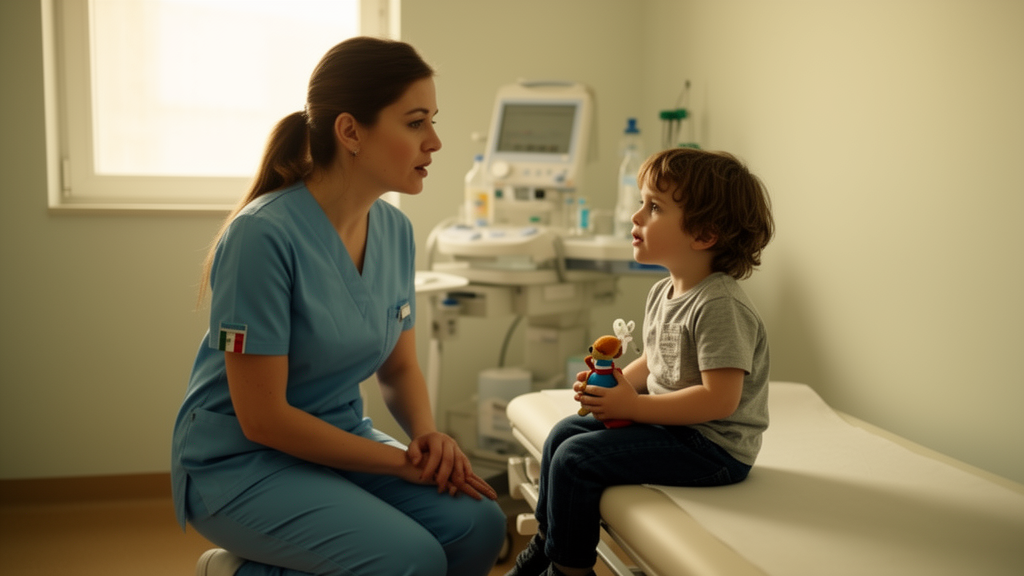
A survey of 503 Italian nurses and nurse coordinators has revealed a striking gap between what critical care nurses know about childhood autism and how prepared they feel to actually care for autistic patients in emergency and critical care settings. The study, published in the Journal of Autism and Developmental Disorders, found that while participants scored well on a validated knowledge test, more than nine in ten reported feeling not at all or not very prepared for autism-related care. Between May and July 2025, researchers recruited nurses through non-probability convenience sampling to complete an online survey.
The questionnaire combined socio-demographic items, the 19-item Knowledge about Childhood Autism among Health Workers (KCAHW) questionnaire, and study-specific closed- and open-ended questions about care experiences. The KCAHW instrument is focused on children, while the care-experience questions were designed to be age-neutral, covering autistic patients of any age. Using the original scoring key, the mean KCAHW score was 15.96 out of 19, with a standard deviation of 2.54.
At least 80 percent of participants scored a point on 16 of the 19 items, indicating broad familiarity with core features of childhood autism. Differences in knowledge scores by sex, age, professional experience, educational level, geographic area, and clinical setting were mostly small. The largest differences were found between clinical settings, with effect sizes ranging from 0.133 to 0.195 as measured by epsilon squared, suggesting that where a nurse works may shape knowledge more than personal or professional characteristics do.
Care experiences told a very different story from test scores. A total of 74.0 percent of participants reported difficulties in caring for autistic people, and 90.9 percent felt not at all or not very prepared for such care. The training gap was equally stark: 91.1 percent had never attended any autism spectrum disorder-specific training, meaning that the vast majority of these nurses were working without formal education on the condition they encounter in practice.
When asked to describe their difficulties in open-ended responses, the most frequent theme was communication and relational problems, accounting for 58.6 percent of the 266 answers provided. Crisis management emerged as a significant concern. Just over half of participants, 56.3 percent, reported having managed a crisis involving an autistic patient.
Among the 133 accounts they described, 58.6 percent involved caregivers or the healthcare team, while 15.8 percent involved medication, sedation, or restraint. Only 54.7 to 55.7 percent of participants said they routinely chose a quiet setting, avoided noise, or adapted lighting. In environments where alarms, bright lights, and crowding are constant, this suggests that a substantial share of nurses do not systematically adjust the sensory environment for autistic patients.
The authors conclude that participants recognized much of the childhood-autism content covered by the KCAHW questionnaire, but that this knowledge did not translate into perceived preparedness. They call for practice-oriented education together with assessment tools that evaluate professional competence across the lifespan, noting that the current questionnaire is child-focused while nurses care for autistic patients of all ages. The study's reliance on convenience sampling means the findings may not generalize to all Italian nurses, and self-reported preparedness does not necessarily measure actual care quality.
Nevertheless, the contrast between high knowledge scores and low confidence, reported by a large sample across multiple clinical settings, offers a clear signal that factual familiarity with autism alone does not equip critical care nurses for the realities of autistic patients in crisis.
Subject of Research: Nurses' knowledge of childhood autism and care experiences in Italian emergency and critical care settings
Article Title: Knowledge of Childhood Autism and Care Experiences in Critical Settings: A Survey Among Italian Nurses
Article References: Rubbi, I., Lupo, R., Rosa, G., Greco, G. M., Marchisio, D., Panzanaro, L., Cucci, F., Calabrò, A., Conte, L., Dellafiore, F., Artioli, G., & Vitale, E. (2026). Knowledge of Childhood Autism and Care Experiences in Critical Settings: A Survey Among Italian Nurses. Journal of Autism and Developmental Disorders. https://doi.org/10.1007/s10803-026-07538-3
Image Credits: AI Generated
DOI: 10.1007/s10803-026-07538-3
Keywords: autism, nurses, critical care, emergency care, KCAHW questionnaire, nursing education, Italy, survey, communication difficulties, crisis management, sensory environment, preparedness
Cite Scienmag News
Ophelia Keating. (October 27, 2026). Italian Nurses Know Autism Facts but Feel Unprepared to Care for Autistic Patients. Scienmag. https://scienmag.com/italian-nurses-know-autism-facts-but-feel-unprepared-to-care-for-autistic-patients/
Ophelia Keating. "Italian Nurses Know Autism Facts but Feel Unprepared to Care for Autistic Patients." Scienmag, 27 October 2026, https://scienmag.com/italian-nurses-know-autism-facts-but-feel-unprepared-to-care-for-autistic-patients/. Accessed 27 October 2026.
Ophelia Keating. "Italian Nurses Know Autism Facts but Feel Unprepared to Care for Autistic Patients." Scienmag. October 27, 2026. https://scienmag.com/italian-nurses-know-autism-facts-but-feel-unprepared-to-care-for-autistic-patients/


