

Tuesday, October 27, 2026
Science
No Result
View All Result
  • Login
  • HOME
  • SCIENCE NEWS
  • CONTACT US
  • HOME
  • SCIENCE NEWS
  • CONTACT US
No Result
View All Result
Scienmag
No Result
View All Result
Home Science News

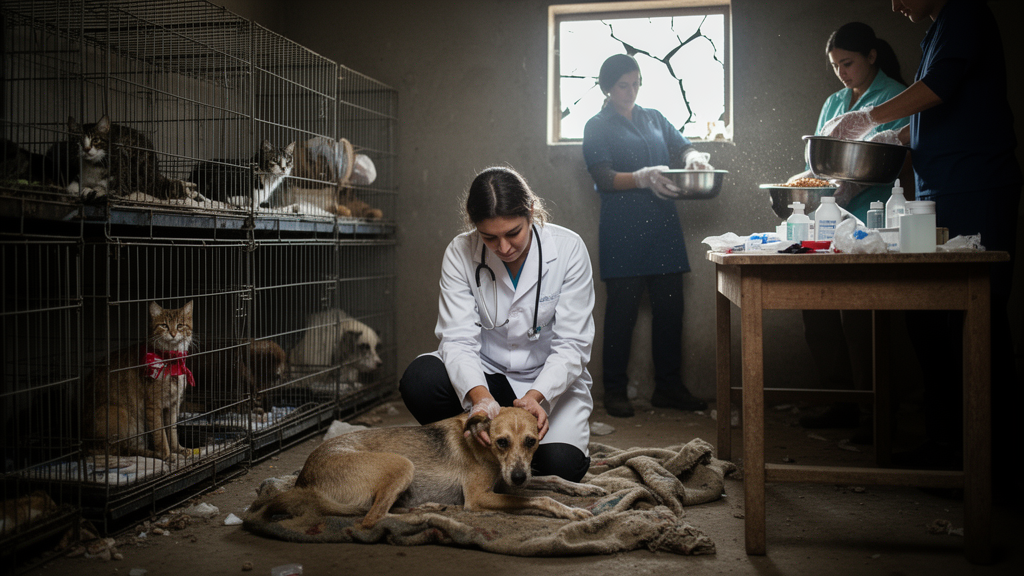
Veterinarians report widespread animal welfare decline in wartime Ukraine

October 27, 2026
in Science News
William Thompson
By William Thompson Scienmag Editorial Profile - Livestock Health and Welfare
Reading Time: 3 mins read
0
Veterinarians report widespread animal welfare decline in wartime Ukraine

Veterinarians report widespread animal welfare decline in wartime Ukraine

65
SHARES
587
VIEWS
Share on FacebookShare on Twitter
ADVERTISEMENT

A survey of Ukrainian veterinary professionals suggests that Russia's full-scale invasion has affected animal welfare far beyond direct battlefield injuries, with nearly six in ten respondents describing the overall welfare of animals in their care as worse or much worse than before February 2022. The study, led by researchers at the University of Minnesota in collaboration with the National University of Life and Environmental Sciences in Kyiv, is published in Frontiers in Veterinary Science. The team conducted an anonymous cross-sectional online survey between March 12 and June 5, 2026.

The primary analysis included 119 veterinary professionals who had practiced in Ukraine both before and after the invasion began. The most frequently reported changes were behavioral and psychological. Of 109 respondents answering the relevant items, 89.9 percent reported increases in noise-related fear or phobia, 88.1 percent reported anxiety or hypervigilance, and 86.8 percent reported separation-related distress in animals.

Physical and access-related harms were also common. Conflict-related injuries were reported by 69.9 percent of the 93 respondents addressing that question, financial constraints limiting veterinary care by 69.1 percent of 110, and delayed presentation of chronic disease by 64.9 percent of 111. The authors note that these patterns suggest welfare challenges are multidimensional, extending well beyond wounds caused directly by hostilities to include barriers that prevent animals from receiving timely care.

Geography mattered. Regional associations were identified for conflict-related injuries, roaming-related injuries, noise-related fear, separation-related distress and overall perceived welfare change. After adjusting for practice setting and species group, respondents in the Kyiv Region had higher odds of reporting worsened animal welfare than those in Central Ukraine, with an adjusted odds ratio of 6.29 and a p-value of 0.004.

The authors emphasize that these regional comparisons are exploratory and should be interpreted cautiously. When asked what was driving the deterioration, respondents most often cited owner financial hardship, identified by 87.4 percent of the 119 participants, followed by displacement of people and animals at 61.3 percent and an increase in stray or abandoned animals at 58.0 percent. Sustaining veterinary services during armed conflict depends not only on supplies and infrastructure but on practitioners who are themselves living through the invasion, and the authors argue that supporting this workforce deserves greater attention.

Based on their findings, the researchers recommend maintaining access to veterinary care, supporting displaced animals and the veterinary workforce, and integrating animal welfare into humanitarian preparedness planning. They frame these as areas warranting greater attention rather than as evaluated interventions, since the study measured perceptions rather than testing specific programs. The authors are careful about the study's limits.

Sampling was non-probability based, meaning respondents may not represent all Ukrainian veterinary professionals; responses were retrospective perceptions rather than prospectively measured welfare outcomes; and the regional analyses were exploratory. The survey captures how experienced clinicians perceived change, which is a valuable but indirect measure of animal welfare on the ground.

Subject of Research: Perceived impacts of the war in Ukraine on animal welfare, as reported by veterinary professionals in a cross-sectional survey

Article Title: Beyond the battlefield: veterinary professionals reveal the hidden impact of Russia's full-scale invasion on animal welfare in Ukraine

Article References: Yustyniuk, V., Galaburda, M., Zhitnitskiy, P. E., Martyniuk, O., Melnyk, V., Valchuk, O., & Perez, A. M. (2026). Beyond the battlefield: veterinary professionals reveal the hidden impact of Russia's full-scale invasion on animal welfare in Ukraine. Frontiers in Veterinary Science, 13, 1968453. https://doi.org/10.3389/fvets.2026.1968453

Image Credits: AI Generated

DOI: 10.3389/fvets.2026.1968453

Keywords: animal welfare, Ukraine, veterinary professionals, armed conflict, Five Domains Model, cross-sectional survey, displacement, access to veterinary care, conflict-related injuries, compassion fatigue, One Health, stray animals

Cite Scienmag News

William Thompson. (October 27, 2026). Veterinarians report widespread animal welfare decline in wartime Ukraine. Scienmag. https://scienmag.com/veterinarians-report-widespread-animal-welfare-decline-in-wartime-ukraine/

William Thompson. "Veterinarians report widespread animal welfare decline in wartime Ukraine." Scienmag, 27 October 2026, https://scienmag.com/veterinarians-report-widespread-animal-welfare-decline-in-wartime-ukraine/. Accessed 27 October 2026.

William Thompson. "Veterinarians report widespread animal welfare decline in wartime Ukraine." Scienmag. October 27, 2026. https://scienmag.com/veterinarians-report-widespread-animal-welfare-decline-in-wartime-ukraine/


Tags: access to veterinary careaccess to veterinary care during wartimeanimal welfarearmed conflictcompassion fatigueconflict-related injuriesconflict-related injuries in animalscross-sectional surveydelayed veterinary care for chronic diseasesdisplacementeffects of military conflict on animal wellbeingfinancial constraints on animal treatment in UkraineFive Domains modelimpact of conflict on domestic animalsmultidimensional animal welfare challenges in war zonesnoise-related fear and anxiety in animalsOne Healthpsychological effects of war on petsseparation distress in animals due to warstray animalssurvey of Ukrainian veterinary professionalsUkraineVeterinary animal welfare decline in Ukraine during wartimeveterinary professionals
Share26Tweet16
Previous Post

Endometrial Microbiota Imbalances Found in Nearly Nine in Ten IVF Patients

Next Post

Research report: Performance evaluation of sodium-ion batteries for microgrid and off-grid energy storage applications

Related Posts

Machine Learning Flags Metabolic Factors Behind Failed Nocturnal Erection Tests
Science News

Machine Learning Flags Metabolic Factors Behind Failed Nocturnal Erection Tests

October 27, 2026
Research report: Performance evaluation of sodium-ion batteries for microgrid and off-grid energy storage applications
Science News

Research report: Performance evaluation of sodium-ion batteries for microgrid and off-grid energy storage applications

October 27, 2026
Endometrial Microbiota Imbalances Found in Nearly Nine in Ten IVF Patients
Biology

Endometrial Microbiota Imbalances Found in Nearly Nine in Ten IVF Patients

October 27, 2026
Single-cell atlas reveals inflammatory monocyte state tied to WTAP in healthy lungs and COPD
Biology

Single-cell atlas reveals inflammatory monocyte state tied to WTAP in healthy lungs and COPD

October 27, 2026
AI Agents Can Run the Simulation, but Not the Promise: Where Teacher Delegation Must Stop
Science News

AI Agents Can Run the Simulation, but Not the Promise: Where Teacher Delegation Must Stop

October 27, 2026
Two literatures, one spa: study finds therapeutic architecture and wellness resort research rarely overlap
Earth Science

Two literatures, one spa: study finds therapeutic architecture and wellness resort research rarely overlap

October 27, 2026
Next Post
Research report: Performance evaluation of sodium-ion batteries for microgrid and off-grid energy storage applications

Research report: Performance evaluation of sodium-ion batteries for microgrid and off-grid energy storage applications

  • Mothers who receive childcare support from maternal grandparents show more optimized

    Mothers who receive childcare support from maternal grandparents show more parental warmth, finds NTU Singapore study

    27656 shares
    Share 11059 Tweet 6912
  • University of Seville Breaks 120-Year-Old Mystery, Revises a Key Einstein Concept

    1061 shares
    Share 424 Tweet 265
  • Bee body mass, pathogens and local climate influence heat tolerance

    682 shares
    Share 273 Tweet 171
  • Researchers record first-ever images and data of a shark experiencing a boat strike

    546 shares
    Share 218 Tweet 137
  • Groundbreaking Clinical Trial Reveals Lubiprostone Enhances Kidney Function

    531 shares
    Share 212 Tweet 133
Science

Embark on a thrilling journey of discovery with Scienmag.com—your ultimate source for cutting-edge breakthroughs. Immerse yourself in a world where curiosity knows no limits and tomorrow’s possibilities become today’s reality!

RECENT NEWS

  • Machine Learning Flags Metabolic Factors Behind Failed Nocturnal Erection Tests
  • Research report: Performance evaluation of sodium-ion batteries for microgrid and off-grid energy storage applications
  • Veterinarians report widespread animal welfare decline in wartime Ukraine
  • Endometrial Microbiota Imbalances Found in Nearly Nine in Ten IVF Patients

Categories

  • Agriculture
  • Anthropology
  • Archaeology
  • Athmospheric
  • Biology
  • Biotechnology
  • Blog
  • Bussines
  • Cancer
  • Chemistry
  • Climate
  • Earth Science
  • Editorial Policy
  • Marine
  • Mathematics
  • Medicine
  • Pediatry
  • Policy
  • Psychology & Psychiatry
  • Science Education
  • Science News
  • Social Science
  • Space
  • Technology and Engineering

Subscribe to Blog via Email

Enter your email address to subscribe to this blog and receive notifications of new posts by email.

Join 5,151 other subscribers

© 2025 Scienmag - Science Magazine

Welcome Back!

Login to your account below

Forgotten Password?

Retrieve your password

Please enter your username or email address to reset your password.

Log In
No Result
View All Result
  • HOME
  • SCIENCE NEWS
  • CONTACT US

© 2025 Scienmag - Science Magazine

Discover more from Science

Subscribe now to keep reading and get access to the full archive.

Continue reading