


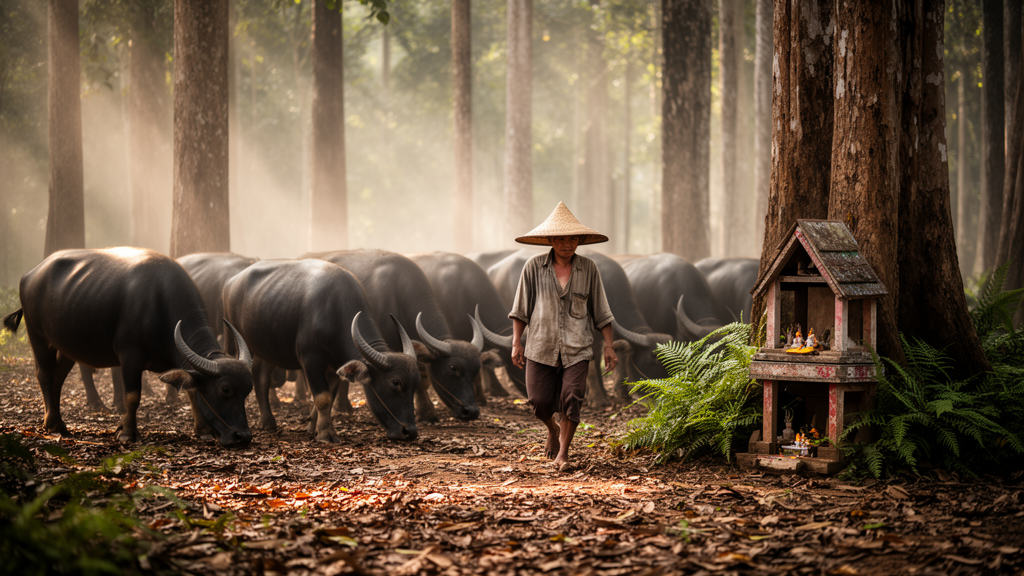
In the mountainous province of Nan, northern Thailand, an indigenous swamp buffalo landrace survives not through formal breeding programs but through a web of seasonal movement, farmer-led selection, ritual obligation, and collective negotiation over grazing land. A qualitative field study conducted between 2022 and 2024 documents how Lua communities in Nan Province maintain the Nam Wa buffalo, an animal officially recognized in 2013 as a Geographical Indication and as a Native Thai Animal Breed, yet one whose persistence depends far more on locally governed landscapes than on official protection. The research, published in the journal Pastoralism, identifies the socioecological conditions under which herders keep this landrace going, and warns that conservation initiatives that ignore those conditions may fail.
The research team, led by Nicolas Lainé of IRD-UMR PALOC in Paris together with colleagues at Kasetsart University, Chiang Mai University, and an independent scholar in Bangkok, carried out nine field missions of five to seven days each across seven villages in Nan Province. Particular attention was paid to Ban Huai Phan, a socially mixed village with a substantial Lua population in Chiang Klang district, and to settlements in Thung Chang, Chaloem Phra Kiat, and Bo Kluea districts. The work combined semi-structured interviews with forty interlocutors, including thirty-two male buffalo owners aged between 29 and 67, alongside village elders, ritual specialists, community leaders, village animal health volunteers, and local livestock officers.
Participant observation accompanied everyday husbandry, from morning and evening herd supervision to seasonal movements between rice fields and forest pastures. The study's scope carries important limitations. The researchers explicitly did not undertake genetic, demographic, or productivity measurements, so reports of decline, inbreeding concerns, and breeding-male scarcity are treated as local assessments rather than population estimates.
No dedicated census of the Nam Wa buffalo exists; the animals remain folded into the overall buffalo count for Nan Province, which recorded more than 12,000 buffaloes in 2025. Ban Huai Phan alone maintains more than 200 buffaloes according to the latest village-level count conducted by the animal health volunteer who liaises with the Department of Livestock Development. Nevertheless, herders and livestock officers described marked decline or near disappearance of buffalo keeping in several former Nam Wa-raising areas, particularly in the upper districts.
What herders value in the Nam Wa buffalo reveals a great deal about the landscape in which it lives. Lua herders identify the landrace through a combination of morphological and behavioral traits: medium-sized, relatively slim bodies; crescent or half-moon shaped horns; a straight backline; small, slightly outward-flaring ears often with white hair inside; and calm eyes described as "sweet." But selection emphasizes function over form. Herders particularly prize rounded, strong hooves for movement across steep, muddy, and rocky terrain; a calm temperament and ease of handling; maternal ability and reproductive reliability; and strong herd cohesion.
Older females are frequently described as herd leaders during grazing and seasonal movement. These criteria connect the animals herders retain to the conditions in which those animals must move, forage, and reproduce. Buffalo management follows a seasonal rhythm tightly linked to rice cultivation.
During the dry season, from November to April, buffaloes remain near the village rice fields, known locally as thung na, where they graze on rice straw, stubble, weeds, and aquatic plants near streams and small rivers. They contribute manure to soil fertility, receive vitamins and minerals, and are supervised daily. When the rains arrive, from May to October, herds are moved to forest grazing areas called pang kwai, where animals graze more freely and owners visit them periodically.
Rainy-season forest grazing gives access to a wider diversity of forage and is associated by herders with improved body condition, but it also exposes animals to risks: snakes and dhole, a wild canid, are reported as threats in the upper districts, and injuries occur when animals slip, fall, or become trapped by their horns in small trees or bamboo. Seasonal mobility also structures reproduction. Herders report that mating occurs mainly during the rainy season, when different herds mix in the forest grazing areas, with pregnancies continuing into the following dry season.
When a female comes into heat outside this period, her owner may temporarily bring her to a breeding male kept by another household before returning her to the family herd. Reproduction thus depends on relations between owners and on access to breeding males as much as on seasonal herd movement. Herders and livestock officers expressed concern about inbreeding when herds become isolated or breeding males grow scarce.
Department of Livestock Development initiatives, including the Cattle and Buffalo Bank for Farmers, have introduced breeding males into some local herds, but herders described access to suitable males as intermittent and dependent on herd proximity and household arrangements. Ritual practices add a layer of governance that outsiders might easily overlook. Ritual calendars structure the timing of movements to the forest pastures and the return of herds to the rice fields, with decisions about when herds should move discussed collectively among buffalo owners and formalized through ritual acts.
Each pang kwai is associated with a spirit location, and households moving buffaloes into a given area are expected to make appropriate offerings to the forest spirits tied to specific grazing zones. Herders also describe pong, permanently wet and mineral-rich places that attract buffaloes but are considered dangerous because of accidents, illness, or misfortune; offerings are made at village pong during Lua New Year and at forest pong when buffaloes graze nearby. A buffalo blessing called sukwaan kwai is performed after periods of intensive work such as plowing, during which herders speak directly to their animals, thank them, and apologize for demanding labor, with offerings commonly following a rule of one chicken per buffalo.
These rituals are not merely ceremonial. Cautionary stories circulate among herders about buffaloes lost to predators or fatal accidents after a household neglected its ritual obligations, linking appropriate conduct toward particular grazing places with responsibilities for the animals using them. The researchers argue that such narratives reinforce expectations concerning conduct toward animals and grazing places, resonating with broader scholarship on common-resource governance showing that collective management often depends on locally recognized rules, obligations, and situated authority alongside formal regulation.
Health management similarly blends institutional and local knowledge. Since 2022, buffaloes in the study area have received annual vaccination against foot-and-mouth disease through the Department of Livestock Development, with assistance from village animal health volunteers who also conduct livestock counts and relay campaign information. Herders in Ban Huai Phan still recall a major foot-and-mouth outbreak in 1995 that caused substantial buffalo mortality.
Alongside formal veterinary care, herders use roughly a dozen plant-based preparations for wounds, skin problems, parasites, bleeding, postpartum recovery, insects, and snake bites. Thunbergia laurifolia leaves and flowers are fashioned into a collar following snake bites; young leaves of Mangifera sylvatica are crushed and rubbed onto the skin as an insect repellent; Spondia pinnata bark is boiled to clean wounds; and fresh Chromolaena odorata leaves, sometimes with tobacco, are applied to fresh wounds. A companion study from Ban Huai Phan documented fifty-nine plant species consumed by buffaloes, twenty of which also appear in the Lua household medicinal repertoire, suggesting that herders' knowledge of useful plants grows out of repeated observation of animal feeding in shared landscapes, though the authors caution this does not demonstrate intentional animal self-medication.
The conservation implications are practical rather than genetic. The study does not evaluate genetic diversity, demographic viability, or productivity, and cannot determine the relative effectiveness of genetic or production-based conservation measures. It does, however, identify conditions that such measures would need to engage with: seasonal mobility, access to grazing mosaics, farmer selection criteria, low-input feeding regimes, and the local institutions through which herds are managed and reproduced.
The authors note that introducing buffaloes from other regions may increase access to breeding males or introduce higher-productivity traits, but animals selected under intensive systems may carry higher nutritional and management requirements than locally adapted stock, potentially increasing dependence on purchased feed and altering household breeding objectives. Dedicated population counts, pedigree reconstruction, genetic diversity studies, and productivity measurements would be valuable next steps, particularly given locally expressed concerns about herd isolation and breeding-male scarcity. Beyond Nan Province, the case shows that conserving an indigenous breed also means sustaining the practices, landscapes, obligations, and forms of attention through which that breed continues to exist.
Subject of Research: Indigenous Nam Wa buffalo husbandry and Lua seasonal forest grazing governance in Nan Province, Thailand
Article Title: Nam Wa buffalo and Lua extensive farming: seasonal forest grazing and local governance in Nan, Thailand
Article References: Lainé, N., Janyasuthiwong, S., Ketui, S., & Fooyontphanich, K. (2026). Nam Wa buffalo and Lua extensive farming: seasonal forest grazing and local governance in Nan, Thailand. Pastoralism: Research, Policy and Practice, 16, Article 16278. https://doi.org/10.3389/past.2026.16278
Image Credits: AI Generated
Keywords: Nam Wa buffalo, Lua communities, Nan Province, Thailand, indigenous livestock, seasonal grazing, ethnoveterinary knowledge, pastoral governance, in situ conservation, swamp buffalo, grazing commons, agropastoralism
Cite Scienmag News
Margaret Porter. (October 27, 2026). Forest Grazing and Ritual Rules Keep Thailand’s Nam Wa Buffalo Alive. Scienmag. https://scienmag.com/forest-grazing-and-ritual-rules-keep-thailands-nam-wa-buffalo-alive/
Margaret Porter. "Forest Grazing and Ritual Rules Keep Thailand’s Nam Wa Buffalo Alive." Scienmag, 27 October 2026, https://scienmag.com/forest-grazing-and-ritual-rules-keep-thailands-nam-wa-buffalo-alive/. Accessed 27 October 2026.
Margaret Porter. "Forest Grazing and Ritual Rules Keep Thailand’s Nam Wa Buffalo Alive." Scienmag. October 27, 2026. https://scienmag.com/forest-grazing-and-ritual-rules-keep-thailands-nam-wa-buffalo-alive/


