


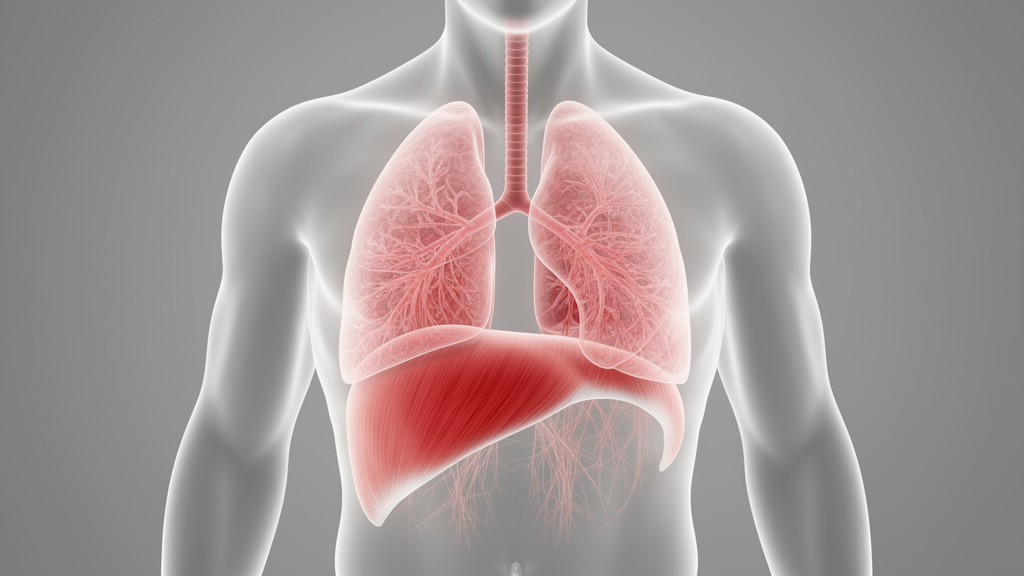
Many people who recover from even a mild SARS-CoV-2 infection continue to struggle with breathlessness during exercise, yet standard cardiopulmonary workups often come back normal. A new study from University Hospital RWTH Aachen and collaborating German and Italian institutions points to an overlooked culprit: the diaphragm. In a cohort of 25 outpatients with persistent exertional dyspnea assessed a median of 24 months after mild COVID-19, the researchers found measurable diaphragm weakness and structural changes that correlated closely with how breathless the patients felt, despite unremarkable routine testing.
The study, published in Frontiers in Physiology in the respiratory physiology and pathophysiology section, focused specifically on non-hospitalized patients, a group largely missing from earlier research. Previous work had linked exertional dyspnea to diaphragm weakness among hospitalized COVID-19 survivors, but no studies had applied state-of-the-art respiratory muscle assessment to ambulatory cohorts with mild initial disease. To fill that gap, the team evaluated pulmonary function, the six-minute walk test, echocardiography, and—critically—direct measures of diaphragm performance.
The centerpiece of the respiratory muscle assessment was twitch transdiaphragmatic pressure (TwPdi), obtained by stimulating the phrenic nerve roots at the neck with a magnetic coil. Diaphragm parameters were compared against a healthy control group matched three-to-one for age, sex, body mass index, and comorbidities, allowing the investigators to isolate differences attributable to the post-COVID state rather than to demographics or baseline health. At the group level, routine blood tests, pulmonary function testing, and echocardiography offered no clear alternative explanation for the patients' breathlessness, underscoring how easily this condition can be dismissed as functional or unexplained.
The diaphragm told a different story. COVID-19 survivors exhibited significantly lower TwPdi than matched controls, a difference that reached statistical significance at p = 0.02. When patients were stratified into dyspnea subgroups, the variation in diaphragm strength across those subgroups was even more pronounced, with an overall ANOVA p-value of 0.009.
That impression was reinforced by a correlation analysis. Twitch transdiaphragmatic pressure was negatively correlated with dyspnea severity as rated on the modified Borg scale, a standard measure of perceived breathlessness during exertion. The correlation coefficient was r = -0.67, with a 95 percent confidence interval spanning -0.84 to -0.37 and a p-value below 0.001.
A relationship of this magnitude suggests that a substantial share of the variation in perceived breathlessness tracks with diaphragm contractile strength, though correlation in a cross-sectional study cannot by itself establish causation. Ultrasound added evidence of structural alteration. Post-COVID patients showed significantly reduced diaphragm thickness both at FRC (p = 0.02) and at TLC (p < 0.001) compared with controls.
Together with the reduced twitch pressures, the ultrasound findings paint a picture of a respiratory muscle that is both weaker and structurally changed long after an infection that never required hospital admission. The authors conclude that persistent exertional dyspnea after mild COVID-19 is associated with diaphragm weakness and structural changes despite normal cardiopulmonary findings, supporting a key role for respiratory muscle impairment as a potential contributor to dyspnea in long COVID. The framing is deliberately cautious: the study demonstrates an association in a relatively small outpatient cohort, not a proven causal mechanism, and the final formatted version of the article is still forthcoming.
Nevertheless, the findings carry practical weight, because they suggest that standard pulmonary function tests and echocardiography may systematically miss the source of symptoms in this population.
Subject of Research: Diaphragm weakness and structural changes associated with persistent exertional dyspnea after mild COVID-19
Article Title: Persistent exertional dyspnea following mild COVID-19: potential association with diaphragm impairment
Article References: Regmi, B., Ratsimba, S. F. N., Jörn, B., Giannoni, A., Boentert, M., Pink, I., Kahles, F., Dreher, M., & Spiesshoefer, J. (2026). Persistent exertional dyspnea following mild COVID-19: potential association with diaphragm impairment. Frontiers in Physiology, 17, Article 1968156. https://doi.org/10.3389/fphys.2026.1968156
Image Credits: AI Generated
DOI: 10.3389/fphys.2026.1968156
Keywords: long COVID, diaphragm, dyspnea, respiratory muscle, twitch transdiaphragmatic pressure, phrenic nerve stimulation, diaphragm ultrasound, SARS-CoV-2, respiratory physiology, Frontiers in Physiology, Persistent, exertional
Cite Scienmag News
Kristina Jarvis. (October 27, 2026). Mild COVID-19 May Leave the Diaphragm Weakened in Long COVID Patients. Scienmag. https://scienmag.com/mild-covid-19-may-leave-the-diaphragm-weakened-in-long-covid-patients/
Kristina Jarvis. "Mild COVID-19 May Leave the Diaphragm Weakened in Long COVID Patients." Scienmag, 27 October 2026, https://scienmag.com/mild-covid-19-may-leave-the-diaphragm-weakened-in-long-covid-patients/. Accessed 27 October 2026.
Kristina Jarvis. "Mild COVID-19 May Leave the Diaphragm Weakened in Long COVID Patients." Scienmag. October 27, 2026. https://scienmag.com/mild-covid-19-may-leave-the-diaphragm-weakened-in-long-covid-patients/


