


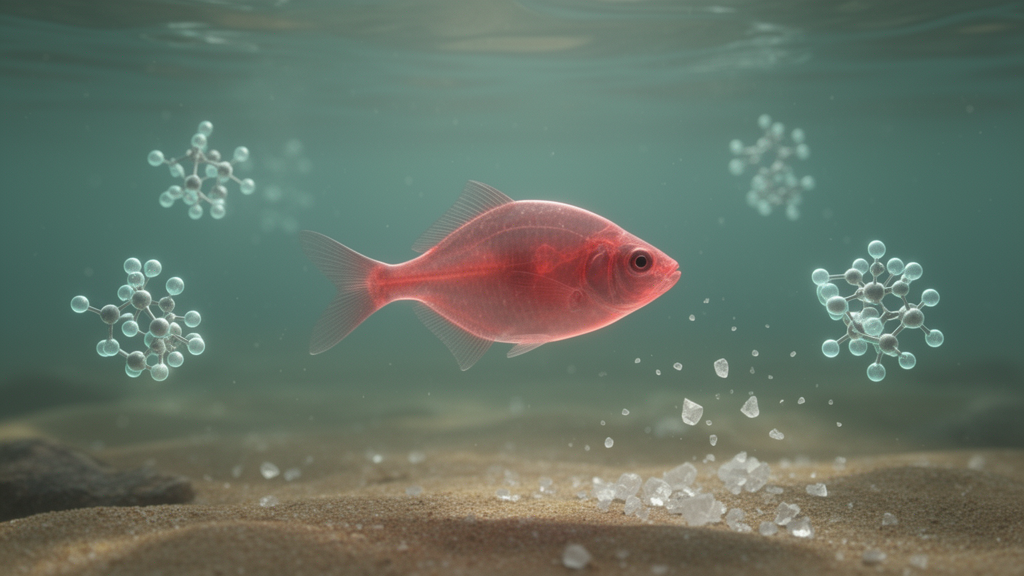
A tiny concentration of a widely used PFAS replacement chemical, combined with the saltier waters now common in warming Texas estuaries, can sharply reduce the survival of red drum embryos and larvae, according to a new laboratory study published in Frontiers in Marine Science. Researchers at the University of Texas at Austin’s Marine Science Institute exposed embryos of red drum (Sciaenops ocellatus), a prized Gulf Coast sportfish, to perfluorohexanesulfonic acid, or PFHxS, at just 1 microgram per liter, a level chosen to reflect high-end but realistic conditions near sites contaminated by firefighting foam. Across four salinity levels, the chemical cut the odds of hatching by roughly 60 percent, and its impact on cumulative survival was strongest not at the most extreme salinity but at intermediate hypersaline conditions, a pattern the authors say carries important lessons for how chemical safety testing is designed.
Red drum spawn near tidal inlets and estuary mouths in late summer and fall, releasing buoyant embryos that drift into seagrass nursery habitats and hatch within 18 to 25 hours. The larvae exhaust their yolk reserves and begin feeding on their own around 96 hours after fertilization, then settle into nurseries between 15 and 20 days after hatching. While older juveniles and adults tolerate a broad range of environmental conditions, these early life stages are unusually vulnerable to chemical and physical stress, including hypersalinity. Their rapid development also makes them a useful model for testing how multiple stressors interact during the most fragile window of a fish’s life.
The Texas Gulf Coast estuaries where red drum spawn face a double burden. Recurrent drought, reduced freshwater inflow from coastal urbanization, and climate-driven salinity swings push these waters toward the hypersaline extremes the fish must endure. The same urbanized watersheds are also sources of per- and polyfluoroalkyl substances, or PFAS, a class of persistent, surfactant-active chemicals used in countless industrial and consumer products. Regulatory attention has centered on the legacy compounds PFOS and PFOA, prompting industry to shift toward shorter-chain replacements such as PFHxS, which were assumed to be less bioaccumulative and less toxic. That assumption is increasingly under strain: PFHxS is now among the most frequently detected PFAS at sites where aqueous film-forming foam has been used, it has a longer half-life in humans and greater water solubility than PFOS, and it was added to the Stockholm Convention as a persistent organic pollutant in 2022.
The choice of 1 microgram per liter was grounded in environmental measurements rather than convention. PFHxS is typically found below 50 nanograms per liter near wastewater treatment outfalls but can reach 3.5 micrograms per liter near fluorochemical production and foam-impacted sites, and concentrations up to 576 nanograms per liter have been reported in coastal waters downstream of such sites. Along the Texas coast, PFAS levels rose substantially after foam was deployed during the 2019 Intercontinental Terminal Company fire, and groundwater beneath a coastal military installation contains PFHxS at up to 185 micrograms per liter, bordered by estuaries that serve as red drum spawning and settlement habitat. The test concentration therefore represents a high-end but plausible scenario for embryos developing in affected estuarine waters, well below levels measured at contamination sources themselves.
The experiment was a fully crossed factorial design: embryos from four independent spawns were assigned to one of four salinities, 30, 35, 39 or 43 parts per thousand, crossed with either control water or water spiked with PFHxS. Each spawn-by-salinity-by-treatment combination was replicated in three dishes of 20 embryos, for a total of 96 dishes and 1,920 embryos. The salinities corresponded to increases of 0, 5, 9 and 13 parts per thousand above spawning conditions, all within the range naturally recorded in early life stage red drum habitats along the southern United States. Measured PFHxS concentrations averaged 0.981 micrograms per liter, or 98.1 percent of the nominal target, and no PFHxS was detected in control samples, confirming the assay’s specificity.
The survival results were striking. Hatch success among control embryos declined from 95.4 percent at the isosmotic salinity to 85.0 percent at 43 parts per thousand, and PFHxS reduced the odds of hatching by approximately 60 percent overall, an odds ratio of 0.40 with a 95 percent confidence interval of 0.29 to 0.56. The two stressors acted additively on the embryonic stage, with no significant interaction for hatch success. Cumulative survival to 48 hours told a more nuanced story: control survival fell from 82.9 percent to 62.1 percent across the salinity range, PFHxS reduced the odds of survival by about 36 percent, and here the interaction was statistically significant. The chemical’s effect was concentrated at the intermediate salinities, cutting survival by 18.8 percentage points at 35 parts per thousand and 15.0 points at 39 parts per thousand, while showing no detectable effect at either the isosmotic salinity or the highest salinity tested.
When the researchers conditioned survival on successful hatching, a clearer mechanism emerged. PFHxS had no effect on the survival of larvae that had already hatched, with an odds ratio of 0.97, whereas hypersalinity independently reduced post-hatch survival from roughly 87 to 90 percent at the lower salinities to 72 to 75 percent at the higher ones. The chemical’s apparent impact on cumulative survival therefore reflected hatching failure carried forward, not larval mortality. That PFHxS affected the embryonic stage, which is nominally shielded by the semi-permeable chorion, but not the directly exposed larval stage, suggests the effects are not driven by acute toxicity and may instead involve interference with embryonic development or the hatching process itself. This interpretation aligns with the elevated frequency of unpigmented eyes among exposed larvae, which may signal developmental delay.
Morphological measurements of surviving larvae reinforced the developmental story. Hypersalinity affected six of nine endpoints, producing a coherent reduction in body size: notochord length and somatic body area declined by 3.6 and 4.6 percent respectively across the salinity range, and pericardial edema prevalence rose from about 4 percent to 12 percent. PFHxS affected three endpoints, concentrated on energy reserves and organ development. Relative yolk sac area was 5.9 percent lower in exposed larvae, the largest continuous treatment effect observed, accompanied by a 3.2 percent reduction in relative brain area. Most pronounced was eye pigmentation: the odds of fully pigmented eyes fell roughly five-fold, with unpigmented larvae rising from 2.6 to 5.7 percent in controls to 14.0 to 18.9 percent among exposed larvae at the three highest salinities. The authors suggest impaired yolk mobilization may involve PPARα-mediated disruption of lipid processing, consistent with metabolic findings in zebrafish larvae exposed to comparable PFHxS concentrations. For a visually foraging larval fish that must begin feeding about 72 hours after hatching, delayed retinal pigmentation could compromise both prey detection and predator avoidance during a narrow and decisive window.
The team also confronted a subtle statistical hazard. Because morphology could only be measured in larvae that survived to 48 hours, differential survival between treatments could bias the sublethal estimates. Selection was minimal at 30 and 43 parts per thousand but substantial at the intermediate salinities, and the key PFHxS effects behaved differently across this gradient. The yolk sac effect was largest where differential survival was lowest and remained significant under worst-case trimming bounds, and the eye pigmentation effect was robust even under the most adverse assumptions, raising unpigmented-eye prevalence by at least 7.7 percentage points. The brain area effect, by contrast, could not be considered fully robust to the worst selection scenario. Notably, spawn was the largest single source of variation for every morphometric endpoint, exceeding treatment effects by up to an order of magnitude, which validates the multi-spawn design and warns that single-clutch studies risk conflating maternal effects with treatment effects.
The broader implication is a challenge to standard toxicology. Regulatory testing typically isolates a single chemical under benign conditions, yet a single-stressor design run only at the isosmotic salinity would have underestimated the PFHxS effect on hatching and missed the effect on larval survival entirely: at 30 parts per thousand the chemical showed no detectable effect on cumulative survival, while at 35 and 39 parts per thousand it reduced the odds of survival by 66 and 49 percent respectively. The authors caution that their study tested only one concentration, could not evaluate temperature effects because temperature was confounded with spawn, and involved a 48-hour laboratory exposure, with exposure concentrations at the highest salinity confirmed only nominally. Still, the message is clear: at concentrations actually found near contaminated sites, a replacement PFAS once assumed benign can impair the survival and development of an economically vital estuarine fish, and the true risk only becomes visible when chemicals are tested against the salinity extremes that wild larvae increasingly face.
Subject of Research: Interactive effects of PFHxS exposure and hypersalinity on survival and development of early life stage red drum
Article Title: Hypersalinity and environmentally relevant perfluorohexanesulfonic acid independently and interactively impair survival and development in early life stage red drum (Sciaenops ocellatus)
Article References: Roark, K. J., Ackerly, K. L., Bolser, D. G., & Nielsen, K. (2026). Hypersalinity and environmentally relevant perfluorohexanesulfonic acid independently and interactively impair survival and development in early life stage red drum (Sciaenops ocellatus). Frontiers in Marine Science, 13, 1881663. https://doi.org/10.3389/fmars.2026.1881663
Image Credits: AI Generated
DOI: 10.3389/fmars.2026.1881663
Keywords: PFAS, PFHxS, red drum, estuaries, hypersalinity, developmental toxicity, early life stage, multi-stressor, aqueous film-forming foam, Texas Gulf Coast, larval morphology, marine pollution
Cite Scienmag News
Violet Maxwell. (October 27, 2026). A ‘Safer’ PFAS Replacement and Saltier Water Together Threaten Red Drum Larvae. Scienmag. https://scienmag.com/a-safer-pfas-replacement-and-saltier-water-together-threaten-red-drum-larvae/
Violet Maxwell. "A ‘Safer’ PFAS Replacement and Saltier Water Together Threaten Red Drum Larvae." Scienmag, 27 October 2026, https://scienmag.com/a-safer-pfas-replacement-and-saltier-water-together-threaten-red-drum-larvae/. Accessed 27 October 2026.
Violet Maxwell. "A ‘Safer’ PFAS Replacement and Saltier Water Together Threaten Red Drum Larvae." Scienmag. October 27, 2026. https://scienmag.com/a-safer-pfas-replacement-and-saltier-water-together-threaten-red-drum-larvae/


