


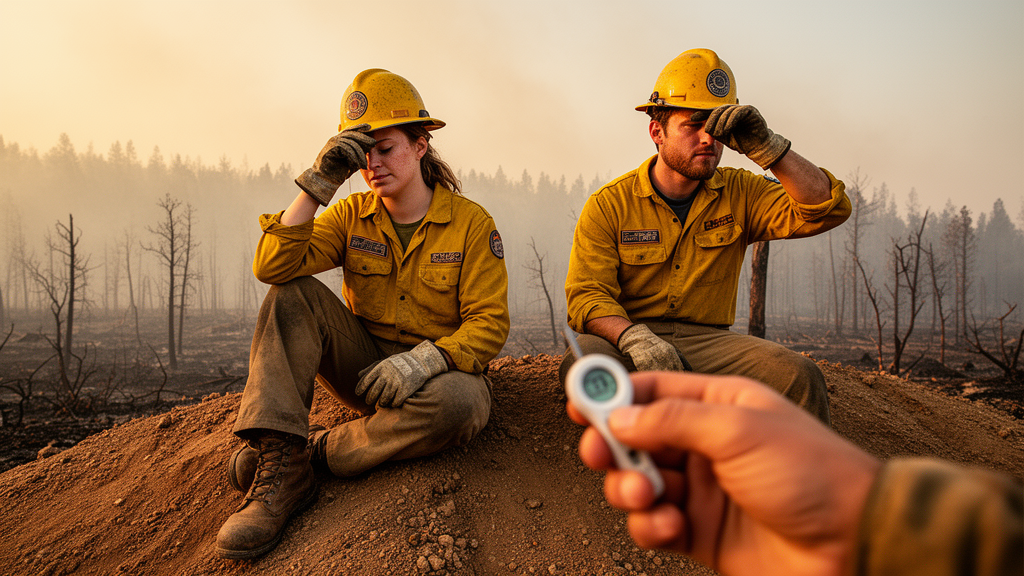
Wildland firefighting pushes the human body into one of the most thermally punishing work environments any occupation can offer. Crews hike across broken terrain carrying tools that weigh between 3 and 20 kilograms, often in ambient temperatures of 25 to 34 degrees Celsius, with short-term excursions that can approach 120 degrees Celsius and heat fluxes near 10,000 watts per square meter. Personal protective clothing is essential for survival in those moments, yet the same multilayer garments that shield against flames also trap heat and moisture, sharply limiting the body’s ability to shed its own metabolic output. Previous work has linked this elevated thermal load to performance impairments of 12 to 50 percent on firefighting-related physical tasks. Now, a new controlled laboratory study from the University of León in Spain provides the first direct comparison of how female and male wildland firefighting personnel respond to this kind of prolonged occupational heat stress while wearing standard protective equipment.
The research, published in Frontiers in Physiology, recruited twenty-two Spanish participants, eleven females and eleven males aged 21 to 41, all involved in wildland firefighting activities. The male participants had more than three years of operational experience, whereas nearly all of the women were candidates in training for firefighting positions. Crucially, every participant had passed the Pack Test, the standardized arduous-duty fitness assessment used in wildland firefighting selection, so all subjects met the minimum physical requirements for the role. The women reported regular menstrual cycles and were tested during the early luteal phase, days 14 to 22, and none used oral contraceptives. The study protocol was approved by the Ethics Committee of the University of León and conducted in accordance with the Declaration of Helsinki.
Each volunteer completed two laboratory sessions separated by 48 to 72 hours. The first session established aerobic capacity and ventilatory thresholds through a graded exercise test performed on a treadmill while wearing the full protective ensemble, alongside a body composition assessment using multifrequency tetrapolar bioelectrical impedance. The second session was the centerpiece: a 125-minute submaximal protocol designed to replicate the sustained metabolic and thermal demands of wildfire suppression. Participants walked at 6 kilometers per hour on a 3 percent incline, a workload of roughly 0.5 watts per kilogram that mirrors the intensity at which crews typically hike, and then completed bouts at intensities distributed to match the pattern observed during real 1-to-3-hour suppression operations. The entire test was performed in a controlled chamber at 30 degrees Celsius and 30 percent relative humidity, conditions frequently encountered during Mediterranean wildfire campaigns, with recovery periods at 23 degrees Celsius and 44 percent humidity.
The measurement battery was extensive. Gastrointestinal temperature was recorded every 30 seconds using an ingestible telemetry pill swallowed at least eight hours before testing. Chest skin temperature was logged each minute with an iButton sensor attached over the left pectoral muscle. Heart rate was sampled every five seconds, blood lactate was drawn from earlobe capillary samples after each intensity bout, and perceived exertion and thermal sensation were rated on validated scales. Body and clothing masses were measured before and after the protocol to estimate total sweat production, sweat retained in the garments, and evaporation, corrected for fluid intake. Finally, the team applied a partitional calorimetry model to partition the heat balance into metabolic heat production, heat storage, evaporative heat loss, respiratory heat exchange, and dry heat exchange.
The headline result is nuanced. Across the extended test, females showed higher mean values for nearly every physiological variable monitored: heart rate, oxygen uptake relative to maximum, blood lactate, gastrointestinal temperature, chest skin temperature, and the physiological strain index, a composite metric combining thermal and cardiovascular load. Males, by contrast, reported higher ratings of perceived exertion, and their exertion ratings also climbed faster over time. Maximal gastrointestinal temperature reached 38.8 degrees Celsius in females versus 38.4 degrees in males, although peak strain index values were statistically comparable between groups, and roughly half of all participants, seven women and three men, exceeded a core temperature of 38.5 degrees Celsius during the protocol, underscoring how substantial the thermal challenge was for everyone.
The picture changed when the researchers reanalyzed the data at matched relative exercise intensities, interpolating each individual’s responses between 40 and 80 percent of their own maximal oxygen uptake. At those standardized workloads, the sex difference in core temperature essentially vanished, and the physiological strain index showed no difference at all. What persisted were higher heart rate and higher chest skin temperature in females, a pattern the authors interpret as consistent with greater redistribution of body heat toward the skin, potentially helping women maintain core thermal responses comparable to men’s despite greater cardiovascular strain. The authors caution, however, that skin blood flow and regional heat transfer were not directly measured, so this interpretation remains a plausible mechanism rather than a demonstrated one.
The most striking divergence emerged in how the two groups dumped heat. Males produced substantially more sweat in total, 2.3 kilograms on average versus 1.4 kilograms for females, and evaporated more of it in absolute terms. But when sweat losses were normalized to body surface area or body mass, the differences shrank, and females actually achieved markedly greater evaporative efficiency, evaporating 82.2 percent of the sweat they produced compared with 63.1 percent in males. In the heat balance ledger, males relied more heavily on evaporative heat loss, averaging 263.6 watts per square meter against 217.3 in females, while females showed a greater contribution from dry heat exchange, 92.5 versus 48.5 watts per square meter. Notably, total heat storage and metabolic heat production were similar between the sexes, meaning the two groups arrived at comparable overall thermal strain by different routes.
Exploratory correlation analyses pointed toward individual characteristics as key drivers of this variability. Body fat percentage was positively associated with mean gastrointestinal temperature and chest skin temperature, with correlation coefficients of 0.55 and 0.53 respectively, and also with the physiological strain index. Maximal oxygen uptake showed negative correlations with core temperature and strain, but these relationships disappeared entirely when aerobic capacity was expressed relative to lean body mass rather than total body mass, hinting that body composition, not fitness alone, underlies part of the association. Consistent with this, one female participant terminated the test after reaching a core temperature of 39 degrees Celsius and experiencing dizziness; she presented relatively high body mass, body mass index, and body fat percentage alongside the lowest aerobic capacity in the sample. The authors stress that no causal inference can be drawn from a single observation, and that the correlation analyses were exploratory, unadjusted for multiple comparisons, and conducted in a small sample.
Several caveats temper the findings. The male participants were experienced firefighters while most of the women were trainees, so between-group differences cannot be attributed exclusively to biological sex; fitness, familiarity with protective equipment, and occupational experience all differ alongside sex. Menstrual cycle phase was determined by self-report rather than hormonal verification, and because all women were tested in the early luteal phase, progesterone-related elevations in baseline core temperature, which can reach roughly 0.8 degrees Celsius, may partly explain the higher starting and sustained gastrointestinal temperatures observed in females. Protective garment fit was not quantitatively assessed, yet standard protective clothing is typically designed around male anthropometrics, and a looser fit in female wearers could create air pockets that enhance ventilation and evaporation, though poorly fitted gear can also impair mobility and increase burn injury risk through the bellows effect under real fire conditions. Chest skin temperature from a single site served as a surrogate for mean skin temperature in the heat balance calculations, and sweat lost through dripping was not collected, both of which introduce uncertainty into the estimated components.
Even with those limitations, the study carries practical weight for a workforce in which women remain a minority, at roughly 10 to 15 percent of wildland firefighting personnel in some countries. It suggests that when workload is matched to individual aerobic capacity, core thermal responses of women and men in protective gear may be more alike than traditional assumptions imply, while the routes to heat dissipation differ in ways that equipment design has largely ignored. The authors argue that future evaluations of heat tolerance in wildland firefighting should account for individual fitness, body composition, and the fit and characteristics of personal protective equipment, and that larger, better-matched studies should clarify whether the observed associations hold and how best to optimize protective clothing, training, and heat management for all crew members on the fireline.
Subject of Research: Sex differences in thermophysiological responses to simulated occupational heat stress in wildland firefighting
Article Title: Thermophysiological responses to occupational heat stress during simulated wildland firefighting in females and males: influence of fitness and body composition
Article References: Gutiérrez-Arroyo, J., Carballo-Leyenda, B., García-Heras, F., Rodríguez-Medina, J., & Rodríguez-Marroyo, J. A. (2026). Thermophysiological responses to occupational heat stress during simulated wildland firefighting in females and males: influence of fitness and body composition. Frontiers in Physiology, 17, 1936332. https://doi.org/10.3389/fphys.2026.1936332
Image Credits: AI Generated
DOI: 10.3389/fphys.2026.1936332
Keywords: wildland firefighting, thermoregulation, heat stress, personal protective equipment, sex differences, aerobic fitness, body composition, core temperature, sweat evaporation, physiological strain, occupational physiology, partitional calorimetry
Cite Scienmag News
Faith Mcneil. (October 27, 2026). Fitness and Body Fat Shape Heat Strain in Female and Male Wildland Firefighters. Scienmag. https://scienmag.com/fitness-and-body-fat-shape-heat-strain-in-female-and-male-wildland-firefighters/
Faith Mcneil. "Fitness and Body Fat Shape Heat Strain in Female and Male Wildland Firefighters." Scienmag, 27 October 2026, https://scienmag.com/fitness-and-body-fat-shape-heat-strain-in-female-and-male-wildland-firefighters/. Accessed 27 October 2026.
Faith Mcneil. "Fitness and Body Fat Shape Heat Strain in Female and Male Wildland Firefighters." Scienmag. October 27, 2026. https://scienmag.com/fitness-and-body-fat-shape-heat-strain-in-female-and-male-wildland-firefighters/


