


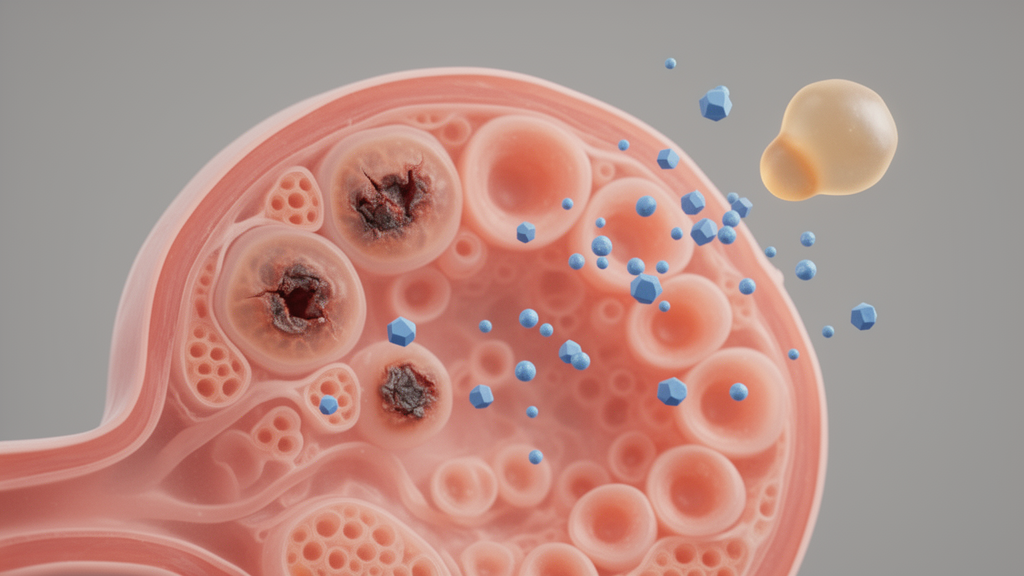
A widely used strategy for protecting fertility during cancer treatment has run into fresh trouble in the laboratory. In a new preclinical study, researchers at Monash University and the Peter MacCallum Cancer Centre in Australia report that suppressing ovarian function with a gonadotropin-releasing hormone (GnRH) antagonist did not shield the ovaries of tumour-bearing mice from the damaging effects of cyclophosphamide, one of the most ovotoxic chemotherapy drugs in clinical use. Worse, the suppression drug itself appeared to add injury: young mice given the combination developed more ovarian fibrosis than those treated with chemotherapy alone.
The findings, published in Frontiers in Endocrinology, strike at the heart of an ongoing debate in oncofertility. GnRH analogues are already given to some female cancer patients alongside chemotherapy in the hope of reducing the risk of premature ovarian insufficiency, the loss of ovarian function before age 40. Yet whether these drugs actually preserve the ovarian reserve, the finite pool of primordial follicles that constitutes a woman’s lifetime supply of oocytes, remains contested. The new study adds weight to the sceptical side of the ledger, and it does so in a model designed to mirror clinical reality more closely than most previous work.
The ovarian reserve is established before birth and cannot be regenerated. Once primordial follicles are lost, reproductive potential and hormone production decline permanently. Because the reserve cannot be measured directly in living patients, clinicians rely on indirect markers such as serum anti-Müllerian hormone (AMH), which is produced by granulosa cells of growing pre-antral and small antral follicles rather than by the dormant primordial follicles themselves. This indirectness is precisely why the Australian team turned to exhaustive histological analysis of mouse ovaries, counting follicles section by section under blinded conditions.
The experimental design was deliberately clinically grounded. Female C57BL/6J mice, both six-week-old animals representing a reproductively young cohort and six-month-old animals representing a reproductively aged cohort, received orthotopic injections of AT3-OVA mammary tumour cells into the fourth mammary fat pad. Once tumours reached a defined size, the mice were randomised to receive saline, the GnRH antagonist degarelix, one or two doses of cyclophosphamide, or the combination. Tissues were collected when tumours reached a predefined humane endpoint, meaning the animals carried active tumour burden throughout treatment, as cancer patients do when they receive chemotherapy.
Degarelix was chosen because it suppresses gonadotrophin signalling rapidly and directly, without the initial hormone flare that accompanies GnRH agonists. The drug worked as intended in this model. Corpora lutea, the ovarian structures left behind after ovulation, were absent or nearly absent in mice treated with degarelix alone or combined with cyclophosphamide, in both young and aged animals. Ovarian volume, another indirect clinical marker of ovarian reserve, collapsed dramatically: degarelix alone reduced ovarian volume by 62 percent in young mice and 74 percent in aged mice, with even larger reductions when combined with chemotherapy. Under the microscope, stromal cells in degarelix-treated ovaries appeared atrophied, with darker nuclei and cytoplasm than controls.
But suppression of ovarian activity did not translate into protection of the follicle pool. Single-dose cyclophosphamide depleted primordial follicle numbers by 62 percent in young mice and 89 percent in aged mice compared with controls. Adding degarelix changed nothing meaningful: co-treated mice showed similar reductions to those receiving chemotherapy alone, in both age groups and across both single- and two-dose regimens. Growing follicles fared no better. Primary follicle numbers fell by 85 percent in aged mice after a single cyclophosphamide dose, and secondary follicles dropped by 72 percent after single-dose and 46 percent after two-dose treatment, with co-treatment producing comparable depletion. In young mice receiving two chemotherapy doses, co-treatment was actually associated with a higher proportion of atretic, degenerating follicles and reduced antral follicle numbers.
Serum AMH told the same story. In the young single-dose cohort, AMH concentrations fell by 54 percent with cyclophosphamide alone, 50 percent with degarelix alone, and 71 percent with the combination. Notably, degarelix on its own reduced AMH, hinting that the antagonist may itself exert some ovarian effects even without chemotherapy. The authors point to earlier reports that another GnRH antagonist, cetrorelix, depleted the ovarian reserve in rats and mice even in the absence of chemotherapy, raising a caution flag about the class more broadly.
The fibrosis results were perhaps the most striking. Ovarian fibrosis, the excessive deposition of collagen that is generally associated with impaired ovarian function, was significantly greater in young mice receiving degarelix plus single-dose cyclophosphamide than in controls or chemotherapy-only animals, with medullary fibrosis specifically elevated. In the two-dose cohort, medullary fibrosis was greater in young co-treated mice compared with controls. These findings contrast with a previous rat study in which the GnRH agonist triptorelin appeared to attenuate cyclophosphamide-induced collagen deposition, a discrepancy the authors attribute to differences in staining methods and the more intensive dosing protocol used in that earlier work.
Mechanistically, the failure of ovarian suppression to protect the reserve is consistent with what is known about primordial follicle biology. The dormant follicles that make up the reserve are thought to be maintained and activated largely independently of gonadotrophin signalling, so dampening follicle-stimulating hormone output would not be expected to shield them from a DNA-damaging alkylating agent. Cyclophosphamide forms DNA crosslinks and double-strand breaks that trigger cell death, and it can directly damage primordial follicle oocytes while also impairing granulosa and thecal cells. The prepubertal-hormonal-milieu hypothesis that underpins GnRH analogue use, based on the observation that chemotherapy before puberty tends to cause less severe ovarian failure, may simply not hold for the primordial pool in adult ovaries.
The authors are careful about the limits of their work. The tumour-volume-based tissue collection endpoint introduced variability in the age at which ovaries were harvested, and tumour burden itself could have modified some ovarian responses; notably, corpora lutea numbers persisted in chemotherapy-only mice, whereas other non-tumour-bearing studies have reported reductions. Suppression by degarelix, though rapid, develops over hours and may have been incomplete when cyclophosphamide was administered within the same hour. And because GnRH agonists rather than antagonists are the agents most commonly used clinically, the results cannot be extrapolated directly to standard practice. The authors also note that a previous study reporting protection with the agonist goserelin lacked goserelin-only and chemotherapy-only control groups, and that goserelin may have direct antiproliferative effects on the oestrogen-receptor-positive MCF-7 tumours used in that model, complicating interpretation.
What the study does establish is that ovarian suppression alone, achieved with a rapidly acting antagonist, was not sufficient to preserve the ovarian reserve in this model, and may itself have contributed to ovarian injury through fibrosis and follicle atresia. The authors call for further preclinical investigation of clinically used GnRH agonists and antagonists across chemotherapy regimens and age groups, incorporating functional reproductive outcomes such as natural breeding or in vitro fertilisation after treatment cessation. Until such data exist, the question of whether pharmacological ovarian suppression genuinely protects fertility during chemotherapy remains open, and patients and clinicians continue to rely on established but invasive options such as oocyte, embryo and ovarian tissue cryopreservation, which preserve fertility potential without preventing treatment-induced ovarian insufficiency itself.
Subject of Research: Testing whether GnRH antagonist-induced ovarian suppression protects the ovarian reserve from cyclophosphamide chemotherapy in tumour-bearing mice
Article Title: GnRH antagonist-induced ovarian suppression does not protect the ovarian reserve from cyclophosphamide chemotherapy in tumour-bearing mice
Article References: Lewis, Y. M., Herszberg, D., Fowler, K., Hun, M., Brown, E., Loi, S., Winship, A. L., & Hutt, K. J. (2026). GnRH antagonist-induced ovarian suppression does not protect the ovarian reserve from cyclophosphamide chemotherapy in tumour-bearing mice. Frontiers in Endocrinology, 17, 1959150. https://doi.org/10.3389/fendo.2026.1959150
Image Credits: AI Generated
DOI: 10.3389/fendo.2026.1959150
Keywords: GnRH antagonist, degarelix, cyclophosphamide, ovarian reserve, fertility preservation, premature ovarian insufficiency, ovarian fibrosis, anti-Müllerian hormone, chemotherapy, tumour-bearing mice, oncofertility, primordial follicles
Cite Scienmag News
Nathaniel Bowman. (October 27, 2026). GnRH Antagonist Fails to Shield Mouse Ovaries from Chemotherapy Damage. Scienmag. https://scienmag.com/gnrh-antagonist-fails-to-shield-mouse-ovaries-from-chemotherapy-damage/
Nathaniel Bowman. "GnRH Antagonist Fails to Shield Mouse Ovaries from Chemotherapy Damage." Scienmag, 27 October 2026, https://scienmag.com/gnrh-antagonist-fails-to-shield-mouse-ovaries-from-chemotherapy-damage/. Accessed 27 October 2026.
Nathaniel Bowman. "GnRH Antagonist Fails to Shield Mouse Ovaries from Chemotherapy Damage." Scienmag. October 27, 2026. https://scienmag.com/gnrh-antagonist-fails-to-shield-mouse-ovaries-from-chemotherapy-damage/


