


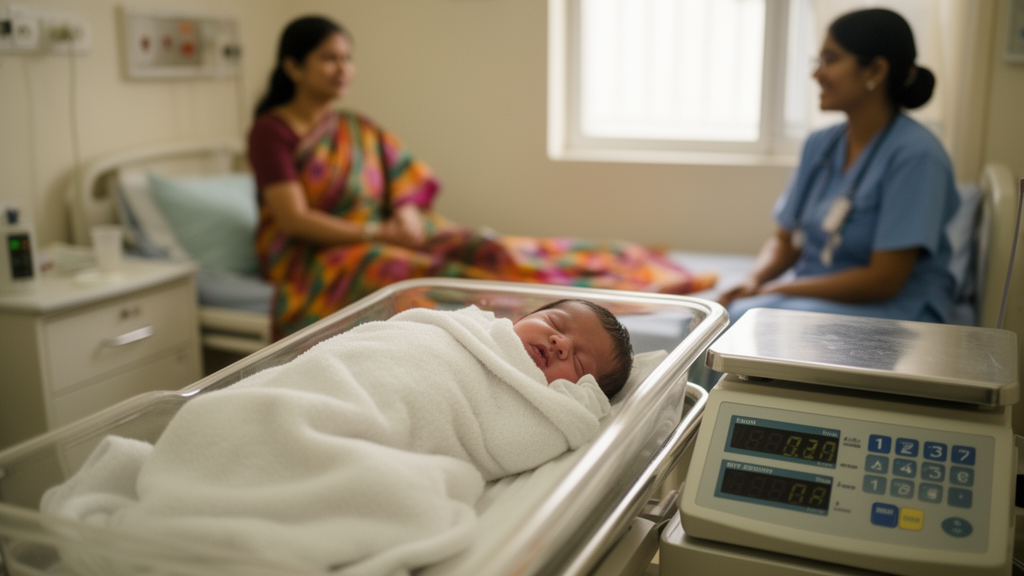
Pregnant women in the Indian city of Hyderabad who reported higher levels of stress or depressive symptoms during their third trimester gave birth to infants weighing slightly less on average, according to a prospective cohort study published in Frontiers in Public Health. The effect was modest: each additional point on a stress or depression screening scale was associated with a reduction in birth weight of roughly six to seven grams. Crucially, however, neither psychological measure was linked to preterm birth or to low birth weight as a clinical category, and neither was associated with gestational age at delivery.
The study, conducted by researchers at the ICMR-National Institute of Nutrition in Hyderabad together with colleagues at the London School of Hygiene and Tropical Medicine, followed 717 pregnant women enrolled between June 2021 and December 2022 as part of the Action Against Stunting Hub mother-child cohort. Of these, 616 women with complete psychosocial data were included in the analysis, and 562 formed the analytical sample for the fully adjusted regression models. All participants lived in the urban communities of Addagutta, Seethaphalmandi, and Warasiguda and were recruited during their third trimester of pregnancy with a singleton live fetus.
The researchers measured psychological distress using two widely validated screening instruments. Depressive symptoms were screened with the Edinburgh Postnatal Depression Scale, a 10-item instrument scored from 0 to 30. Both questionnaires were translated into Telugu and Hindi using standardized forward-backward translation and administered face to face in private settings by trained field investigators.
Social support was measured with the Multidimensional Scale for Perceived Social Support, covering support from family, friends, and significant others. The prevalence of elevated perceived stress, defined as a score of 14 or higher, was 17.4 percent, while 21.4 percent of women screened positive for elevated depressive symptoms with scores of 10 or higher. These figures are notably lower than pooled global estimates from a recent systematic review, which reported antenatal prevalences of around 52 percent for perceived stress and 28 percent for depressive symptoms.
The authors suggest this divergence may reflect differences in screening tools, timing of assessment, and sociocultural context. Notably, 98 percent of participants reported receiving social support from family and friends, a factor the researchers believe may have buffered psychological distress in this population. Gestational age was determined using a hierarchical approach designed to maximize accuracy.
First trimester ultrasonography estimates, available for 479 participants, were given highest priority, followed by second trimester scans for 81 women, and last menstrual period dating for the remaining 56. Birth weight was measured within 12 hours of delivery by trained hospital staff using calibrated digital infant weighing scales, and all deliveries occurred in institutional settings. Low birth weight was defined as less than 2,500 grams and preterm birth as delivery before 37 completed weeks of gestation.
In the adjusted multivariable linear regression models, each one-point increase in the perceived stress score was associated with a 5.84 gram reduction in birth weight, with a 95 percent confidence interval spanning 11.49 grams below to 0.19 grams above zero. Each one-point increase in the depressive symptom score was associated with a 7.45 gram reduction, with a confidence interval of 13.72 to 1.17 grams below zero. Neither score, however, showed a significant association with gestational age.
When the researchers ran logistic regression models for the binary outcomes, the adjusted odds ratios for low birth weight were 1.03 for both stress and depressive symptom scores, and around 1.01 to 1.02 for preterm birth, none of which reached statistical significance. The authors propose a biological explanation for why birth weight might fall without gestational age being affected. Increased fetal cortisol exposure can impair placental nutrient transport.
Distress may also induce low-grade inflammation and reduce uteroplacental blood flow, restricting fetal growth without necessarily triggering preterm labor. This pathway could plausibly produce smaller babies at term rather than earlier deliveries. The effect sizes observed here are smaller than those reported in some earlier studies.
A meta-analysis of 23 studies previously linked antenatal psychological distress to increased risks of preterm birth, low birth weight, and intrauterine growth restriction, while one earlier cohort study reported a 55-gram birth weight reduction along with increased odds of low birth weight. By contrast, a study cited by the authors found a 23-gram reduction without increased odds of either clinical outcome, closely mirroring the present findings. The researchers attribute the smaller effect in their cohort to the relatively low prevalence of psychological distress and the near-universal social support reported by participants, which may have attenuated stress-axis activation and its downstream effects on fetal growth.
The study has several limitations that the authors acknowledge. Psychological measures were assessed only once, during the third trimester, so distress earlier in pregnancy could not be captured. Residual confounding remains possible, particularly because maternal body mass index, nutritional status, gestational weight gain, and antidepressant use were not available for adjustment.
Post-hoc statistical power for the birth weight associations was estimated at roughly 49 to 60 percent, so the precision of the estimates was evaluated primarily through confidence intervals. About 14 percent of the enrolled sample was lost to psychosocial assessment, although baseline characteristics were comparable between those with and without complete data. Recruitment during the COVID-19 pandemic between 2021 and 2022 may also have influenced maternal psychological wellbeing and healthcare access, and the focus on selected lower-income urban communities limits generalizability.
Despite the modest effect size, the authors argue the findings carry practical weight for antenatal care. They suggest that assessing maternal psychological distress as part of routine antenatal services could benefit maternal wellbeing and potentially contribute to better pregnancy outcomes, even where the clinical thresholds of low birth weight and preterm birth are not crossed. They call for future research into the biological role of social support in buffering stress-axis activation, using biomarkers such as salivary or hair cortisol and inflammatory markers, to clarify how psychosocial factors shape fetal growth and to identify targets for intervention.
Subject of Research: Association of antenatal perceived stress and depressive symptoms with birth weight and gestational age in an Indian prospective cohort
Article Title: Association of antenatal perceived stress and depressive symptoms with birth weight and gestational age: a prospective cohort study within the Action Against Stunting Hub, India
Article References: Thomas, J., Fernandez Rao, S., Dasi, T., Gunturu, M., Chilumula, M., Augustine, L. F., Mahajan, H., Davies-Kershaw, H., Heffernan, C., Rudhra, A., Banjara, S. K., Challa, S., Kulkarni, B., Pullakhandam, R., & Palika, R. (2026). Association of antenatal perceived stress and depressive symptoms with birth weight and gestational age: a prospective cohort study within the Action Against Stunting Hub, India. Frontiers in Public Health, 14, 1983882. https://doi.org/10.3389/fpubh.2026.1983882
Image Credits: AI Generated
DOI: 10.3389/fpubh.2026.1983882
Keywords: antenatal stress, depressive symptoms, birth weight, gestational age, low birth weight, preterm birth, maternal mental health, HPA axis, social support, Hyderabad cohort, pregnancy outcomes, Action Against Stunting Hub
Cite Scienmag News
Harold Sullivan. (October 27, 2026). Prenatal Stress and Depressive Symptoms Tied to Slightly Lower Birth Weight in Indian Cohort. Scienmag. https://scienmag.com/prenatal-stress-and-depressive-symptoms-tied-to-slightly-lower-birth-weight-in-indian-cohort/
Harold Sullivan. "Prenatal Stress and Depressive Symptoms Tied to Slightly Lower Birth Weight in Indian Cohort." Scienmag, 27 October 2026, https://scienmag.com/prenatal-stress-and-depressive-symptoms-tied-to-slightly-lower-birth-weight-in-indian-cohort/. Accessed 27 October 2026.
Harold Sullivan. "Prenatal Stress and Depressive Symptoms Tied to Slightly Lower Birth Weight in Indian Cohort." Scienmag. October 27, 2026. https://scienmag.com/prenatal-stress-and-depressive-symptoms-tied-to-slightly-lower-birth-weight-in-indian-cohort/


