


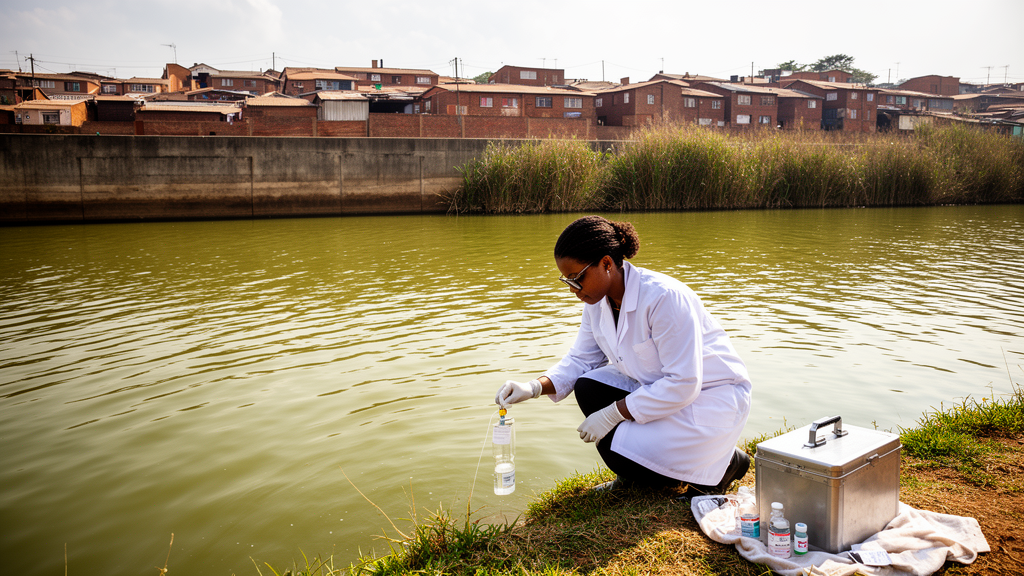
Researchers have detected five antiretroviral drugs, two antibiotics, fourteen pesticides and elevated concentrations of several metals in the water of the Orlando Dam in Soweto, Gauteng Province, South Africa, in what the authors describe as the first report of these contaminant classes in that urban impoundment. The screening, published in Environmental Science and Pollution Research, compared the Orlando Dam with four water bodies in the rural Vhembe District of Limpopo Province: the Albasini, Nandoni and TateVondo dams and the Xikundu Weir. The two settings produced strikingly different contamination profiles, pointing to surrounding land use as the dominant driver of what ends up in the water.
The study was conducted during the summer of 2021, with one surface water sample collected from each site approximately 45 centimetres below the surface. Samples destined for organic contaminant analysis were collected in one-litre glass bottles to minimise adsorption of compounds, while metal and nutrient samples went into acid-preserved plastic bottles. All organic analyses were performed by an ISO/IEC 17025-accredited laboratory using solid-phase extraction followed by broad-spectrum screening with gas chromatography coupled to time-of-flight mass spectrometry and liquid chromatography coupled to quadrupole time-of-flight mass spectrometry. Five antiretroviral drugs, namely dolutegravir, nevirapine, tenofovir disoproxil, lamivudine and efavirenz, were quantified by liquid chromatography with tandem mass spectrometry. Metals were screened with a semi-quantitative inductively coupled plasma scan covering 68 trace elements.
The Orlando Dam emerged as the most heavily contaminated site by a wide margin. It alone tested positive for all five antiretrovirals as well as the antibiotics sulfamethoxazole and trimethoprim, and it yielded fourteen pesticide detections, compared with two at the Nandoni Dam, one at the TateVondo Dam, three at the Albasini Dam and two at the Xikundu Weir. None of the pharmaceuticals or antiretrovirals tested was detected at any of the Limpopo sites. The concentrations measured in the Orlando Dam included efavirenz at 1600 nanograms per litre, lamivudine at 1700 nanograms per litre and dolutegravir at 77 nanograms per litre, with tenofovir disoproxil and nevirapine detected but reported only as present.
These pharmaceutical findings matter because prior laboratory research suggests that environmentally relevant concentrations of some antiretrovirals can affect non-target aquatic organisms. Earlier work cited by the authors reported effects in fish at efavirenz concentrations as low as 10.3 nanograms per litre and nevirapine concentrations of 3740 nanograms per litre, and a lamivudine exposure of 100 micrograms per litre produced complete mortality in the filter-feeding crustacean Daphnia magna over 48 hours. The authors attribute the presence of these drugs in the Orlando Dam to the high prevalence of HIV/AIDS in South Africa, which carries roughly 22 percent of the global HIV and AIDS burden, and particularly in Gauteng, where an estimated 1.9 million people are living with HIV. Wastewater treatment infrastructure in many areas is limited, allowing excreted drugs to reach surface waters through effluent discharge and runoff.
The pesticide picture told a similar story of contrast. Of the 22 pesticides tested, 19 fell below the detection limit of 50 nanograms per litre, but the Orlando Dam still yielded the greatest diversity of detections, including the triazine herbicides atrazine at 120 nanograms per litre and simazine, the herbicide metolachlor at 86 nanograms per litre and the fungicide flutriafol at 58 nanograms per litre. The atrazine concentration was well below the South African guideline of 10 micrograms per litre for protecting aquatic ecosystems, and the metolachlor level also sat below most international drinking water values, although it exceeded the Canadian aquatic ecosystem guideline of 7.8 micrograms per litre. South Africa has no official guideline value for flutriafol.
Notably, none of the targeted organochlorine pesticides, including DDT and its metabolites, was detected at any site, despite the long history of indoor residual spraying with DDT for malaria vector control in the Vhembe District, a practice permitted under an exemption to the Stockholm Convention. Instead, the rural dams were characterised mainly by organophosphate and carbamate residues. Malathion, diazinon and pirimiphos-methyl were present below the detection limit in all the dams, while the carbamates carbaryl and propoxur appeared in the Albasini and Orlando dams respectively. The authors note that organophosphate pesticides can impair acetylcholinesterase activity, affecting respiration, reproduction, nervous system, liver and kidney function in aquatic and terrestrial organisms, and that organophosphate poisoning is recognised as a public health issue in South Africa.
Metal analysis revealed exceedances of South African water quality guidelines for the protection of aquatic ecosystems at several sites. Aluminium in the Albasini Dam reached 0.42 milligrams per litre, manganese in the Orlando Dam reached 0.34 milligrams per litre against a guideline of 0.18 milligrams per litre, and zinc in the Nandoni, TateVondo and Xikundu sites exceeded the 0.002 milligrams per litre guideline for aquatic life. Iron and manganese concentrations were markedly higher in the Orlando Dam than elsewhere, consistent with earlier work reporting iron values of 0.614 to 13 milligrams per litre in the same water body. The Orlando Dam receives water from the Diepkloofspruit and Baileyspruit rivers, which drain groundwater influenced by the Witwatersrand Basin, an area with a long mining history and known metal contamination.
Nutrient results added to the concern around the urban site. Nitrate and nitrite were below detection in all dams, but ammonia was detected at one Orlando Dam site at 6.5 milligrams per litre, exceeding the target water quality range for domestic use and aquatic ecosystems and surpassing the level of about 2 milligrams per litre typically found in surface waters. The tributaries feeding the dam are known to receive sewage discharge, and the researchers observed livestock, littering with personal hygiene products and mining-related chemical spillage in the catchment during sampling. Elevated ammonia is concerning because studies in fish have linked it to altered thyroid hormone levels and disrupted brain neurotransmission.
The authors are careful about the limits of their data. Because sampling was conducted once at each site, there were no biological replicates, no inferential statistics could be performed, and all results are descriptive. They also report that information on field blanks, laboratory blanks, duplicate samples, matrix spike recoveries and certified reference materials was not provided in the analytical reports, and therefore could not be included. General water quality parameters such as electrical conductivity and total dissolved solids fell within guideline ranges at all sites, while pH values at Xikundu Weir, one Nandoni site and two TateVondo sites sat marginally above the range for aquatic systems.
Overall, the study frames a shift in South African freshwater contamination away from legacy pollutants such as DDT towards pharmaceuticals, modern pesticides and trace metals. The urban Orlando Dam, downstream of the Baragwanath Hospital and wastewater treatment plants, carried the heaviest and most diverse burden, while the rural Vhembe dams showed contamination largely tied to agriculture, grazing livestock and domestic waste. The researchers recommend continued monitoring with seasonal sampling and quantitative risk assessment to better understand temporal variation and the potential ecological and human health implications for water bodies used for recreation, irrigation and domestic purposes.
Subject of Research: Emerging contaminants including antiretroviral drugs, pesticides and metals in urban and rural South African dams
Article Title: Investigating emerging contaminants in dams from the Vhembe District in Limpopo and, for the first time, in the Orlando Dam, Gauteng Province, South Africa
Article References: Seshoka, M. F., van Dyk, J., & Barnhoorn, I. J. (2026). Investigating emerging contaminants in dams from the Vhembe District in Limpopo and, for the first time, in the Orlando Dam, Gauteng Province, South Africa. Environmental Science and Pollution Research. https://doi.org/10.1007/s11356-026-38342-2
Image Credits: AI Generated
DOI: 10.1007/s11356-026-38342-2
Keywords: South Africa, Orlando Dam, Vhembe District, endocrine-disrupting chemicals, antiretroviral drugs, pharmaceuticals, pesticides, DDT, heavy metals, water quality, Soweto, freshwater pollution
Cite Scienmag News
Violet Maxwell. (October 27, 2026). Urban dam in Soweto carries antiretroviral drugs and pesticides in first-of-its-kind screening. Scienmag. https://scienmag.com/urban-dam-in-soweto-carries-antiretroviral-drugs-and-pesticides-in-first-of-its-kind-screening/
Violet Maxwell. "Urban dam in Soweto carries antiretroviral drugs and pesticides in first-of-its-kind screening." Scienmag, 27 October 2026, https://scienmag.com/urban-dam-in-soweto-carries-antiretroviral-drugs-and-pesticides-in-first-of-its-kind-screening/. Accessed 27 October 2026.
Violet Maxwell. "Urban dam in Soweto carries antiretroviral drugs and pesticides in first-of-its-kind screening." Scienmag. October 27, 2026. https://scienmag.com/urban-dam-in-soweto-carries-antiretroviral-drugs-and-pesticides-in-first-of-its-kind-screening/


