


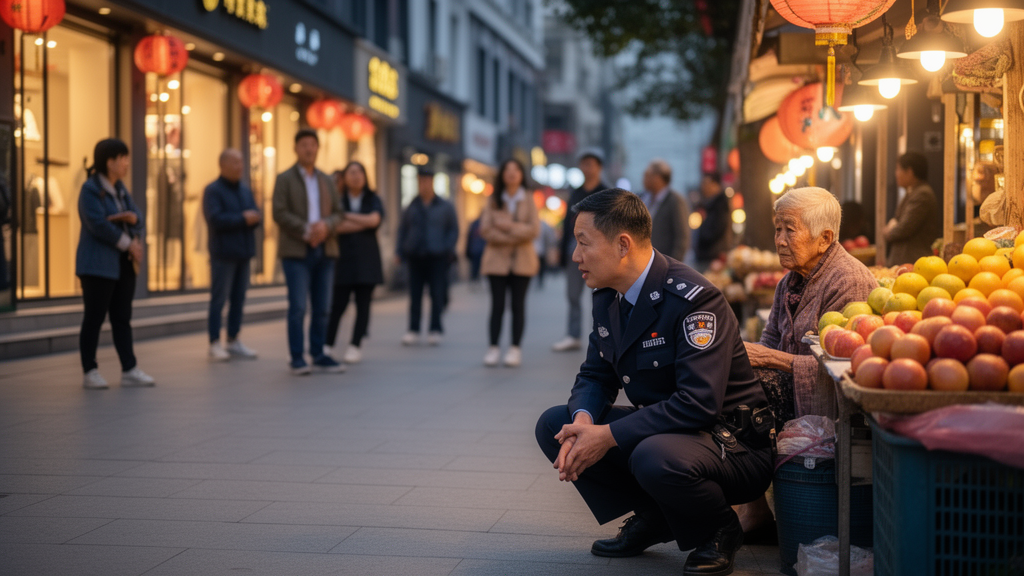
Public trust in the police does not rest on a single foundation, but new research from Guangzhou, China, suggests that the everyday quality of contact between officers and residents matters more than almost anything else. A survey of 1,899 residents across 72 diverse neighborhoods in the southern Chinese metropolis found that police–resident interactions carried the strongest explanatory power over how legitimate people judged the police to be, outstripping both individual characteristics and the perceived conditions of the surrounding community. The study, conducted by researchers at South China University of Technology and Guangzhou University and published in Frontiers in Psychology, set out to test procedural justice theory in a non-Western context.
Empirical work in China has produced mixed results, and the authors argue that earlier studies have largely ignored how interactional experiences, neighborhood conditions, and institutionally embedded factors combine to shape legitimacy perceptions. To address that gap, the team organized the potential influences into three broad domains: individual attributes of respondents, the character of police–resident interactions, and the perceived community environment. Within the interactional domain, two measures emerged as the most potent positive predictors of perceived legitimacy: police work capability and overall satisfaction with the police.
Police work performance and the perceived effectiveness of police stops followed closely behind as strong positive contributors. Justice perceptions also mattered, but less than the headline measures of capability and satisfaction. Both procedural justice—fairness in how officers exercise authority—and distributive justice—fairness in how police resources and attention are allocated—showed significant but comparatively weaker associations with legitimacy.
In the Guangzhou sample, concrete appraisals of what the police can do and how satisfying their work is appear to carry more weight. Not every contact with the legal system builds trust. The researchers found that legal socialization experiences, particularly having been stopped by police and holding stricter legal attitudes, were associated with lower legitimacy ratings.
Prior stops, in other words, did not function as neutral civic education; they were linked to more skeptical views of law enforcement authority. Individual attributes produced some unexpected patterns. Holders of a local hukou—the household registration that distinguishes long-term locals from migrants in Chinese cities—reported higher perceived legitimacy than those without it.
But married individuals and residents of higher-status neighborhoods unexpectedly reported lower legitimacy ratings, a result the authors present as a contextual feature of legitimacy formation in China's urban settings rather than a confirmation of assumptions drawn from Western policing research. The neighborhood environment contributed its own distinct signal. Perceived social disorder—visible signs of crime, incivility, or decay—was associated with weaker legitimacy evaluations, while community cohesion strengthened them.
The study's scope and design matter for interpreting these results. The data come from a cross-sectional survey in a single Chinese city, so the findings describe associations among perceptions at one point in time rather than demonstrating causal effects. The sample's breadth—1,899 residents spread across 72 neighborhoods of varying character—does allow the authors to argue that legitimacy is built from a combination of personal experience, institutional contact, and environmental context, and that no single domain tells the whole story.
The practical implication the authors draw is that policing strategies should prioritize routine, high-quality citizen interactions and community engagement. If capability and satisfaction with police work are the strongest correlates of legitimacy, then the cumulative texture of ordinary encounters—how competent officers appear, how satisfying residents find their dealings with them—may matter more for public trust than formal fairness mechanisms alone. The findings complement and extend existing models of police legitimacy by highlighting their contextual specificity: what builds trust in Guangzhou's neighborhoods reflects local institutional arrangements and urban conditions, and the authors caution against assuming that frameworks developed elsewhere transfer unchanged to China's urban environment.
Subject of Research: Perceptions of police legitimacy and their influencing factors among residents of Guangzhou, China
Article Title: Perceptions of police legitimacy and its influencing factors: evidence from Guangzhou, China
Article References: Lu, H., Zheng, S., Zheng, J., Song, G., & Xiao, L. (2026). Perceptions of police legitimacy and its influencing factors: evidence from Guangzhou, China. Frontiers in Psychology, 17, Article 1903028. https://doi.org/10.3389/fpsyg.2026.1903028
Image Credits: AI Generated
DOI: 10.3389/fpsyg.2026.1903028
Keywords: police legitimacy, procedural justice, Guangzhou, China, police-resident interactions, community cohesion, social disorder, hukou, legal socialization, survey research, forensic and legal psychology, Perceptions
Cite Scienmag News
Glenn Wilkins. (October 27, 2026). Everyday Encounters With Police Shape Trust Most in Chinese City Survey. Scienmag. https://scienmag.com/everyday-encounters-with-police-shape-trust-most-in-chinese-city-survey/
Glenn Wilkins. "Everyday Encounters With Police Shape Trust Most in Chinese City Survey." Scienmag, 27 October 2026, https://scienmag.com/everyday-encounters-with-police-shape-trust-most-in-chinese-city-survey/. Accessed 27 October 2026.
Glenn Wilkins. "Everyday Encounters With Police Shape Trust Most in Chinese City Survey." Scienmag. October 27, 2026. https://scienmag.com/everyday-encounters-with-police-shape-trust-most-in-chinese-city-survey/


