

Tuesday, October 27, 2026
Science
No Result
View All Result
  • Login
  • HOME
  • SCIENCE NEWS
  • CONTACT US
  • HOME
  • SCIENCE NEWS
  • CONTACT US
No Result
View All Result
Scienmag
No Result
View All Result
Home Science News

Post-Weaning Isolation Leaves Lasting, Sex-Specific Marks on Mouse Social Behavior

October 27, 2026
in Science News
Glenn Wilkins
By Glenn Wilkins Scienmag Editorial Profile - Clinical Psychology
Reading Time: 2 mins read
0
Post-Weaning Isolation Leaves Lasting, Sex-Specific Marks on Mouse Social Behavior

Post-Weaning Isolation Leaves Lasting, Sex-Specific Marks on Mouse Social Behavior

65
SHARES
587
VIEWS
Share on FacebookShare on Twitter
ADVERTISEMENT

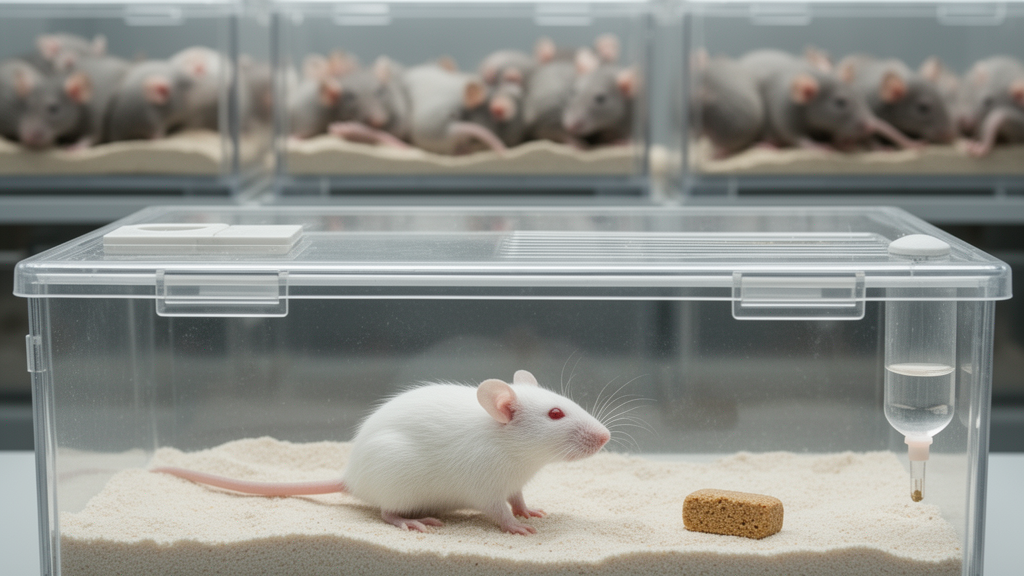
Mice separated from cage mates right after weaning show persistent, sex-specific changes in how they interact with others, according to a longitudinal behavioral study of juvenile social isolation in C57BL/6J mice.

Researchers individually housed mice from postnatal day 21 and then tracked spontaneous social interaction at postnatal days 35, 49, and 63. Using an augmented reality-based behavioral monitoring system, they quantified locomotor activity, inter-mouse distance, mean contact duration per initiated encounter, and interaction dynamics during extended cage-based sessions in both light and dark phases.

Across most developmental stages and sex-phase combinations, isolated mice kept a greater inter-mouse distance than their group-housed counterparts, suggesting a robust and lasting reduction in proximity-seeking after early social deprivation.

By contrast, reductions in mean contact duration per initiated encounter were not uniform. They varied by sex, developmental stage, and whether behavior was observed during the light or dark phase, indicating that the effects of isolation on the quality of individual social encounters are more context-dependent than the effects on distance.

Locomotor activity also differed by developmental stage and sex, with late-emerging increases particularly evident during the dark phase in isolated mice. Meanwhile, lower interaction-partner switching appeared only in isolated males, only at the earliest stage tested, day 35, and only during the light phase, a narrow and transient effect rather than a general feature of isolation.

The authors highlight an important design consideration: isolated mice were reunited at testing with cage mates from which they had been separated for more than two weeks and were therefore effectively unfamiliar, whereas group-housed mice were tested with continuously familiar cage mates. The reported effects thus reflect social isolation together with its intrinsic reduction in social familiarity, not isolation alone.

Because the study is observational in design, the findings describe associations between post-weaning isolation and later social behavior rather than demonstrating causal mechanisms. The work also cannot disentangle how much of the effect stems from the absence of social contact versus the loss of familiarity with specific partners.

Nevertheless, the results indicate that continued post-weaning social isolation is associated with persistent, sex-specific alterations in sociability and social interaction dynamics in mice. The pattern of changes suggests that juvenile social experience may shape the developmental maturation and temporal organization of social interaction across adolescence and early adulthood.

As juvenile social isolation is widely used as a model of early social deprivation, these longitudinal, sex-stratified measurements may help clarify how disrupted early social experience contributes to long-term psychiatric vulnerability, and why such vulnerability often differs between males and females.

Subject of Research: Continued post-weaning social isolation is associated with persistent, sex-specific changes in sociability and social interaction dynamics in mice

Article Title: Continued post-weaning social isolation is associated with persistent, sex-specific changes in sociability and social interaction dynamics in mice

Article References: Yamamuro, K., Takahashi, M., Okuda, M., Okumura, K., Kashida, N., Yoshihara, T., Takeda, T., Toritsuka, M., Yamauchi, T., & Makinodan, M. (2026). Continued post-weaning social isolation is associated with persistent, sex-specific changes in sociability and social interaction dynamics in mice. PLOS One, 21(10), e0361386. https://doi.org/10.1371/journal.pone.0361386

Image Credits: AI Generated

DOI: 10.1371/journal.pone.0361386

Keywords: Continued, post-weaning, social, isolation, associated, persistent, sex-specific, changes, sociability, interaction, dynamics, mice

Cite Scienmag News

Glenn Wilkins. (October 27, 2026). Post-Weaning Isolation Leaves Lasting, Sex-Specific Marks on Mouse Social Behavior. Scienmag. https://scienmag.com/post-weaning-isolation-leaves-lasting-sex-specific-marks-on-mouse-social-behavior/


Glenn Wilkins. "Post-Weaning Isolation Leaves Lasting, Sex-Specific Marks on Mouse Social Behavior." Scienmag, 27 October 2026, https://scienmag.com/post-weaning-isolation-leaves-lasting-sex-specific-marks-on-mouse-social-behavior/. Accessed 27 October 2026.

Glenn Wilkins. "Post-Weaning Isolation Leaves Lasting, Sex-Specific Marks on Mouse Social Behavior." Scienmag. October 27, 2026. https://scienmag.com/post-weaning-isolation-leaves-lasting-sex-specific-marks-on-mouse-social-behavior/

Tags: associatedaugmented reality behavioral monitoringchangescontact duration and interaction qualitycontinueddevelopmental stages in micedynamicsinter-mouse distance analysisinteractionisolationjuvenile social isolation effectslight vs. dark phase behaviorlocomotor activity in isolated micelong-term impact of early social deprivationmiceMouse social behaviorPersistentpost-weaningpost-weaning mouse developmentsex differences in social interaction patternsSex-Specificsex-specific behavioral changessociabilitysocial
Share26Tweet16
Previous Post

Metformin Fish Behavior Study Retracted Over Falsified Animal Ethics Approval

Next Post

Liver Injury Affects One in Eight Patients on Immune Checkpoint Inhibitors in Real-World Study

Related Posts

Liver Injury Affects One in Eight Patients on Immune Checkpoint Inhibitors in Real-World Study
Medicine

Liver Injury Affects One in Eight Patients on Immune Checkpoint Inhibitors in Real-World Study

October 27, 2026
Metformin Fish Behavior Study Retracted Over Falsified Animal Ethics Approval
Science News

Metformin Fish Behavior Study Retracted Over Falsified Animal Ethics Approval

October 27, 2026
Ninety Years Later, a Second Species of a Near-Mythical Blind Cave Beetle Finally Emerges
Biology

Ninety Years Later, a Second Species of a Near-Mythical Blind Cave Beetle Finally Emerges

October 27, 2026
Back Support Exoskeletons Ease Muscle Strain, but Metrics Tell Different Stories
Science News

Back Support Exoskeletons Ease Muscle Strain, but Metrics Tell Different Stories

October 27, 2026
Social Support, Not Clinical Hours, Linked to Lower Stress in Nursing Students
Science News

Social Support, Not Clinical Hours, Linked to Lower Stress in Nursing Students

October 27, 2026
PLOS ONE Retracts Osteosarcoma Resveratrol Study Over Image and Statistics Concerns
Science News

PLOS ONE Retracts Osteosarcoma Resveratrol Study Over Image and Statistics Concerns

October 27, 2026
Next Post
Liver Injury Affects One in Eight Patients on Immune Checkpoint Inhibitors in Real-World Study

Liver Injury Affects One in Eight Patients on Immune Checkpoint Inhibitors in Real-World Study

  • Mothers who receive childcare support from maternal grandparents show more optimized

    Mothers who receive childcare support from maternal grandparents show more parental warmth, finds NTU Singapore study

    27656 shares
    Share 11059 Tweet 6912
  • University of Seville Breaks 120-Year-Old Mystery, Revises a Key Einstein Concept

    1061 shares
    Share 424 Tweet 265
  • Bee body mass, pathogens and local climate influence heat tolerance

    682 shares
    Share 273 Tweet 171
  • Researchers record first-ever images and data of a shark experiencing a boat strike

    546 shares
    Share 218 Tweet 137
  • Groundbreaking Clinical Trial Reveals Lubiprostone Enhances Kidney Function

    531 shares
    Share 212 Tweet 133
Science

Embark on a thrilling journey of discovery with Scienmag.com—your ultimate source for cutting-edge breakthroughs. Immerse yourself in a world where curiosity knows no limits and tomorrow’s possibilities become today’s reality!

RECENT NEWS

  • Liver Injury Affects One in Eight Patients on Immune Checkpoint Inhibitors in Real-World Study
  • Post-Weaning Isolation Leaves Lasting, Sex-Specific Marks on Mouse Social Behavior
  • Metformin Fish Behavior Study Retracted Over Falsified Animal Ethics Approval
  • Ninety Years Later, a Second Species of a Near-Mythical Blind Cave Beetle Finally Emerges

Categories

  • Agriculture
  • Anthropology
  • Archaeology
  • Athmospheric
  • Biology
  • Biotechnology
  • Blog
  • Bussines
  • Cancer
  • Chemistry
  • Climate
  • Earth Science
  • Editorial Policy
  • Marine
  • Mathematics
  • Medicine
  • Pediatry
  • Policy
  • Psychology & Psychiatry
  • Science Education
  • Science News
  • Social Science
  • Space
  • Technology and Engineering

Subscribe to Blog via Email

Enter your email address to subscribe to this blog and receive notifications of new posts by email.

Join 5,151 other subscribers

© 2025 Scienmag - Science Magazine

Welcome Back!

Login to your account below

Forgotten Password?

Retrieve your password

Please enter your username or email address to reset your password.

Log In
No Result
View All Result
  • HOME
  • SCIENCE NEWS
  • CONTACT US

© 2025 Scienmag - Science Magazine

Discover more from Science

Subscribe now to keep reading and get access to the full archive.

Continue reading