


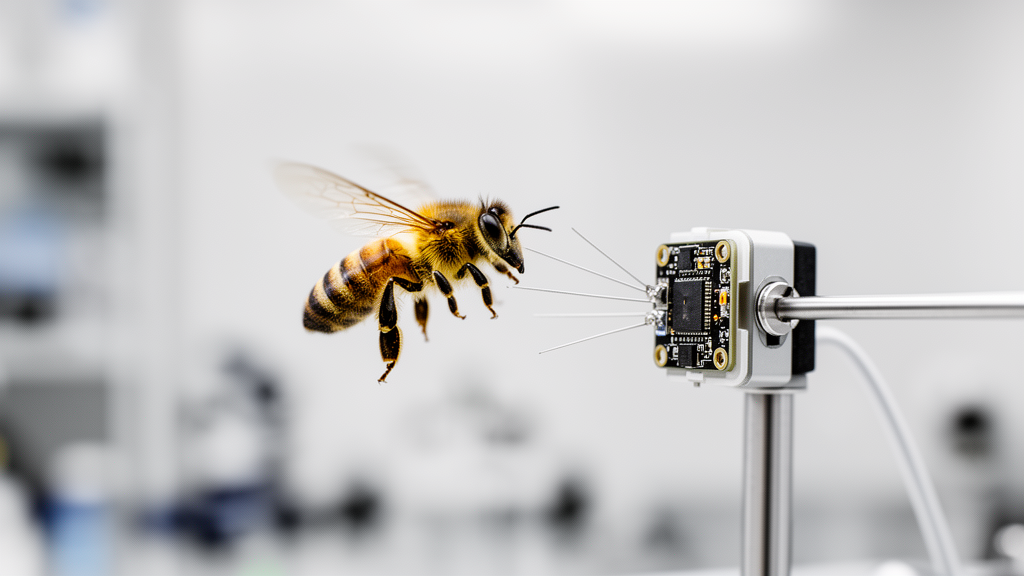
Researchers have unveiled FloBuzz, a modular automated flower and robotic feeder system that pairs reward delivery with programmable electric shock stimulation in free-flying honey bees (Apis mellifera), enabling aversive learning experiments under real outdoor field conditions.
Most existing automated feeder systems are reward-centric, built to dispense nectar substitutes and track foraging, but they cannot probe how pollinators respond to negative stimuli. FloBuzz closes that gap with a 3D-printed feeder equipped with a shock grid, a syringe pump featuring fluid level feedback, and a computer vision module that detects bee visits and triggers shocks in a closed loop.
In a replicated field proof-of-concept experiment, the team measured mean bee occupancy at the feeder across different stimulus voltages. Occupancy decreased as voltage increased, demonstrating a measurable, voltage-dependent deterrent response in freely foraging bees.
The results validate that FloBuzz can deliver automated, programmable aversive stimulation outdoors, a capability previously limited to laboratory setups. Because pollinator behavior under environmental stressors is central to assessing ecosystem health, a platform that integrates appetitive and aversive stimuli in the field could broaden how scientists study bee learning, decision-making and avoidance.
The system’s modular architecture is its key design feature: each component, from the shock grid to the vision-based trigger, can be reconfigured for studies requiring controlled combinations of rewards and punishments. The authors position FloBuzz as a flexible foundation for future field experiments on aversive learning in pollinators, while noting that the current findings establish the system’s feasibility rather than any conclusions about long-term effects on bee colonies.
Subject of Research: Automated aversive stimulation of free-flying honey bees with a modular robotic feeder system
Article Title: FloBuzz: A modular feeder system for automated aversive stimulation in free-flying bees
Article References: Gultekinoglu, E., Erdem, B., Botasun, A., Arslan, O. C., Sevin, S., Gozen, A. G., Alemdar, H., Sahin, E., & Turgut, A. E. (2026). FloBuzz: A modular feeder system for automated aversive stimulation in free-flying bees. PLOS One, 21(10), e0361207. https://doi.org/10.1371/journal.pone.0361207
Image Credits: AI Generated
DOI: 10.1371/journal.pone.0361207
Keywords: FloBuzz, honey bees, Apis mellifera, aversive learning, robotic feeder, computer vision, electric shock, pollinators, field experiment, foraging behavior, closed-loop stimulation, modular
Cite Scienmag News
Elena Sutton. (October 27, 2026). FloBuzz Delivers Automated Electric Shocks to Free-Flying Bees. Scienmag. https://scienmag.com/flobuzz-delivers-automated-electric-shocks-to-free-flying-bees/
Elena Sutton. "FloBuzz Delivers Automated Electric Shocks to Free-Flying Bees." Scienmag, 27 October 2026, https://scienmag.com/flobuzz-delivers-automated-electric-shocks-to-free-flying-bees/. Accessed 27 October 2026.
Elena Sutton. "FloBuzz Delivers Automated Electric Shocks to Free-Flying Bees." Scienmag. October 27, 2026. https://scienmag.com/flobuzz-delivers-automated-electric-shocks-to-free-flying-bees/


