


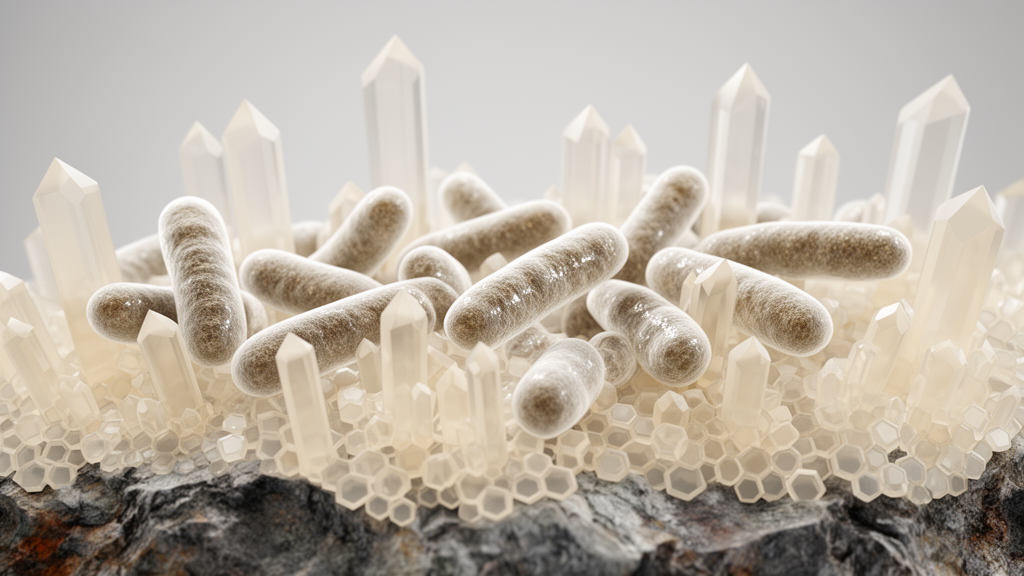
Bacteria do not merely trigger the precipitation of calcium phosphate minerals; they actively dictate which mineral forms, how crystals grow, and how stable the resulting precipitates are. That is the central conclusion of a laboratory study published in the journal Frontiers in Microbiology, in which researchers from Curtin University, the University of Granada and the University of Adelaide compared mineral formation in abiotic solutions, in solutions containing only isolated extracellular polymeric substances (EPS), and in solutions containing whole bacterial cells of two very different species. Microorganisms have long been known to influence calcium phosphate precipitation, but the relative contributions of the bacterial cell surface and the slimy layer of EPS that surrounds many cells had remained poorly separated.
The new study is, according to its authors, the first microscale investigation to disentangle those two contributions for Gram-positive and Gram-negative bacteria. They set up three kinds of precipitation systems: purely chemical (abiotic) controls, systems containing isolated EPS, and systems containing whole cells. Each system was supplied with dissolved calcium and phosphate, and the researchers then tracked how much of those ions disappeared from solution, what minerals appeared, and what those minerals looked like at the microscale.
The first line of evidence came from surface chemistry. Zeta potential measurements and Fourier Transform Infrared Spectroscopy (FTIR) showed that both bacterial cells and isolated EPS present negatively charged surfaces with chemically distinct functional groups. That negative charge matters because it allows the interfaces to bind dissolved Ca²⁺ ions, concentrating them at the surface and creating local conditions favourable for phosphate minerals to nucleate.
In other words, both cells and their polymer coatings can act as templates for mineral formation. Solution chemistry backed this up. The biotic systems, whether containing cells or EPS, depleted phosphate and calcium ions from solution more strongly than the abiotic controls, a sign of enhanced crystal precipitation.
But the similarities ended there. Field emission scanning electron microscopy (FESEM) and Brunauer–Emmett–Teller (BET) surface area analysis revealed that the biological interfaces produced crystal morphologies and surface characteristics that were clearly distinct from one another and from the abiotic precipitates. The most striking differences emerged from X-ray diffraction (XRD), which identifies which mineral phases are actually present.
Abiotic precipitation produced a mixture of calcium phosphate phases rather than a single mineral. EPS-mediated precipitation promoted nucleation, but the precipitates remained dominated by precursor phases — the transient, less ordered calcium phosphates that usually precede mature apatite. Whole-cell systems, by contrast, favoured hydroxyapatite formation directly.
Sporosarcina pasteurii produced phase-pure crystalline HAp, while Pseudomonas fluorescens produced precipitates dominated by HAp. Stability told the same story from a different angle. In acid dissolution experiments, the biogenic precipitates proved more resistant to dissolution than the abiotic ones, confirming that minerals formed in the presence of bacterial interfaces are not only more ordered in phase composition but also more durable.
What explains the hierarchy of outcomes? The authors argue that the decisive factor is not surface charge alone — after all, both cells and EPS carried negative charge — but the spatial organisation of surface functional groups. The way chemical groups are arranged and spaced on a cell wall or within a polymer matrix appears to govern how calcium ions are coordinated, how nuclei form, and which crystal phase wins out during growth.
Localised metabolic activity may also contribute by modifying the microenvironment around the cells, but the study's design points to the interfaces themselves as the key determinants. The practical implication is a mechanistic blueprint. The work also sharpens a conceptual point for geomicrobiology: EPS and cell walls are not interchangeable nucleation surfaces, but chemically distinct templates with different mineralogical consequences.
As with any laboratory precipitation study, the findings describe controlled systems with defined solution chemistry, and the authors note that the final formatted version of the article is forthcoming. Nevertheless, the message is clear: in microbially induced calcium phosphate precipitation, the bacterium is not just a passive scaffold.
Subject of Research: The roles of bacterial cell surfaces and extracellular polymeric substances in microbially induced hydroxyapatite precipitation
Article Title: Bacterial interfaces and surface chemistry shape hydroxyapatite mineral architecture during microbially induced calcium phosphate precipitation
Article References: Toprak, P., Rodriguez-Navarro, C., Mukherjee, A., Pring, A., & Dhami, N. K. (2026). Bacterial interfaces and surface chemistry shape hydroxyapatite mineral architecture during microbially induced calcium phosphate precipitation. Frontiers in Microbiology, 17, Article 1949480. https://doi.org/10.3389/fmicb.2026.1949480
Image Credits: AI Generated
DOI: 10.3389/fmicb.2026.1949480
Keywords: biomineralisation, hydroxyapatite, calcium phosphate, extracellular polymeric substances, Sporosarcina pasteurii, Pseudomonas fluorescens, bacterial cell surface, zeta potential, X-ray diffraction, geomicrobiology, crystal morphology, biogenic minerals
Cite Scienmag News
Bethany Barker. (October 26, 2026). Bacterial Surface Chemistry Steers Hydroxyapatite Crystal Formation, Study Finds. Scienmag. https://scienmag.com/bacterial-surface-chemistry-steers-hydroxyapatite-crystal-formation-study-finds/
Bethany Barker. "Bacterial Surface Chemistry Steers Hydroxyapatite Crystal Formation, Study Finds." Scienmag, 26 October 2026, https://scienmag.com/bacterial-surface-chemistry-steers-hydroxyapatite-crystal-formation-study-finds/. Accessed 26 October 2026.
Bethany Barker. "Bacterial Surface Chemistry Steers Hydroxyapatite Crystal Formation, Study Finds." Scienmag. October 26, 2026. https://scienmag.com/bacterial-surface-chemistry-steers-hydroxyapatite-crystal-formation-study-finds/


