


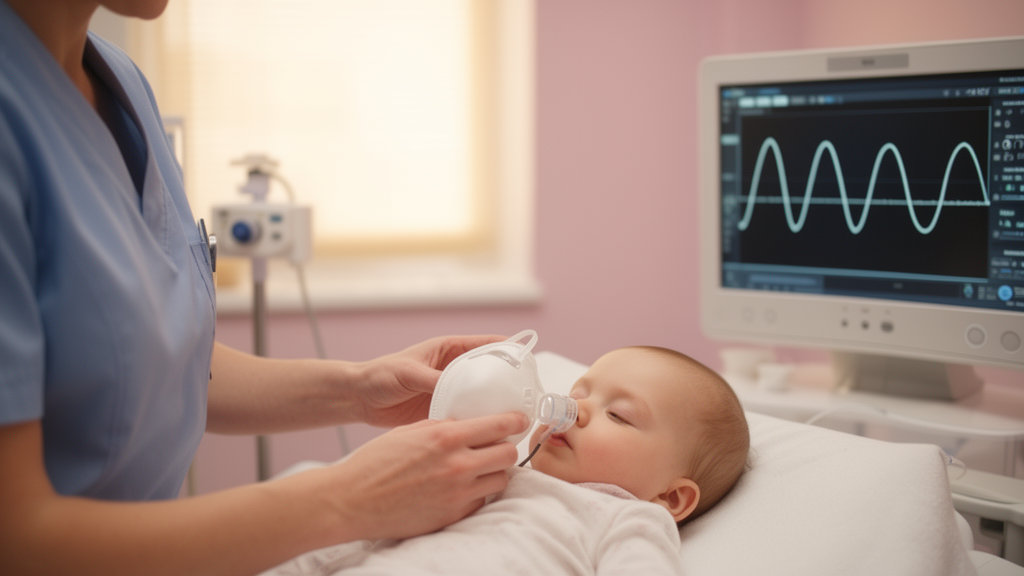
Infants and toddlers who wheeze repeatedly show measurable differences in how they breathe out during quiet, tidal breathing, according to a retrospective analysis of 178 young children who underwent pulmonary function testing at Shijiazhuang Maternal and Child Health Hospital in China. The study, published in the journal Frontiers in Pediatrics, compared 120 children with recurrent wheezing against 58 non-wheezing controls and found that two key tidal breathing indices were consistently lower in the wheezing group, offering clinicians a potential objective window into a condition that has long been difficult to assess in patients too young to cooperate with standard lung function tests. Recurrent wheezing is one of the most common respiratory complaints in early childhood, but evaluating it objectively is a persistent challenge.
The researchers focused on two core indices derived from tidal breathing curves. The first, tPTEF/tE, is the ratio of the time to peak tidal expiratory flow to the total expiratory time. The second, VPTEF/VE, is the ratio of the volume expired to peak tidal expiratory flow to the total expiratory volume.
That is precisely the pattern the study observed. Children with recurrent wheezing had a lower tPTEF/tE than controls, with a mean difference of -0.041, and a lower VPTEF/VE, with a mean difference of -0.045, both statistically significant at P<0.001. Any tidal breathing abnormality was far more frequent in the wheezing group, affecting 75.8 percent of those children compared with 27.6 percent of controls.
To test whether these associations held up independently of other factors, the team built a multivariable logistic regression model that included both core indices together. Higher values of tPTEF/tE and VPTEF/VE were each independently associated with lower odds of recurrent wheezing, with adjusted odds ratios of 0.746 per 0.01 increase for both indices, each at P<0.001. In other words, even small increments in these ratios corresponded to meaningfully reduced odds of belonging to the recurrent wheezing group.
The authors also ran a series of sensitivity analyses to probe the robustness of the findings. They repeated the comparisons after excluding premature infants, children with pneumonia, patients who had received oxygen therapy, those exposed to bronchodilators, and tests of lower quality that remained analyzable. The results stayed consistent across all of these exclusions, suggesting the signal was not driven by confounding from prematurity, acute infection, or technical artifacts in the recordings.
An exploratory receiver operating characteristic analysis quantified how well the two indices discriminated between wheezing and non-wheezing children. The area under the curve was 0.779 for tPTEF/tE and 0.792 for VPTEF/VE, values generally interpreted as moderate discriminatory ability. That places the indices well above chance performance but short of the near-perfect separation that would make them stand-alone diagnostic tests.
The study team was careful to frame the findings accordingly. The authors concluded that infants and young children with recurrent wheezing showed lower tPTEF/tE and VPTEF/VE, suggesting altered tidal expiratory breathing mechanics, and that these indices may provide supportive objective information for evaluating recurrent wheezing, but should not be used as standalone diagnostic markers. As a retrospective, single-center study, the analysis also carries inherent limitations typical of its design.
By showing that the timing and volume of peak expiratory flow during ordinary breathing distinguish wheezing toddlers from their peers, and that the association survives multiple sensitivity checks, the research supports a role for these simple, non-invasive measurements as part of a broader clinical evaluation. For a population in which objective lung function data has historically been scarce, that is a practical step forward, even if the final diagnostic word still rests with the clinician rather than the breathing curve alone.
Subject of Research: Tidal breathing pulmonary function indices in infants and young children with recurrent wheezing
Article Title: A retrospective analysis of tidal breathing pulmonary function characteristics in infants and young children with recurrent wheezing
Article References: Ding, Q., Tian, H., Wang, Y., Wang, X., & Chen, J. (2026). A retrospective analysis of tidal breathing pulmonary function characteristics in infants and young children with recurrent wheezing. Frontiers in Pediatrics, 14, Article 1966843. https://doi.org/10.3389/fped.2026.1966843
Image Credits: AI Generated
DOI: 10.3389/fped.2026.1966843
Keywords: recurrent wheezing, tidal breathing, pulmonary function testing, infants, young children, tPTEF/tE, VPTEF/VE, expiratory flow limitation, pediatric pulmonology, retrospective study, ROC analysis, small airway obstruction
Cite Scienmag News
Harold Sullivan. (October 26, 2026). Tidal Breathing Test Flags Airflow Differences in Wheezing Infants. Scienmag. https://scienmag.com/tidal-breathing-test-flags-airflow-differences-in-wheezing-infants/
Harold Sullivan. "Tidal Breathing Test Flags Airflow Differences in Wheezing Infants." Scienmag, 26 October 2026, https://scienmag.com/tidal-breathing-test-flags-airflow-differences-in-wheezing-infants/. Accessed 26 October 2026.
Harold Sullivan. "Tidal Breathing Test Flags Airflow Differences in Wheezing Infants." Scienmag. October 26, 2026. https://scienmag.com/tidal-breathing-test-flags-airflow-differences-in-wheezing-infants/


