


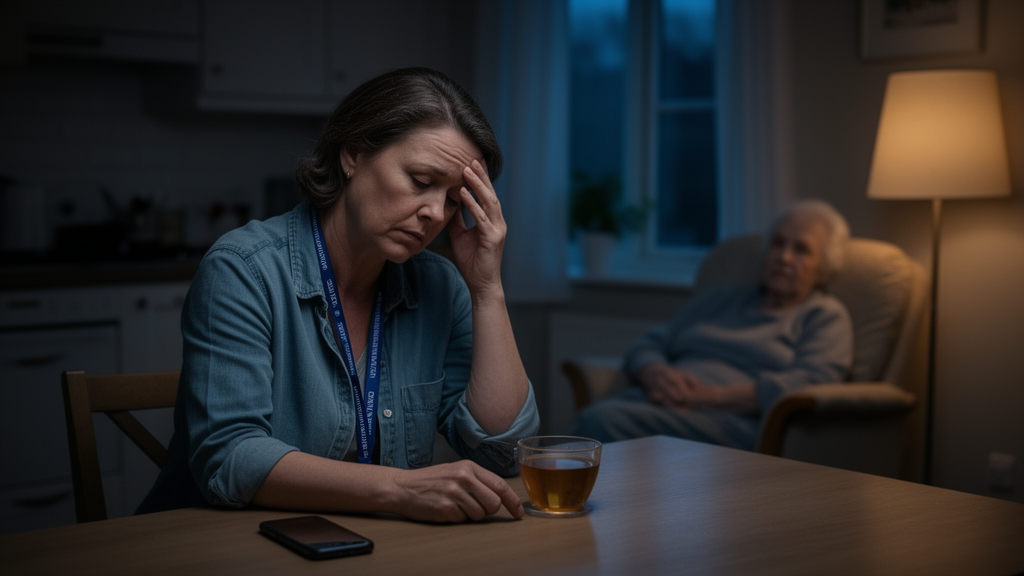
Employed family caregivers who care for relatives with dementia or mild cognitive impairment face a relentless arithmetic problem: a finite day divided among paid work, caregiving duties, sleep, and whatever remains. A new cross-sectional study from Japan suggests that what remains may matter more than how much time the demands themselves consume. Researchers at the University of Occupational and Environmental Health in Kitakyushu found that caregivers reporting less than one hour per day of restorative free time — discretionary time they could use for their own mental or physical well-being — had nearly twice the prevalence of psychological distress compared with caregivers who had three hours or more. Notably, the number of hours spent caregiving or working showed no significant association with distress once other factors were taken into account.
The study, published in Frontiers in Psychology as part of the Sustaining for Aging Dementia Relatives Support and Employment (SASAE) project, recruited participants from the outpatient dementia clinic of the university hospital between October 2021 and December 2025. Of 360 patient–caregiver pairs approached, 346 caregivers consented and received questionnaires, 261 returned them, and 210 employed caregivers with complete data formed the final analysis sample. The caregivers, 68 men and 142 women with a mean age of 54.3 years, were caring for recipients whose mean age was 79.9 years; 34 percent of recipients had Alzheimer’s disease, 37 percent had mild cognitive impairment, and 29 percent had other dementia-related disorders.
Psychological distress was measured with the Japanese version of the Kessler 6 scale, a six-item screening instrument covering nervousness, hopelessness, restlessness, effortfulness, depressive mood, and worthlessness over the previous 30 days. The researchers used a cutoff of 5 or above, the threshold proposed for screening mood and anxiety disorders in the Japanese general population. Overall, 40 percent of the caregivers met this threshold. Distress was far from evenly distributed across the time-use categories: it affected 36.2 percent of caregivers with three or more hours of restorative free time, 38.5 percent of those with one to less than three hours, and 70.6 percent of the small group with less than one hour.
Because psychological distress was relatively common in the sample, the team used modified Poisson regression with robust variance estimation to estimate prevalence ratios rather than odds ratios. In the fully adjusted model — which accounted for caregiver age, sex, marital status, education, job type, working days, shift work, cohabitation, smoking, and alcohol consumption, as well as care recipient age, sex, diagnosis, cognitive and functional scores, and long-term care certification level — caregivers with less than one hour of restorative free time had an adjusted prevalence ratio of 1.95 (95 percent confidence interval: 1.07–3.54) compared with those with three hours or more. Caregivers in the intermediate category, with one to less than three hours, did not differ significantly from the reference group.
Sleep told a parallel story. Caregivers who slept less than six hours per day had a significantly higher prevalence of psychological distress than those sleeping six to less than eight hours, with an adjusted prevalence ratio of 1.78 (95 percent confidence interval: 1.24–2.56). This association held across all five sensitivity models the researchers ran. By contrast, working hours and daily caregiving duration were not significantly associated with distress after multivariable adjustment, although caregivers providing more than eight hours of care per day showed a raised prevalence in the time-use-adjusted model that did not survive full adjustment.
The concept at the heart of the study — restorative free time — was measured with a single self-reported question developed for the project: on average, how much time per day do you have that you can use at your own discretion for your mental or physical well-being? The authors are careful to distinguish this from related constructs in occupational health psychology. Psychological detachment and relaxation describe experiences during non-work time, whereas restorative free time captures the perceived availability of time that could be used for recovery at all. It is narrower than discretionary time in general because it explicitly refers to time available for one’s own well-being. The item was developed through multidisciplinary discussion among psychiatrists, clinical psychologists, epidemiologists, and dementia specialists, but it has not been formally validated as a standardized scale, and the cutoffs used to categorize it were not based on established clinical thresholds.
Why might recovery time outperform raw caregiving hours as a correlate of distress? The authors frame the finding through established theoretical lenses, while stressing that these mechanisms were not directly tested. The Effort–Recovery Model proposes that strain accumulates when recovery is insufficient to offset ongoing demands. Conservation of Resources Theory holds that psychological stress arises when valued resources are threatened, lost, or inadequately replenished. Environmental psychology has long emphasized restorative experiences as a means of replenishing cognitive and emotional resources, and the concept of allostatic load describes the cumulative physiological burden of prolonged stress-system activation. Family caregiving, unlike scheduled work, often involves contingent and unpredictable demands that can crowd out recovery opportunities even when nominal free time exists — which may explain why hours of care alone fail to capture caregivers’ actual burden.
Supplementary exploratory analyses, using unadjusted logistic regression, examined which characteristics were associated with having less than one hour of restorative free time. On the caregiver side, higher K6 scores were associated with severely limited restorative free time (odds ratio 1.12 per point), while age, sex, marital status, education, job type, working days, and shift work were not. On the care recipient side, higher levels of long-term care need — certification at care level 1 to 5 — were associated with a more than threefold increase in the odds of the caregiver having less than one hour of recovery time (odds ratio 3.53), and lower scores on the Physical Self-Maintenance Scale, indicating poorer functional independence, were also associated with limited restorative free time (odds ratio 0.71 per point). Cognitive function measured by the Mini-Mental State Examination showed no significant association. The authors caution that these were unadjusted, exploratory associations with only 17 caregivers in the lowest time category, and should not be read as independent predictors.
The study’s limitations are substantial and the authors enumerate them candidly. The cross-sectional design cannot establish temporal or causal direction, and reverse causation is plausible: distressed caregivers may perceive or report having less restorative free time. All time-use variables were self-reported and subject to recall bias and subjective interpretation. Important factors such as behavioral and psychological symptoms of dementia, subjective caregiver burden, and social support were not included in the models, and household income was collected but excluded for conceptual reasons. The single-hospital setting in Japan limits generalizability to unemployed caregivers, rural populations, or settings without specialist dementia services, and caregivers under heavier burden may have been less likely to participate or return complete questionnaires. The modest sample size relative to the 34 parameters in the fully adjusted model raises the possibility of overfitting, and recruitment spanning the later stages of the COVID-19 pandemic may have shaped caregivers’ time use in ways the analysis cannot disentangle.
Within those limits, the findings carry a practical signal: severely limited restorative free time may serve as a marker of employed caregivers at elevated risk of psychological distress, potentially easier to ask about than detailed time diaries. The authors suggest that approaches such as respite care and flexible work arrangements warrant evaluation in future intervention studies to determine whether they can expand recovery opportunities and improve caregiver well-being. They also call for research into the qualitative dimensions of restorative free time — how caregivers spend it, and which activities are most restorative — and for longitudinal designs that can test whether changes in recovery time precede changes in distress. For now, the message is measured: in this Japanese clinic-based sample, the scarcest resource for working caregivers was not help with tasks but time to recover from them.
Subject of Research: Associations between daily time use, including restorative free time, and psychological distress among employed family caregivers of individuals with cognitive impairment in Japan
Article Title: Restorative free time and psychological distress among employed family caregivers of individuals with cognitive impairment: a cross-sectional study
Article References: Matsumoto, T., Ohkubo, N., Eguchi, H., Fujino, Y., Yoshimura, R., & Ikenouchi, A. (2026). Restorative free time and psychological distress among employed family caregivers of individuals with cognitive impairment: a cross-sectional study. Frontiers in Psychology, 17, Article 1898843. https://doi.org/10.3389/fpsyg.2026.1898843
Image Credits: AI Generated
DOI: 10.3389/fpsyg.2026.1898843
Keywords: family caregivers, dementia, mild cognitive impairment, psychological distress, restorative free time, sleep duration, caregiving burden, cross-sectional study, Kessler 6 scale, work-life balance, Japan, recovery time
Cite Scienmag News
Cassandra Pierce. (October 26, 2026). Less Than One Hour of Daily Recovery Time Linked to Distress in Working Caregivers. Scienmag. https://scienmag.com/less-than-one-hour-of-daily-recovery-time-linked-to-distress-in-working-caregivers/
Cassandra Pierce. "Less Than One Hour of Daily Recovery Time Linked to Distress in Working Caregivers." Scienmag, 26 October 2026, https://scienmag.com/less-than-one-hour-of-daily-recovery-time-linked-to-distress-in-working-caregivers/. Accessed 26 October 2026.
Cassandra Pierce. "Less Than One Hour of Daily Recovery Time Linked to Distress in Working Caregivers." Scienmag. October 26, 2026. https://scienmag.com/less-than-one-hour-of-daily-recovery-time-linked-to-distress-in-working-caregivers/


