


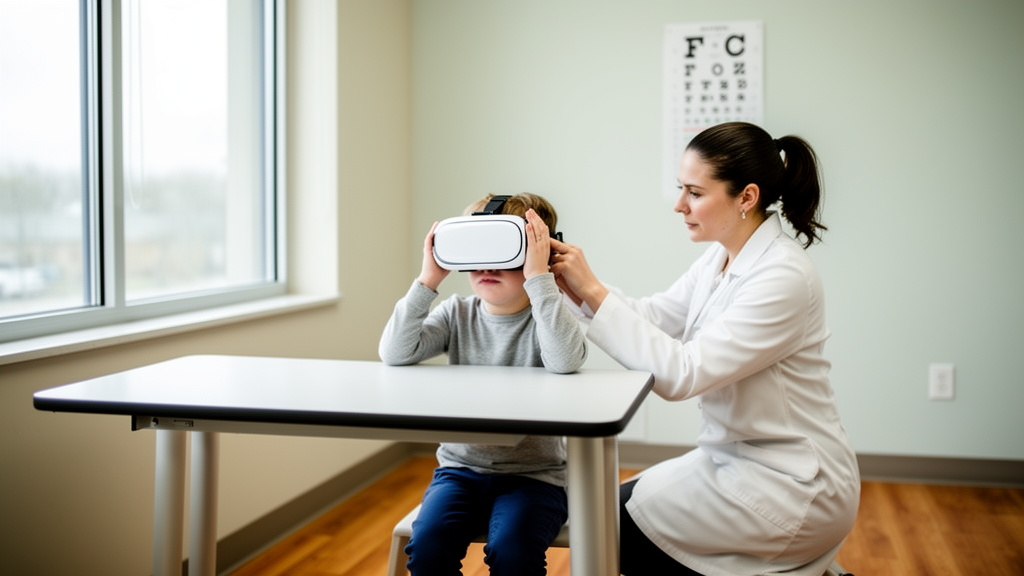
Virtual reality-based treatments for amblyopia, the childhood condition commonly known as lazy eye, are associated with measurable improvements in visual acuity and depth perception, according to a new systematic review and meta-analysis published in BMC Pediatrics. But the authors caution that the evidence base is too sparse and too biased to declare VR a proven alternative to patching. Amblyopia affects roughly 2 to 5 percent of children and is the leading cause of monocular visual impairment in childhood.
Standard treatments, including patching the stronger eye and atropine drops, work well for many children but are frequently undermined by poor adherence, particularly among school-age children who resist wearing an eye patch at school. The review, registered with PROSPERO, searched six databases including PubMed, EMBASE, Scopus, Web of Science, CINAHL Ultimate and CENTRAL for quantitative studies published between January 2012 and December 2025. The team assessed risk of bias using the Cochrane RoB 2 tool for randomized trials, ROBINS-I for non-randomized studies, and design-specific JBI appraisal checklists.
Nine studies met the inclusion criteria. Because the included studies differed substantially in comparators and treatment exposure, the researchers could not pool the key between-group comparison of best-corrected visual acuity, the standard measure of vision sharpness. The very high statistical heterogeneity, with an I² of 95 percent, signals that the individual studies varied widely in their reported changes.
Stereopsis, the ability to perceive depth from binocular vision, fared more consistently. Definitions of treatment success varied so much across studies that the authors declined to combine them at all. Adherence data offered one of the more striking findings, though from a single source.
In one mixed-age randomized trial in which the prescribed treatment burdens differed substantially between arms, children assigned to VR were far more likely to complete at least 75 percent of their prescribed treatment than children assigned to patching, with an odds ratio of 23.22 (95 percent confidence interval, 7.48 to 72.13). The authors stress this comes from a single trial with unequal prescribed doses, so it cannot be generalized. Safety reporting was another weak point.
The quality assessment was sobering. The authors conclude that while the exploratory pre-post syntheses show improvements in visual acuity and stereopsis over time following VR-based interventions, these non-comparative findings cannot establish treatment efficacy. They call for larger pediatric randomized trials with standardized visual outcomes, adherence measures and participant-level safety reporting before VR can be positioned as an evidence-backed option for children with amblyopia.
For now, the review functions less as an endorsement and more as a roadmap: the technology is engaging enough that children appear willing to use it, but the clinical community still lacks the rigorous comparative data needed to say whether that engagement translates into vision gains that match or exceed conventional occlusion therapy.
Subject of Research: Virtual reality-based binocular interventions for childhood amblyopia and their visual outcomes
Article Title: Virtual reality interventions for amblyopia: a systematic review with meta-analysis of visual outcomes
Article References: Huang, M., Huang, B., Weng, J., & Kwok, T. T.-O. (2026). Virtual reality interventions for amblyopia: a systematic review with meta-analysis of visual outcomes. BMC Pediatrics. https://doi.org/10.1186/s12887-026-07880-6
Image Credits: AI Generated
DOI: 10.1186/s12887-026-07880-6
Keywords: amblyopia, virtual reality, pediatrics, visual acuity, stereopsis, systematic review, meta-analysis, adherence, patching, binocular treatment, risk of bias, BMC Pediatrics
Cite Scienmag News
Ophelia Keating. (October 26, 2026). Virtual Reality Shows Early Promise for Amblyopia, But Evidence Remains Thin. Scienmag. https://scienmag.com/virtual-reality-shows-early-promise-for-amblyopia-but-evidence-remains-thin/
Ophelia Keating. "Virtual Reality Shows Early Promise for Amblyopia, But Evidence Remains Thin." Scienmag, 26 October 2026, https://scienmag.com/virtual-reality-shows-early-promise-for-amblyopia-but-evidence-remains-thin/. Accessed 26 October 2026.
Ophelia Keating. "Virtual Reality Shows Early Promise for Amblyopia, But Evidence Remains Thin." Scienmag. October 26, 2026. https://scienmag.com/virtual-reality-shows-early-promise-for-amblyopia-but-evidence-remains-thin/


