


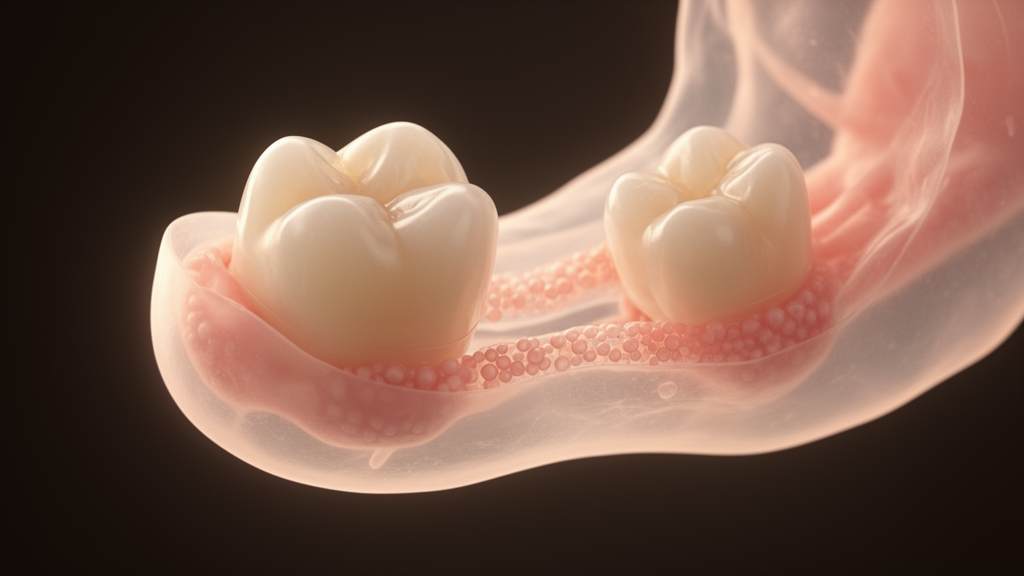
Long before a tooth bud becomes visible, an embryo must already decide where teeth will form. A new study in mice, published in Science China Life Sciences, shows that the upper and lower molars do not begin as independent structures. Instead, they emerge from a single shared molar-forming region on each side of the developing face, which only later divides into two separate domains. The international team includes researchers from Fujian Normal University, King’s College London, the Czech Academy of Sciences and Tulane University. Rather than starting with a recognizable tooth bud, they examined the earlier events that establish how molars form, shifting attention from how a tooth grows to how its future position is laid out.
In mouse embryos, separate upper and lower molar germs, the developing structures that will form molar teeth, are recognizable by embryonic day 11.5, abbreviated E11.5. What happened before that point had remained unclear: did the two germs arise independently, or from a common precursor region? The team combined gene-expression mapping, genetic lineage tracing and tissue transplantation to answer the question. Their evidence supports a two-step model. A common molar primordium, the earliest molar-forming region, is present on each side by E9.0, then separates into upper and lower domains around E9.5 to E9.75.
Several lines of evidence converged on this conclusion. Genetic labeling followed early cells expressing the gene Fgf8 in the surface tissue of the first pharyngeal arch, an embryonic structure that contributes to the jaws. The descendants of these labeled cells contributed to both the upper and the lower molar germs, exactly what a shared origin would predict. In a complementary test, the researchers transplanted tissue from one side of the arch beneath a mouse kidney capsule, where it could continue developing. Grafts taken at E9.0 formed one molar, while grafts taken at E10.0 formed two, supporting the proposed transition from a shared primordium to separate molar-forming domains.
To probe what can disrupt this process, the team turned to a jaw-fusion model. These mice were engineered to produce excess BMP4, a developmental signaling protein, in cranial neural crest cells, the embryonic cell population that supplies much of the face’s skeletal and connective tissue. Instead of forming separate upper and lower molar germs, the mutants developed a single misplaced molar germ on each side at the junction of the fused jaws. The result mirrors a clinical puzzle: in people, jaw fusion and missing teeth can occur together in syngnathia, a rare condition in which the upper and lower jawbones are fused at birth, and this model offers a way to study whether the two defects share a mechanism.
Fluorescent dye tracking revealed the likely culprit: cell movement. In normal embryos, labeled neural crest-derived cells moved away from the junction toward both the upper and lower jaw regions, apparently helping to carve the shared primordium into two territories. In the mutants, this migration largely failed, with cells remaining near the labeling site. Importantly, the defect was not simply a loss of cells. Measurements of cell proliferation and cell death at this early stage showed no significant differences between the groups, pointing to disrupted movement rather than too few cells as the primary problem.
Molecular analyses then connected the cellular defect to a disturbed gene-regulatory network involving BMP4 and FGF8, together with excessive activity of p38, a signaling pathway inside cells. This connects the shared-origin model to a broader developmental question: how molecular signals coordinate cell movements to establish distinct organ-forming regions.
The most striking result came from a drug intervention. When the team tested the p38 inhibitor SB203580 during embryonic development, the outcome changed in a revealing way. Six of nine treated mutants developed separate upper and lower molar germs, yet the jawbone fusion persisted in all nine. This dissociation suggests that the dental and jawbone abnormalities can be separated mechanistically, rather than one being an inevitable consequence of the other.
For developmental biologists, the study adds a layer to a familiar theme: organ position is specified before organ form. The molar germs that dentists later recognize are, at E9.0, a single field whose boundaries have not yet been drawn. The separation of that field depends on choreographed cell movements within the first pharyngeal arch, and those movements depend in turn on a signaling balance that BMP4 dosage can tip. The findings offer a framework for investigating why jaw fusion and missing molars can occur together in people, by proposing that a failure to establish separate tooth-forming fields may underlie both.
The researchers are careful about the limits of the work. This is an animal study, and the small drug-intervention experiment is not evidence of a treatment for human syngnathia or missing teeth. Whether the same early separation process and molecular disruption occur in humans remains to be established. The SB203580 result is evidence of mechanism, not a therapy, and the authors do not present it as one.
Even so, the study reframes a familiar question. Understanding tooth formation, the authors argue, requires asking not only how a tooth grows once initiated, but how the embryo lays out the separate places where teeth are allowed to begin. In the case of the molars, that layout is achieved through a two-step process, a shared field first and a division second, and the division can fail when the signals guiding cell movement go astray.
Subject of Research: Developmental biology of tooth position specification in mouse embryos
Article Title: How upper and lower molars part ways before teeth take shape
Article References: How upper and lower molars part ways before teeth take shape. Original publication (Bibliographic details unavailable.)
Image Credits: AI Generated
DOI: Not provided
Keywords: molar development, tooth germs, cranial neural crest, BMP4, p38 signaling, jaw fusion, Fgf8, embryonic day 9.0, first pharyngeal arch, cell migration, syngnathia, mouse model
Cite Scienmag News
Juliet Wilcox. (October 26, 2026). Mouse study traces how upper and lower molars split from one shared origin. Scienmag. https://scienmag.com/mouse-study-traces-how-upper-and-lower-molars-split-from-one-shared-origin/
Juliet Wilcox. "Mouse study traces how upper and lower molars split from one shared origin." Scienmag, 26 October 2026, https://scienmag.com/mouse-study-traces-how-upper-and-lower-molars-split-from-one-shared-origin/. Accessed 26 October 2026.
Juliet Wilcox. "Mouse study traces how upper and lower molars split from one shared origin." Scienmag. October 26, 2026. https://scienmag.com/mouse-study-traces-how-upper-and-lower-molars-split-from-one-shared-origin/


