


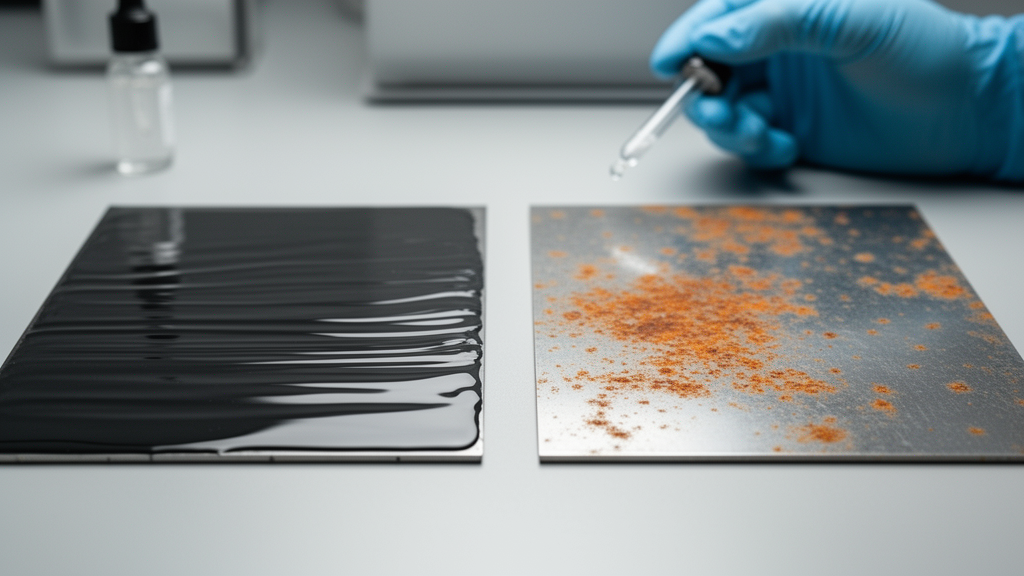
Corrosion quietly devours the world's steel infrastructure, and the coatings long used to stop it carry a dark legacy. Hexavalent chromium-based conversion coatings, the industry standard for decades, are toxic and carcinogenic, and they now face severe global environmental restrictions. A new open-access study published in the Journal of Materials Science: Polymers offers a striking alternative: a precisely sequenced bilayer coating of two conducting polymers, polyaniline and polypyrrole, electrodeposited on low-carbon steel.
The headline result is remarkable — the optimal layer ordering, PANI underneath and PPY on top, achieved a protection efficiency of 92.5 percent in a chloride-rich salt solution, with a corrosion rate reduction of 97.9 percent compared to bare steel. Even more intriguing, the study shows that the order in which the two polymers are deposited fundamentally dictates how the coating grows, how dense it becomes, and how well it ultimately performs. What makes conducting polymers special is that they do not merely sit on the metal like a static plastic wrapper.
Unlike conventional inert polymer binders, polyaniline (PANI) and polypyrrole (PPY) are electrically conductive and electrochemically active. They can passivate an underlying metal by continuously cycling through reversible redox reactions, holding the steel's potential within a stable passive regime where iron dissolution is suppressed. At the same time, they act as an intelligent molecular framework that can trap aggressive ingress anions or release dopant corrosion inhibitors.
This dynamic, active protection is exactly what low-carbon steel needs, because despite its mechanical strength and cost-effectiveness, steel is thermodynamically vulnerable to uniform dissolution and localized pitting in chloride-rich environments — the defining chemistry of seawater. Single-layer coatings, however, have stubborn practical flaws. PANI coatings on steel typically show poor mechanical adhesion and high brittleness, leading to microcracking and delamination.
PPY coatings adhere better to the substrate but tend to develop porous, cauliflower-like microstructures during rapid growth, which allows corrosive chloride ions to migrate through the film during prolonged exposure. The study's author, Pritee Raotole, tackled these weaknesses by stacking the two polymers into bilayer architectures — PANI/PPY and PPY/PANI — synthesized via a highly controllable galvanostatic route in aqueous oxalic acid at a constant current density of 0.66 mA cm⁻², with each layer grown for 2000 seconds in a conventional three-electrode cell using a saturated calomel reference and a platinum counter electrode. The most fascinating part of the work lies in the real-time growth transients.
During galvanostatic deposition, the researchers monitored potential–time (E–t) curves, which revealed three distinct stages for homopolymer growth on bare steel. First comes an induction period, during which the electrode potential stays negative while the steel dissolves locally in oxalic acid and precipitates a passive iron oxalate interphase (FeC₂O₄·2H₂O). The induction times measured 270 seconds for PANI and 140 seconds for PPY — the longer window for aniline indicating that it requires a wider passivation window and higher overpotential to nucleate stable clusters than pyrrole.
Second, the potential rises sharply as the surface achieves temporary passivation and monomer radicals reach critical supersaturation. Third, the potential stabilizes at a steady value — 1.30 V for PANI and 0.602 V for PPY — as the iron oxalate crystals decompose locally and continuous vertical electropolymerization begins. Ex-situ scanning electron microscopy confirmed what was happening during those early seconds.
After a targeted 100-second deposition, within the induction period, the steel surface was blanketed by a compact, continuous crystalline matrix of iron oxalate. The PANI system produced a dense bed of fine sub-micron crystalline aggregates, while the PPY sequence yielded coarser, elongated rod-like and prismatic crystal clusters. Either way, this widespread precipitation suppressed active anodic dissolution of the steel and established the stable, low-energy platform required for polymer nucleation.
When the second polymer layer was deposited on top of the first, the induction period vanished entirely. Both bilayer configurations reached a stable steady-state potential within seconds of applying the current. The explanation: the pre-deposited primary polymer acts as an effective electronic and physical matrix that isolates the reactive steel from the secondary monomer solution, suppressing further iron dissolution and oxalate precipitation.
The second layer therefore grows instantly via a direct polymer-on-polymer nucleation pathway, uninterrupted and low-defect. Even more telling, the steady-state potentials of the bilayers — 0.496 V for PANI/PPY and 1.47 V for PPY/PANI — closely mirror those of their respective outer homopolymer layers, showing that the outer polymer being deposited dictates the surface electrochemistry and charge-transfer resistance during growth. Structural and morphological analyses sealed the case.
Fourier-transform infrared spectroscopy in HATR mode confirmed successful bilayer formation, with reproducible minor band shifts of roughly ±4 cm⁻¹ revealing that the two polymer phases are not merely physically mixed but share strong intermolecular interactions — π-π stacking and hydrogen bonding — at their interface. These interactions reduce polymer free-volume, increase the tortuosity of the diffusion network, and strengthen interfacial adhesion, preventing lateral ion migration along internal layer boundaries. SEM micrographs exposed the sequence-dependent morphology in vivid detail.
Single-layer PANI displayed a spongy, non-uniform granular structure riddled with micro-voids that permit direct electrolyte pathing. Single-layer PPY showed its classic compact cauliflower morphology, uniform but laced with microscopic grain boundaries that trap chloride ions. The PPY/PANI bilayer formed a compact structure with smaller granular clusters, while the PANI/PPY bilayer exhibited a highly continuous, optimized granular overlay in which the secondary PPY layer effectively sealed the structural voids of the initial PANI matrix, cutting defect connectivity across the coating thickness.
The electrochemical verdict was unambiguous. In potentiodynamic polarization tests in 3% NaCl solution, conducted in triplicate with error analysis, all polymer coatings shifted the corrosion potential (Ecorr) in the noble, positive direction relative to bare steel. The magnitude followed a strict order: PANI at +197 mV, PPY at +213 mV, PPY/PANI at +239 mV, and PANI/PPY at +273 mV — the largest shift, driving the system into a stable passive region.
The noble shift came with a dramatic drop in corrosion current density from 18.00 to 0.55 A cm⁻², indicating severely retarded iron dissolution. Protection efficiency peaked at 92.5 percent for PANI/PPY, followed by 91.2 percent for PPY/PANI, decisively outperforming single-layer PPY at 81.7 percent and PANI at 79.6 percent. Corrosion rate reductions reached 97.9 percent for PANI/PPY and 96.7 percent for PPY/PANI.
Critically, the study ruled out thickness as an explanation. Using Faraday's law of electrolysis, the theoretical film thicknesses were calculated from total charge consumption — approximately 4.63 μm for PANI and 2.96 μm for PPY — giving both bilayer stacks an identical normalized total thickness of 7.59 μm. Since thickness and net charge input were perfectly cross-normalized between the two bilayer configurations, the superior performance of the PANI/PPY ordering must stem from intrinsic structural hierarchy rather than a thicker barrier.
The mechanism is cooperative and dual-action: the inner PANI layer, in its emeraldine salt form, acts as an active oxidizer that undergoes reversible redox cycling with the steel, maintaining the iron interface in a stable passive regime and promoting a protective oxide film, while the outer PPY layer, grown uninterrupted on this passivated surface, develops with extremely low defect density and presents a highly tortuous path that restricts mass transport of water, dissolved oxygen, and aggressive chloride ions toward the metal interface. Reversed, the inner PPY provides a slightly lower doping response and the outer PANI exhibits more microstructural voids, allowing higher localized hydration. The implications reach far beyond the laboratory bench.
The author identifies marine splash zones, tidal fluctuations, and full seawater immersion as prime targets, alongside coastal power plants and desalination facilities handling concentrated saline fluids, vessel hulls and ballast water tanks in shipping, and smart, non-toxic replacements for hexavalent chromium passivants that bypass severe environmental restrictions while matching or exceeding traditional performance.
Subject of Research: Enhanced corrosion protection of low-carbon steel using electrochemically synthesized polyaniline and polypyrrole bilayer coatings
Article Title: Enhanced corrosion protection of low-carbon steel using electrochemically synthesized polyaniline and polypyrrole bilayer coatings
Article References: Raotole, P. (2026). Enhanced corrosion protection of low-carbon steel using electrochemically synthesized polyaniline and polypyrrole bilayer coatings. Journal of Materials Science: Polymers, 1(1), 27. https://doi.org/10.1007/s44493-026-00027-0
Image Credits: AI Generated
DOI: 10.1007/s44493-026-00027-0
Keywords: Enhanced, corrosion, protection, low-carbon, steel, electrochemically, synthesized, polyaniline, polypyrrole, bilayer, coatings, scientific research
Cite Scienmag News
Neil Sanderson. (October 26, 2026). Bilayer conducting polymer coatings deliver chromate-free corrosion shield for steel. Scienmag. https://scienmag.com/bilayer-conducting-polymer-coatings-deliver-chromate-free-corrosion-shield-for-steel/
Neil Sanderson. "Bilayer conducting polymer coatings deliver chromate-free corrosion shield for steel." Scienmag, 26 October 2026, https://scienmag.com/bilayer-conducting-polymer-coatings-deliver-chromate-free-corrosion-shield-for-steel/. Accessed 26 October 2026.
Neil Sanderson. "Bilayer conducting polymer coatings deliver chromate-free corrosion shield for steel." Scienmag. October 26, 2026. https://scienmag.com/bilayer-conducting-polymer-coatings-deliver-chromate-free-corrosion-shield-for-steel/


