


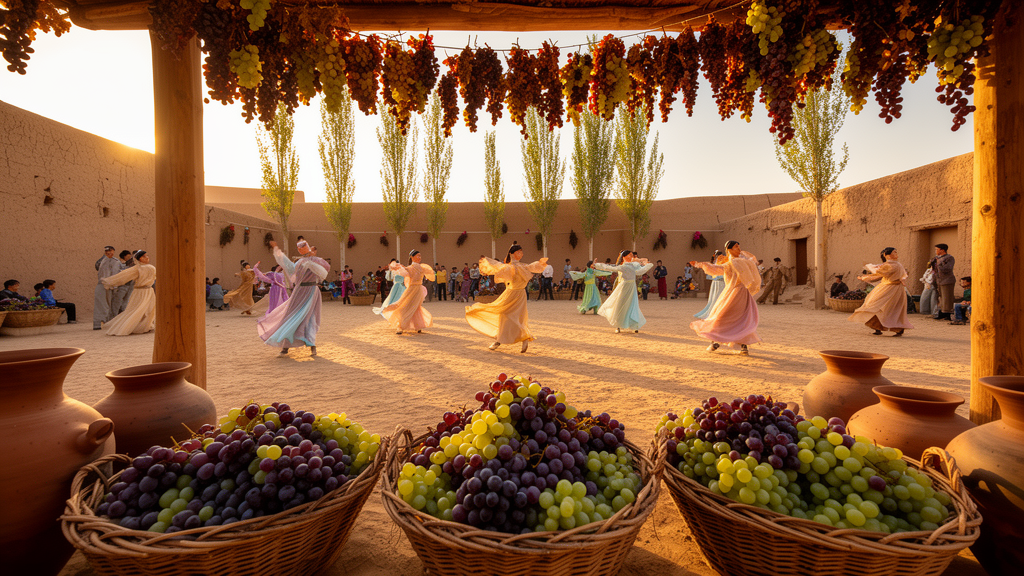
A grape harvest worshipping festival held in medieval Dunhuang may preserve distant echoes of ancient Greek Dionysian ritual, according to a study published in Humanities and Social Sciences Communications. The research examines the Grape Harvest Worshipping Festival, which flourished under the Tang Dynasty’s Guiyi Army regime, and argues that this local celebration of agricultural abundance represents a localized rearticulation of Dionysian symbolism within China’s own agrarian and cosmological framework.
The research team, led by Hongjuan Zhao with colleagues including Mark Bender and Shijia Wang, drew on three complementary lines of evidence: Dunhuang manuscripts, visual iconography, and comparative ritual analysis. During China’s medieval period, spanning the Wei through Song dynasties, the Silk Road enabled intense cultural exchange, and Dunhuang stood at a key crossroads of that traffic. The authors propose that Dionysian practices associated with grapes and harvest celebration may have traveled eastward, possibly carried by Sogdian intermediaries who were prominent traders and cultural brokers along the route.
Importantly, the study frames the festival not as a simple import but as a process of transformation. By engaging recent scholarship on ritual hybridization, transculturation, and symbolic translation, the researchers situate Dunhuang’s ritual culture within a broader matrix of Silk Road exchanges, in which foreign symbols were absorbed and reworked to fit Chinese cosmological ideas and local agricultural concerns. The festival’s focus on ritual worship of grapes and prayers for abundance, in this reading, reflects both the Greek wine-god tradition and distinctly Chinese patterns of agrarian devotion.
The authors present this as an interpretive argument rather than a demonstrated chain of transmission. The wording of the study itself is cautious, stating that the festival “appears to reflect distant resonances” of Dionysian practice and that transmission “possibly” occurred through Sogdian mediation. As an open-access article released ahead of final version-of-record edits, the work invites further comparison with textual and material evidence from along the Silk Road. If the argument holds, it would add a striking example to the documented history of how Greek religious imagery traveled thousands of kilometers east, surviving in mutated form at a desert oasis where viticulture, state authority, and ritual life converged under the Guiyi Army.
Subject of Research: Cultural transmission of Dionysian ritual symbolism to Dunhuang's medieval Grape Harvest Worshipping Festival
Article Title: Dionysus in China: cultural transmission and transformation in Dunhuang’s Grape Harvest Worshipping Festival
Article References: Zhao, H., Bender, M., Yang, F., Wu, S., Jiang, M., & Wang, S. (2026). Dionysus in China: cultural transmission and transformation in Dunhuang’s Grape Harvest Worshipping Festival. Humanities and Social Sciences Communications. https://doi.org/10.1057/s41599-026-09548-z
Image Credits: AI Generated
DOI: 10.1057/s41599-026-09548-z
Keywords: Dunhuang, Silk Road, Dionysus, grape harvest festival, cultural transmission, Sogdians, Tang Dynasty, Guiyi Army, ritual hybridization, Dunhuang manuscripts, iconography, medieval China
Cite Scienmag News
Courtney Benton. (October 26, 2026). Dunhuang grape festival may echo Dionysian rites carried along the Silk Road. Scienmag. https://scienmag.com/dunhuang-grape-festival-may-echo-dionysian-rites-carried-along-the-silk-road/
Courtney Benton. "Dunhuang grape festival may echo Dionysian rites carried along the Silk Road." Scienmag, 26 October 2026, https://scienmag.com/dunhuang-grape-festival-may-echo-dionysian-rites-carried-along-the-silk-road/. Accessed 26 October 2026.
Courtney Benton. "Dunhuang grape festival may echo Dionysian rites carried along the Silk Road." Scienmag. October 26, 2026. https://scienmag.com/dunhuang-grape-festival-may-echo-dionysian-rites-carried-along-the-silk-road/


