


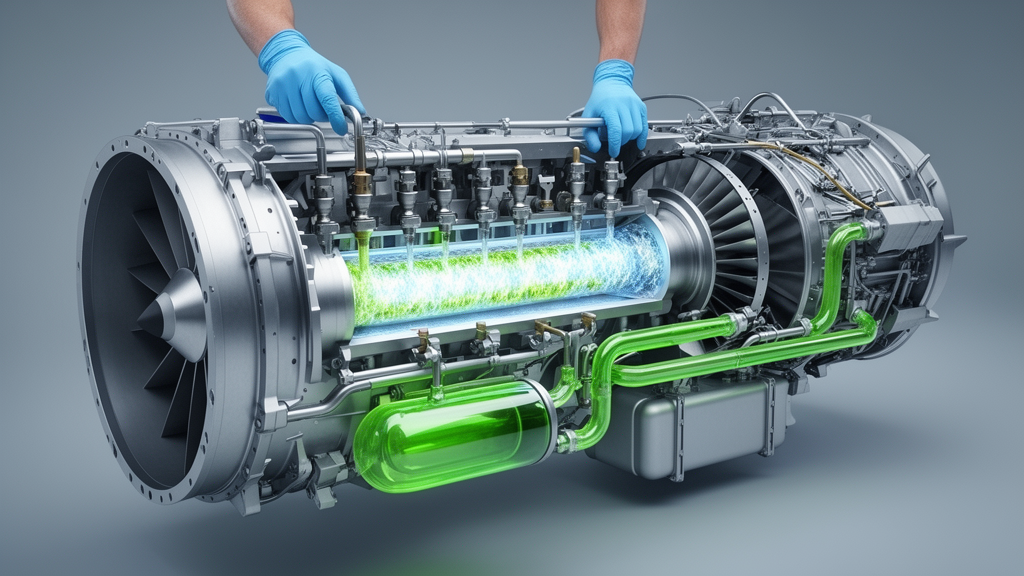
Hydrogen combustion is the only propulsion-level technology available today that can deliver zero carbon dioxide emissions in aviation, yet most research still treats it as a clean-sheet design problem. A new study from Lufthansa Technik’s Corporate Research and Innovation division in Hamburg flips that premise on its head. Engineers Lucia Menke and Lothar Kerschgens asked whether an existing, serially produced gas turbine could be converted to burn hydrogen with only minimal hardware changes, and whether such a retrofit could operate safely within a realistic laboratory infrastructure. Their answer, published in Frontiers in Mechanical Engineering, is a cautious but encouraging yes, delivered through a zero-dimensional thermodynamic model of an auxiliary power unit embedded in the Hydrogen Aviation Lab, a test facility for system-level hydrogen utilization in aircraft.
The Hydrogen Aviation Lab defines the physical and economic boundary conditions that anchor the entire analysis. The study assumes a feasible hydrogen fuel consumption rate supported by a 14-kilogram storage tank, a fuel system operating pressure of roughly 10 bar, and gaseous hydrogen supplied at a cryogenic temperature of approximately 100 K. These constraints ensure the results reflect realistic operational parameters rather than idealized assumptions, and they immediately point toward a small engine. The researchers selected the APS3200 auxiliary power unit, originally developed by Hamilton Sundstrand and used on the Airbus A320, as their demonstrator. Its small dimensions suit a limited hydrogen supply, and its modular structure provides assembly space for a fuel system, combustion chamber, and nozzles, making it an appropriate platform for evaluating hydrogen combustion under practical conditions.
The methodological heart of the paper is a deceptively simple idea: the fuel-to-air ratio, or FAR, is treated as a unified control parameter that governs combustion stability, turbine entry temperature, and operational safety simultaneously. Rather than solving three separate design problems, the engineers show that a single dimensionless quantity can track proximity to flame blowout, adiabatic flame temperature, and flame length all at once. This reduces model complexity while preserving physical validity, and it is particularly powerful in a retrofit context where the combustion chamber geometry and turbine architecture remain fixed. The retrofit scenario deliberately avoids a full redesign of the combustion system, working within existing hardware constraints and making only the changes strictly necessary to enable hydrogen operation.
To establish a trustworthy baseline, the team first calculated the complete thermodynamic cycle of the gas turbine burning kerosene. The simulation was built on maintenance test records from a serial-produced APS3200 without additional instrumentation, using MATLAB 2021a under quasi-steady state flow, ideal gas behavior, adiabatic compression, and standard ambient conditions. The numerical inputs are telling: kerosene has a lower heating value of 43.1 MJ/kg, the compressor operates at a pressure ratio of 8 with an outlet temperature of 623.15 K, total air mass flow is fixed at 2.2 kg/s, and the kerosene fuel mass flow is 0.0412 kg/s at a FAR of 0.02222. The turbine entry temperature target is 1,293.15 K, fixed through APU design and material constraints. For kerosene operation, the iteration identified a dilution air fraction of 34.658 percent, meaning that roughly a third of the compressor discharge air bypasses the primary combustion zone and is introduced downstream to dilute the hot gases before they reach the turbine.
The combustion chamber itself is a study in fluid mechanical elegance. In the primary zone, the nozzle induces a vortex swirl that mixes the liquid kerosene spray with 20 percent of the oxygen-rich air, while swirl vanes create a low-pressure recirculation zone along the chamber axis. This recirculated hot reaction mixture provides a continuous ignition source, stabilizing the flame and enabling continuous combustion. In the dilution zone, colder compressor air regulates the gas temperature down to the turbine entry temperature, and a cooling air film around the flame tube and liner protects the material from thermal stress. Because the model lacked sufficient datapoints to construct compressor or turbine maps, the outputs were compared against manufacturer data and literature values for plausibility rather than fully quantitatively validated, a limitation the authors explicitly acknowledge and flag as a priority for future experimental work.
Hydrogen changes the combustion physics fundamentally. Its specific energy density of 120 MJ/kg is nearly three times that of kerosene, so the fuel mass flow required for equivalent thermal output is far lower. Hydrogen also possesses a high flame speed, low ignition energy, and a remarkably wide flammability range in air, stretching from a lean blowout limit of 0.24 to a rich extinction limit of 6.8 in equivalence ratio terms. That breadth is advantageous for ignition but dangerous near the lean edge, where a small disturbance in fuel supply can extinguish the flame. High flame speeds also create a flashback risk whenever the flame propagates faster than the main gas path velocity, which is why the authors call for comprehensive computational fluid dynamics analysis when designing the retrofit nozzle. Notably, the hydrogen design abandons the kerosene-style recirculation of oxygen-rich air; instead, the airflow is repurposed as a diluting mass flow to bring the turbine entry temperature down.
The hydrogen cycle model captures three effects explicitly. First, hydrogen enters the combustor at 100 K, well below ambient conditions, so the sensible heat required to warm the fuel before reaction is not negligible relative to its low mass flow; the enthalpy bookkeeping decomposes the primary-zone process into warming from 100 K to a reference temperature, heat release at that reference state, and warming of the product stream to the combustion temperature, each evaluated with species- and temperature-appropriate specific heat values. Second, hydrogen converts completely to water vapor, and while the small water vapor amount in the turbine is neglected, the different specific heat values of the products are retained. Third, air properties differ meaningfully between the compressor discharge state and the reference state at which the fuel’s lower heating value is defined. For the hydrogen-air mixture, property data were extracted from the NIST collection, with fixed specific heat values adopted at 10 bar and 2,300 K as a representative combustion condition, a simplification acknowledged as a limitation of the preliminary analysis.
The headline result emerges from an iterative procedure that adjusts the dilution air fraction until the mixed outlet temperature converges on the target turbine entry temperature of 1,293.15 K. At the design point representative of an auxiliary power unit, a FAR of 0.016173 enables safe and stable hydrogen combustion, corresponding to a hydrogen mass flow of 0.016006 kg/s. This suggests an equivalence ratio of 0.24737, sitting just above the lean blowout limit of 0.24 and therefore within the margin for consistent and safe hydrogen combustion, though deliberately lean. To condition the combustion gases to the target temperature, a dilution air fraction of 55.012 percent, corresponding to an air mass flow of 2.2 kg/s with 1.21 kg/s of dilution air, was identified. The higher dilution fraction compared to kerosene reflects the hotter primary-zone combustion, which reaches approximately 2,765 K. The model also enforces a power balance between turbine output and compressor demand, keeping the operating point self-consistent, and imposes a conservative air mass flow limit of 2.2 kg/s to avoid compressor surge, a safety risk amplified by hydrogen’s high reactivity.
The authors are candid about what the study does and does not cover. Nitrogen oxide emissions were deliberately excluded as outside the defined system boundary, even though thermal NO forms through the Zeldovich mechanism above 1,850 K when atmospheric nitrogen and oxygen react, and NOx production depends on reactant retention time and fuel-oxidizer mixing rates. Combustion efficiency was assumed at nearly perfect 99 percent for hydrogen based on its high flammability, against a conservative 95 percent estimate for kerosene, and perfect mixing was assumed given hydrogen’s wide flammability range. Several subsystems, including the electronic control unit, were treated as black boxes. In their conclusion, the engineers report that a hydrogen mass flow of 0.047048 kg/s would not exceed the gas turbine design point, ensuring a margin below the surge limit, and that equivalent thermal performance is achievable with hydrogen but only upon rebalancing fuel metering and cooling management. Their verdict is precise: retrofitting for hydrogen is not a drop-in replacement. It requires targeted modifications in combustor design and control strategy, and the simulation framework presented here provides the foundation for the CFD refinement and experimental validation that must follow before hydrogen aviation infrastructure can move from the lab to the flight line.
Subject of Research: Hydrogen combustion retrofit feasibility analysis of an aircraft auxiliary power unit
Article Title: Retrofitting the Hydrogen Aviation Lab for hydrogen combustion: a thermodynamic analysis
Article References: Menke, L., & Kerschgens, L. (2026). Retrofitting the Hydrogen Aviation Lab for hydrogen combustion: a thermodynamic analysis. Frontiers in Mechanical Engineering, 12, Article 1869973. https://doi.org/10.3389/fmech.2026.1869973
Image Credits: AI Generated
DOI: 10.3389/fmech.2026.1869973
Keywords: hydrogen combustion, aviation, gas turbine, retrofitting, thermodynamics, auxiliary power unit, Hydrogen, combustion, thermodynamic, analysis, scientific research
Cite Scienmag News
Denise Maddox. (October 26, 2026). Hydrogen combustion retrofitted into an existing aircraft APU: thermodynamic feasibility. Scienmag. https://scienmag.com/hydrogen-combustion-retrofitted-into-an-existing-aircraft-apu-thermodynamic-feasibility/
Denise Maddox. "Hydrogen combustion retrofitted into an existing aircraft APU: thermodynamic feasibility." Scienmag, 26 October 2026, https://scienmag.com/hydrogen-combustion-retrofitted-into-an-existing-aircraft-apu-thermodynamic-feasibility/. Accessed 26 October 2026.
Denise Maddox. "Hydrogen combustion retrofitted into an existing aircraft APU: thermodynamic feasibility." Scienmag. October 26, 2026. https://scienmag.com/hydrogen-combustion-retrofitted-into-an-existing-aircraft-apu-thermodynamic-feasibility/


