


When a peripheral nerve is severed, surgeons have long faced a stubborn set of odds: the longer the gap between the cut ends, the longer the delay before repair, and the older the patient, the less likely meaningful function will return. A new case series now reports that filling a collagen tube with a specially prepared platelet-rich plasma restored meaningful sensation in 70 percent of repaired nerves and meaningful motor function in 40 percent, even though every patient in the study had two or three of the factors that normally restrict recovery simultaneously elevated. The findings, published in Frontiers in Bioengineering and Biotechnology, come from a small, uncontrolled, non-blinded series of eight male patients with ten repaired upper-extremity nerves, but they describe repairs carried out under conditions in which autografts, the surgical gold standard, are generally considered far less effective.
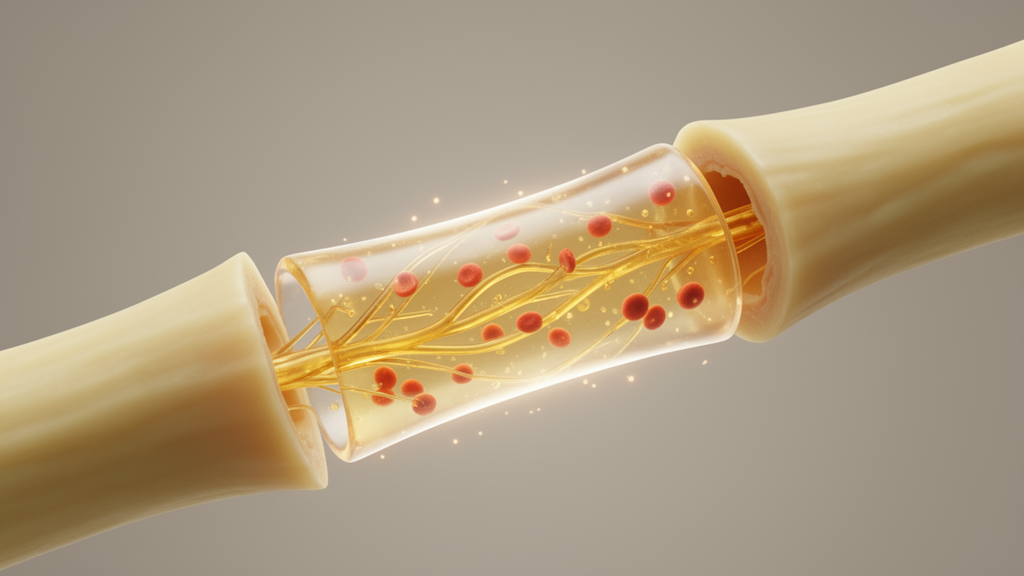
The technique at the center of the report is deliberately simple in concept. Rather than harvesting a healthy sensory nerve from elsewhere in the patient's body to bridge the gap, the surgeons inserted the injured nerve stumps one to two millimeters into a collagen tube and filled the tube with platelet-rich plasma drawn from the patient's own blood. The plasma was separated from 55 milliliters of whole blood using a centrifuge-based system, and six milliliters of the concentrate were injected into the tube together with thrombin.
Within about twenty seconds, the thrombin polymerized the liquid plasma's fibrin into a viscoelastic matrix scaffold, after which the incision was closed. No sutures were used to hold the nerve ends in the tube. What makes the plasma in this study novel is its composition and concentration.
The separation system used, the Zimmer Biomet GPS III, increases the platelet concentration 9.3-fold, which the authors note is several-fold higher than in most published studies, and increases the leukocyte concentration five-fold. They cite prior animal work suggesting that higher platelet concentrations are associated with greater efficacy, and evidence that leukocyte-rich preparations induce more extensive axon regeneration than leukocyte-poor ones. The collagen tube itself, they add, has been shown in rat studies to enhance the effect of platelet-rich plasma.
Before commercially approved tubes became available, the team sewed FDA-approved collagen sheets around a surgical instrument handle to form tubes long enough to bridge gaps up to roughly 7.6 to 7.8 centimeters; later cases used manufactured NeuroMend collagen tubes. The eight patients in the series had suffered traumatic nerve injuries, and the authors deliberately selected cases in which at least one of the three variables known to restrict recovery was already outside the range where conventional repairs tend to succeed. Nerve gaps ranged from 2 to 12 centimeters, with a mean of 6.0 centimeters; repair delays ranged from 0.1 to 3.25 years, with a mean of one year; and patient ages ranged from 18 to 58, with a mean of 36.7 years.
Twenty-two percent of repairs had two of these variables simultaneously large and 78 percent had all three. Half the injuries were caused by gunshot wounds, which the authors note produce not only direct nerve trauma but also indirect damage from heat, shock waves, and cavitation, extending the zone of scarring well beyond the visible cut ends. Before repairing, the surgeons trimmed at least four millimeters from each nerve stump beyond the point where healthy fascicles were visible under the operating microscope, a step intended to remove scar tissue that could obstruct regeneration.
Follow-up combined physical examination with electrodiagnostic testing, though patient noncompliance meant that not all exams could be performed at the planned six- and twelve-month intervals. To keep the analysis consistent, the same clinicians examined all subjects within a two-month window, resulting in recovery times of ten months to 17.8 years, with a mean of 13.3 years. Sensation was assessed with eight different types of stimuli: light touch, pinprick, pressure using Semmes-Weinstein monofilaments, vibration, heat, cold, proprioception, and static two-point discrimination measured with a Disk-Criminator, where a value of 15 millimeters or less corresponds to grade S3+.
Motor recovery was graded on the modified British Medical Research Council scale from M0 to M5, with meaningful recovery defined as M3 or better. Nerve conduction studies and electromyography provided objective confirmation of whether axons had crossed the repair. The electrodiagnostic results showed that electrical stimulation of each repaired nerve proximal to the repair site evoked sensory nerve action potentials recorded distally, indicating that some axons of every nerve had regenerated entirely across the gap.
The evoked responses had prolonged onset latencies that decreased over time, with normal conduction velocities and amplitudes. Needle electromyography of resting reinnervated muscle, however, recorded fibrillations, denervation potentials, and positive sharp waves, and motor unit action potentials showed increased phases compatible with partial reinnervation. This pattern indicates that although axons reached and reinnervated the denervated muscles, the repaired nerves had suffered substantial axonal loss, and most patients showed incomplete muscle recruitment.
The authors note that this supports the well-established observation that reinnervation does not correlate tightly with meaningful functional recovery. The functional outcomes were nonetheless striking given the adverse conditions. Meaningful sensory recovery of grade S3 or better was achieved in 70 percent of the nerves, with a mean sensory recovery of S3.
Every nerve that recovered meaningful sensation responded to between four and eight of the eight applied stimulus types, with a mean of five modalities. Static two-point discrimination of 15 millimeters or less was achieved in 70 percent of the nerves, with 10 percent of observations reaching 2 to 6 millimeters, 60 percent reaching 7 to 15 millimeters, and 30 percent at 16 millimeters or worse. On the motor side, the median recovery was M2, and four of the ten nerve repairs, or 40 percent, achieved meaningful motor recovery of M3 or better.
Notably, 56 percent of the nerves injured by gunshot wounds recovered meaningful sensory and motor function, which the authors describe as greater than anticipated and attribute in part to the more extensive trimming of the nerve stumps. The authors attempted to quantify how gap length, delay, and age influenced recovery, but the analysis remained exploratory. With only eight patients and ten nerves, a multivariable model with three predictors could not be reliably estimated even with bootstrap confidence intervals based on 2,000 resamples.
The sensory recovery model explained approximately 46 percent of the observed variability but was not statistically significant, and increasing age showed the strongest negative association. The motor recovery model explained about 19 percent of the variability, with repair delay and age showing negative associations, but none of the coefficients were statistically significant and the confidence intervals remained wide. The authors therefore present these findings as hypothesis-generating rather than confirmatory, and they caution against drawing conclusions about which injury types or variables benefit most.
The authors also address why platelet-rich plasma has produced inconsistent results across the wider literature. Preparations made with different devices vary enormously, with platelet concentrations differing by up to ten-fold depending on centrifugal force, acceleration, speed, and duration, and with differences in platelet activation, pH, glucose concentration, leukocyte content, and delivery method. Even with the same separation method, effects vary with application duration and frequency.
They hypothesize that their preparation's higher platelet and leukocyte concentrations, higher content of bioactive factors, and the surrounding collagen tube explain its greater efficacy, while emphasizing that the study was not designed to determine mechanism. They also note that this same preparation, applied to nerves evoking chronic neuropathic pain, reliably eliminated that pain in all patients in their earlier work. The authors conclude that bridging nerve gaps with this novel platelet-rich plasma within a collagen tube induced meaningful sensory and motor recovery under conditions where autograft efficacy is generally significantly reduced or absent, and that the technique avoids sacrificing a healthy sensory nerve.
No patient suffered any post-operative complication or adverse event, including infections. They are explicit about the limitations: the series was small, uncontrolled, and non-blinded, making it impossible to reliably compare efficacy across nerve types or trauma etiologies or to assess whether efficacy declines with increasing gap length, delay, or age, and the wide range of intervals between injury and electrophysiological testing may limit generalization of those results. The results, they write, must be validated in a larger, controlled, blinded study before the technique can be considered for wider clinical use.
Subject of Research: Platelet-rich plasma-filled collagen tubes for repairing long peripheral nerve gaps with long repair delays in older patients
Article Title: A novel platelet-rich plasma-filled collagen tube reliably clinically restores meaningful sensory and motor function despite simultaneous long nerve gaps, long repair delays, and increasing age: a case series
Article References: Kuffler, D. P., Sosa, I. J., Reyes, O., & Foy, C. A. (2026). A novel platelet-rich plasma-filled collagen tube reliably clinically restores meaningful sensory and motor function despite simultaneous long nerve gaps, long repair delays, and increasing age: a case series. Frontiers in Bioengineering and Biotechnology, 14, Article 1900300. https://doi.org/10.3389/fbioe.2026.1900300
Image Credits: AI Generated
DOI: 10.3389/fbioe.2026.1900300
Keywords: peripheral nerve repair, platelet-rich plasma, collagen tube, nerve regeneration, autograft, case series, sensory recovery, motor recovery, gunshot injuries, electrodiagnostics, tissue engineering, neurosurgery
Cite Scienmag News
Denise Maddox. (October 26, 2026). Platelet-Rich Plasma in Collagen Tubes Restores Nerve Function in Difficult Cases. Scienmag. https://scienmag.com/platelet-rich-plasma-in-collagen-tubes-restores-nerve-function-in-difficult-cases/
Denise Maddox. "Platelet-Rich Plasma in Collagen Tubes Restores Nerve Function in Difficult Cases." Scienmag, 26 October 2026, https://scienmag.com/platelet-rich-plasma-in-collagen-tubes-restores-nerve-function-in-difficult-cases/. Accessed 26 October 2026.
Denise Maddox. "Platelet-Rich Plasma in Collagen Tubes Restores Nerve Function in Difficult Cases." Scienmag. October 26, 2026. https://scienmag.com/platelet-rich-plasma-in-collagen-tubes-restores-nerve-function-in-difficult-cases/


