
Monday, October 26, 2026
Science
No Result
View All Result
  • Login
  • HOME
  • SCIENCE NEWS
  • CONTACT US
  • HOME
  • SCIENCE NEWS
  • CONTACT US
No Result
View All Result
Scienmag
No Result
View All Result
Home Science News

24-hour movement compositions linked to social-emotional function in young children

October 26, 2026
in Science News
Ella Mckenzie
By Ella Mckenzie Scienmag Editorial Profile - Child Mental Health
Reading Time: 2 mins read
0
24-hour movement compositions linked to social-emotional function in young children

24-hour movement compositions linked to social-emotional function in young children

65
SHARES
587
VIEWS
Share on FacebookShare on Twitter
ADVERTISEMENT

A cross-sectional analysis of 2,060 children found that the balance of sleep, sedentary behaviour, light physical activity and moderate-to-vigorous physical activity across 24 hours was associated with more favourable social-emotional functioning. Estimated compositions associated with the most desirable combined questionnaire scores included more total physical activity and moderate-to-vigorous physical activity than the minimum levels specified in current 24-hour movement guidelines. The study used data from the Sleep and Activity Database for the Early Years study.

Its population comprised 560 children aged 1.2–2.9 years and 1,500 children aged 3.0–4.9 years. Sedentary behaviour, light physical activity and moderate-to-vigorous physical activity were measured with ActiGraph accelerometers, while parents reported their children’s sleep duration. Researchers assessed social-emotional functioning through the five domains of the Strengths and Difficulties Questionnaire: emotional problems, conduct problems, hyperactivity, peer problems and prosocial behaviour.

They applied compositional data analysis to estimate the 24-hour movement-behaviour compositions associated with optimal scores for each domain and for all five domains combined, a condition termed the “Goldilocks day.” The movement-behaviour composition was significantly associated with every domain, with all reported p-values below .01. For children aged one to two years, the estimated composition associated with the most desirable combined scores consisted of 12 hours 12 minutes of sleep, 4 hours 36 minutes of sedentary behaviour, 5 hours 48 minutes of light physical activity and 1 hour 24 minutes of moderate-to-vigorous physical activity. For children aged three to four years, the corresponding estimates were 12 hours 8 minutes of sleep, 4 hours 27 minutes of sedentary behaviour, 5 hours 49 minutes of light physical activity and 1 hour 36 minutes of moderate-to-vigorous physical activity.

These are model-based compositions associated with questionnaire outcomes, not descriptions of how long children with the most desirable scores actually moved or rested. The authors explicitly stated that the results should not be interpreted as behavioural recommendations, describing them instead as movement-behaviour patterns associated with more favourable outcomes within the study population.

Subject of Research: Associations between 24-hour movement-behaviour composition and social-emotional functioning in children aged one to four years

Article Title: 24-hour movement behaviour composition associated with desired social-emotional functioning in the early years

Article References: Zahran, S., Cliff, D. P., Antczak, D., Aadland, E., Anam, E. A., Aadland, K. N., Burley, J., Draper, C. E., Dumuid, D., Santos Silva, D. A., van Sluijs, E. M. F., Christian, H., Tremblay, M. S., Olds, T. S., Santos, R., Zhang, Z., & Janssen, I. (2026). 24-hour movement behaviour composition associated with desired social-emotional functioning in the early years. PLOS One, 21(10), e0361046. https://doi.org/10.1371/journal.pone.0361046

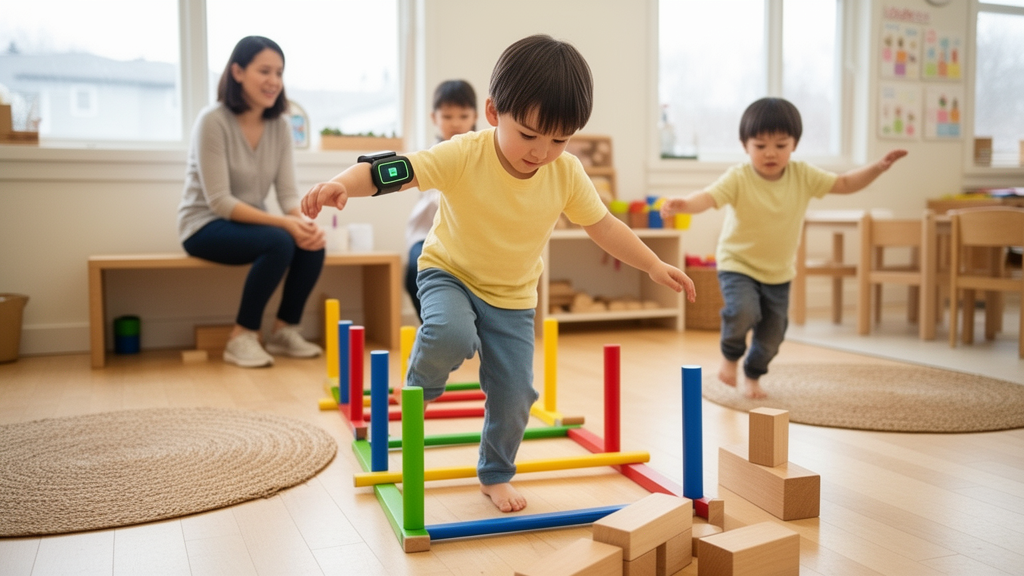
Image Credits: AI Generated

DOI: 10.1371/journal.pone.0361046

Keywords: young children, 24-hour movement, sleep duration, sedentary behaviour, physical activity, social-emotional function, accelerometry, compositional analysis, movement guidelines, Strengths and Difficulties Questionnaire, hour, movement

Cite Scienmag News

Ella Mckenzie. (October 26, 2026). 24-hour movement compositions linked to social-emotional function in young children. Scienmag. https://scienmag.com/24-hour-movement-compositions-linked-to-social-emotional-function-in-young-children/


Ella Mckenzie. "24-hour movement compositions linked to social-emotional function in young children." Scienmag, 26 October 2026, https://scienmag.com/24-hour-movement-compositions-linked-to-social-emotional-function-in-young-children/. Accessed 26 October 2026.

Ella Mckenzie. "24-hour movement compositions linked to social-emotional function in young children." Scienmag. October 26, 2026. https://scienmag.com/24-hour-movement-compositions-linked-to-social-emotional-function-in-young-children/

Tags: 24-hour movement24-hour movement guidelines for young childrenaccelerometer measurement of young children's activity levelsaccelerometryassociations between movement behaviors and emotional well-beingcompositional analysiscompositional data analysis in child health studiesearly childhood physical activity and behavioural outcomeshourimpact of physical activity on child mental healthmovementmovement guidelinesoptimal daily movement compositions for preschool-aged childrenparent-reported sleep duration and social-emotional functionPhysical activityrole of moderate-to-vigorous physical activity in socialsedentary behavioursleep and sedentary behaviour in preschoolerssleep durationsocial-emotional development in early childhoodsocial-emotional functionStrengths and Difficulties Questionnaireyoung children
Share26Tweet16
Previous Post

Systematic review finds 12 transference assessment tools, only two patient-based

Next Post

Antimicrobial prescribing varied widely across Middle Eastern hospitals

Related Posts

Swedish clinical supervisors improvised across professions, qualitative study finds
Science Education

Swedish clinical supervisors improvised across professions, qualitative study finds

October 26, 2026
ASTRO guideline maps radiation therapy roles in bladder cancer
Cancer

ASTRO guideline maps radiation therapy roles in bladder cancer

October 26, 2026
Antimicrobial prescribing varied widely across Middle Eastern hospitals
Medicine

Antimicrobial prescribing varied widely across Middle Eastern hospitals

October 26, 2026
Systematic review finds 12 transference assessment tools, only two patient-based
Psychology & Psychiatry

Systematic review finds 12 transference assessment tools, only two patient-based

October 26, 2026
LLaMA-CLIP fusion improves multimodal digital-human interaction benchmarks
Technology and Engineering

LLaMA-CLIP fusion improves multimodal digital-human interaction benchmarks

October 26, 2026
Dual-strain bacteria and nano-NPK boost sugar beet yields
Agriculture

Dual-strain bacteria and nano-NPK boost sugar beet yields

October 26, 2026
Next Post
Antimicrobial prescribing varied widely across Middle Eastern hospitals

Antimicrobial prescribing varied widely across Middle Eastern hospitals

  • Mothers who receive childcare support from maternal grandparents show more optimized

    Mothers who receive childcare support from maternal grandparents show more parental warmth, finds NTU Singapore study

    27656 shares
    Share 11059 Tweet 6912
  • University of Seville Breaks 120-Year-Old Mystery, Revises a Key Einstein Concept

    1061 shares
    Share 424 Tweet 265
  • Bee body mass, pathogens and local climate influence heat tolerance

    682 shares
    Share 273 Tweet 171
  • Researchers record first-ever images and data of a shark experiencing a boat strike

    546 shares
    Share 218 Tweet 137
  • Groundbreaking Clinical Trial Reveals Lubiprostone Enhances Kidney Function

    531 shares
    Share 212 Tweet 133
Science

Embark on a thrilling journey of discovery with Scienmag.com—your ultimate source for cutting-edge breakthroughs. Immerse yourself in a world where curiosity knows no limits and tomorrow’s possibilities become today’s reality!

RECENT NEWS

  • Swedish clinical supervisors improvised across professions, qualitative study finds
  • ASTRO guideline maps radiation therapy roles in bladder cancer
  • Antimicrobial prescribing varied widely across Middle Eastern hospitals
  • 24-hour movement compositions linked to social-emotional function in young children

Categories

  • Agriculture
  • Anthropology
  • Archaeology
  • Athmospheric
  • Biology
  • Biotechnology
  • Blog
  • Bussines
  • Cancer
  • Chemistry
  • Climate
  • Earth Science
  • Editorial Policy
  • Marine
  • Mathematics
  • Medicine
  • Pediatry
  • Policy
  • Psychology & Psychiatry
  • Science Education
  • Science News
  • Social Science
  • Space
  • Technology and Engineering

Subscribe to Blog via Email

Enter your email address to subscribe to this blog and receive notifications of new posts by email.

Join 5,151 other subscribers

© 2025 Scienmag - Science Magazine

Welcome Back!

Login to your account below

Forgotten Password?

Retrieve your password

Please enter your username or email address to reset your password.

Log In
No Result
View All Result
  • HOME
  • SCIENCE NEWS
  • CONTACT US

© 2025 Scienmag - Science Magazine

Discover more from Science

Subscribe now to keep reading and get access to the full archive.

Continue reading