


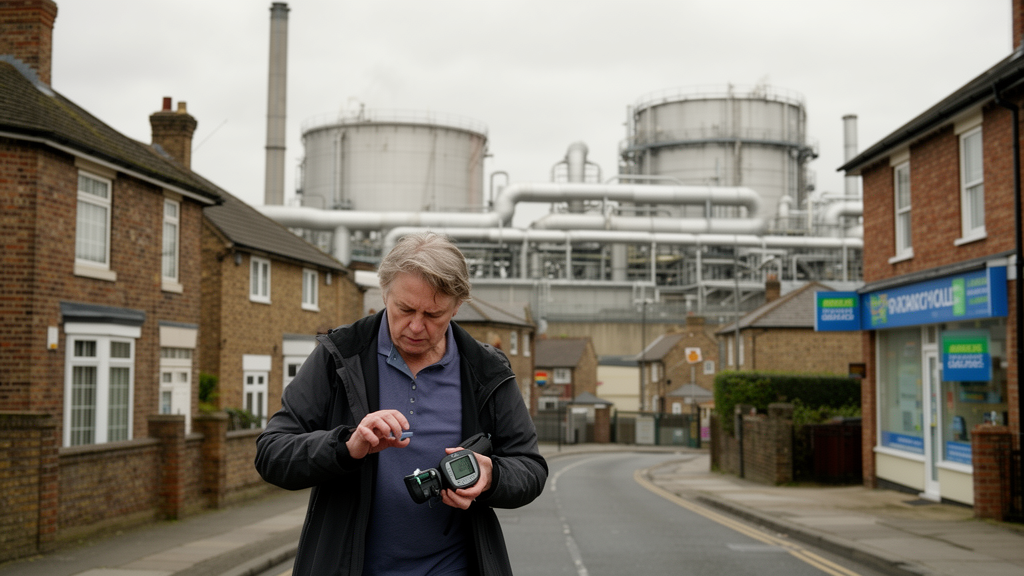
People with type 2 diabetes who lived closer to chemical plants had a higher risk of developing diabetic microvascular complications during a median 13.6 years of follow-up, according to a prospective cohort analysis of 9,963 UK Biobank participants. The association remained after adjustment for measured conventional ambient pollutants and other potential confounders. Compared with participants living at least 20 kilometers from the nearest chemical plant, those living less than 10 kilometers away had a hazard ratio of 1.20 for overall complications, with a 95% confidence interval of 1.10–1.31. The study does not establish that chemical-plant emissions caused the additional cases, and residential distance was used as a spatial indicator of potential exposure rather than as a direct measurement of individual contaminants.
The researchers analyzed UK Biobank participants who had type 2 diabetes mellitus but no diabetic microvascular complications at baseline. Incident complications were identified through linked health records and included diabetic retinopathy, diabetic kidney disease and diabetic neuropathy. During follow-up, 1,883 participants developed at least one of these complications. Cox proportional hazards models assessed residential proximity to the nearest chemical plant both in categorical distance bands and continuously, with sequential adjustment for potential confounders. Restricted cubic spline models were then used to characterize the potentially nonlinear relationship between distance and risk.
The distance pattern appeared across the three complications assessed. Compared with participants residing at least 20 kilometers away, those within 10 kilometers had a hazard ratio of 1.27 for diabetic retinopathy, with a 95% confidence interval of 1.10–1.46; 1.23 for diabetic kidney disease, with a 95% confidence interval of 1.06–1.42; and 1.33 for diabetic neuropathy, with a 95% confidence interval of 1.03–1.72. In the continuous analysis, each one-standard-deviation decrease in distance from the nearest plant was associated with a hazard ratio of 1.07 for overall diabetic microvascular complications, with a 95% confidence interval of 1.01–1.13. These are relative hazard estimates from the cohort, not measurements of an absolute probability increase.
Spline analyses suggested that the excess risk was greatest near plants and attenuated toward the null as distance increased. The estimated excess approached the null at approximately 18 kilometers, with intersections between 17.5 and 18.0 kilometers under alternative knot specifications. This analysis did not assume that the relationship changed by the same amount for every additional kilometer, a concern motivated by the possible nonlinear effects of dispersion, dilution and deposition. The finding nevertheless represents an association within this cohort and does not demonstrate a causal exposure-outcome relationship. The study’s rationale was that chemical plants are fixed industrial point sources with heterogeneous releases to air, land and water, whereas routinely monitored air pollutants may not fully capture source-specific environmental influences.
Robustness checks produced broadly similar directions of association across geographic regions and local plant-density analyses. The investigators also varied the number and placement of spline knots and examined manufacturing type. Spatial mapping and Ripley’s cross-type K-function analyses found no evidence of residential clustering or spatial bias, meaning the analyses did not detect the specified spatial pattern. The study has important limits: its observational design cannot completely exclude residual confounding; residential proximity is a broad proxy rather than a measurement of specific chemical concentrations, contaminants, behavior or timing of exposure; and the findings concern participants who already had type 2 diabetes at baseline, not whether plant proximity causes diabetes itself. The estimates and distance thresholds also come from this UK Biobank cohort and may not apply identically to other populations or industrial settings. Within those constraints, the reported finding is a persistent association between closer residence and higher hazards of retinopathy, kidney disease, neuropathy and overall diabetic microvascular complications after adjustment for measured ambient pollution.
Subject of Research: Prospective association between residential proximity to chemical plants and diabetic microvascular complications among UK Biobank participants with type 2 diabetes.
Article Title: Residential proximity to chemical plants and the risk of diabetic microvascular complications independent of air pollution: a prospective cohort study
Article References: Zhao, X., Zhang, J., Ma, Y., & Zou, H. (2026). Residential proximity to chemical plants and the risk of diabetic microvascular complications independent of air pollution: a prospective cohort study. BMC Public Health. https://doi.org/10.1186/s12889-026-29227-7
Image Credits: AI Generated
DOI: 10.1186/s12889-026-29227-7
Keywords: type 2 diabetes, chemical plants, industrial exposure, ambient air pollution, diabetic retinopathy, diabetic kidney disease, diabetic neuropathy, UK Biobank, prospective cohort, residential proximity, Residential, proximity
Cite Scienmag News
Russell Cooper. (October 26, 2026). Chemical plant proximity linked to diabetic complications in prospective UK cohort. Scienmag. https://scienmag.com/chemical-plant-proximity-linked-to-diabetic-complications-in-prospective-uk-cohort/
Russell Cooper. "Chemical plant proximity linked to diabetic complications in prospective UK cohort." Scienmag, 26 October 2026, https://scienmag.com/chemical-plant-proximity-linked-to-diabetic-complications-in-prospective-uk-cohort/. Accessed 26 October 2026.
Russell Cooper. "Chemical plant proximity linked to diabetic complications in prospective UK cohort." Scienmag. October 26, 2026. https://scienmag.com/chemical-plant-proximity-linked-to-diabetic-complications-in-prospective-uk-cohort/


