


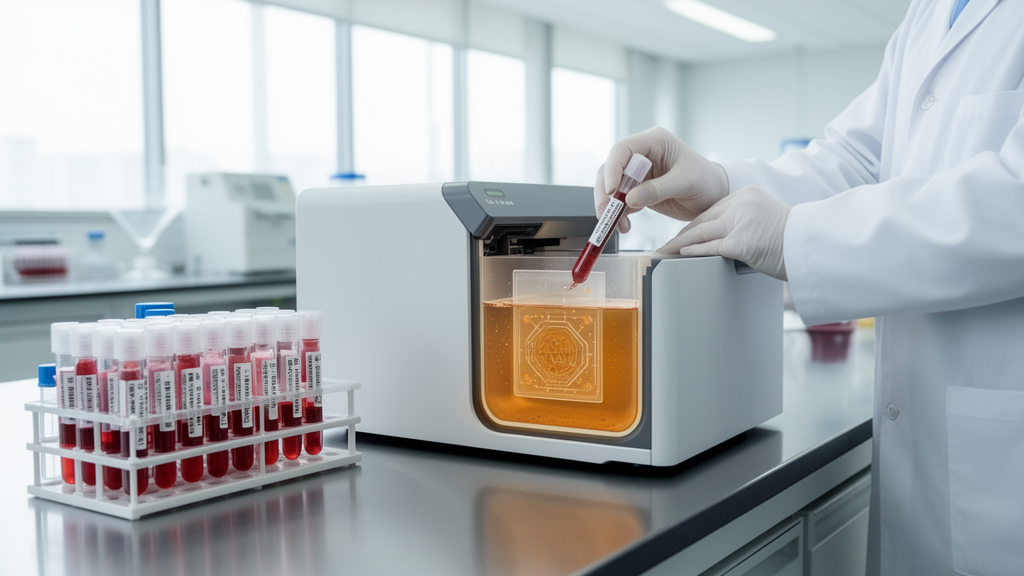
Adding a GRAIL Galleri blood test to routine screening increased the number of cancers detected through screening 6.5-fold in the PATHFINDER 2 trial, according to results published in Nature Medicine. The interventional study enrolled 35,878 adults aged 50 and older across the United States and Canada, and all participants received the multi-cancer test. Among cancers newly detected with Galleri, nearly half were diagnosed at stages 1 or 2, nearly three-quarters were diagnosed at stages 1 through 3, and 70% were cancers that currently lack national screening recommendations.
These results describe detection performance and safety; because the study did not randomly assign participants to screening with or without the blood test, they do not establish that Galleri reduces advanced cancers or deaths. Galleri is designed to screen for more than 50 cancer types using a single blood sample. It uses a machine-learning algorithm to examine chemical patterns in cell-free DNA, seeking to distinguish material originating from cancerous cells from that released by healthy cells.
The test can also estimate where in the body a detected cancer signal originated. That predicted origin is intended to help guide the subsequent diagnostic evaluation, while the original blood result indicates only that a cancer signal was detected, not that a specific diagnosis has been established. The PATHFINDER 2 results were reported by the Oregon Health & Science University Knight Cancer Institute, whose team was the study’s largest enrollment site, with approximately 6,100 participants.
The trial was designed to measure how well Galleri performed when added to screening recommendations for breast, colorectal, cervical and lung cancers. Because every participant received the test, investigators could compare cancers found through the combined approach with the cancers expected to be found through routine screening alone. The study was funded and designed by GRAIL, which also participated in data curation, data analysis, interpretation, drafting and approval of the publication.
That industry role is an important context for interpreting the results. The study also involved a large network of research personnel and community partners across Oregon, while the broader trial enrolled participants throughout the United States and Canada. Among the participants tested, Galleri returned a cancer signal in 287 people.
Of those, 173 were ultimately diagnosed with cancer, producing a positive predictive value of 60.3%. The test’s specificity was 99.64%, corresponding to a false-positive rate of 0.36%. Galleri also correctly predicted the cancer’s location in the body 91.3% of the time.
The location result refers to the test’s ability to identify the anatomical origin of cancers that were subsequently diagnosed, not to every cancer signal returned by the test. Safety follow-up covered more than 35,000 participants. Following a positive result, 0.6% underwent an invasive procedure, and most of those procedures were nonsurgical.
This finding is relevant to a test intended for use among adults without symptoms because a signal-positive result initiates additional evaluation. The investigators and study team emphasized that Galleri was designed as a complement to established screening, not a replacement. That distinction reflects the population studied: PATHFINDER 2 evaluated a blood test alongside clinical recommendations for four routinely screened cancers rather than presenting the test as a substitute for those existing pathways.
The stage distribution of newly detected cancers was encouraging but does not itself demonstrate improved population survival. Nearly half of the cancers found with Galleri were diagnosed at stages 1 or 2, and nearly three-quarters at stages 1 through 3, when curative treatment is more often possible. In addition, 70% of the newly detected cancers were among tumor types that do not currently have national screening recommendations.
The result indicates that the additional detections were not limited to cancers already targeted by routine screening programs, although the PATHFINDER 2 design cannot determine what would have happened to those cancers without the test. Two participant accounts illustrate the diagnostic sequence described in the release. Franklin Weingarten, a retired Oregon physician who enrolled at age 84, received a liver-origin cancer signal that led to a diagnosis of cholangiocarcinoma, a rare and often deadly bile duct cancer without routine screening.
Surgeons removed part of his liver, and the release reported at age 88 that he remained cancer-free. Bart Dawkins, 68, of The Dalles, Oregon, received a signal that led to an early-stage hepatocellular carcinoma diagnosis. The reported origin of the signal guided his rapid evaluation and connection with OHSU’s multidisciplinary liver team.
He later developed a separate cancer elsewhere in his liver and continued receiving care while being evaluated for transplantation. These cases are individual experiences, not controlled estimates of the test’s effect on survival. PATHFINDER 2 has a central limitation for questions about clinical benefit: it included no randomized comparison group that received standard screening without Galleri.
It can therefore quantify the cancers found when the test is added to routine screening and describe the associated safety profile, but it cannot directly show whether testing shifts a population from advanced disease to earlier diagnosis or reduces mortality. The release also described a separate randomized trial, NHS-Galleri, conducted across the United Kingdom’s National Health Service. That study enrolled nearly 140,000 participants in 10.5 months and did not find a statistically significant reduction in the combined number of stage 3 and stage 4 cancers.
Its secondary findings included an approximately four-fold higher overall detection rate when Galleri was added to standard screening, more stage 1 and 2 diagnoses, and reductions of more than 20% in stage 4 diagnoses for 12 deadly cancers in the second and third screening rounds. Nabavizadeh said the NHS-Galleri result may partly reflect a feature of first-round population screening: a reservoir of previously undiagnosed, asymptomatic stage 3 cancers that the test surfaced at once. He said the combined stage 3 and 4 shift is only one of several endpoints needed to assess clinical utility and that longer follow-up is essential.
This distinction remains important: finding cancers earlier is a different outcome from proving that screening changes long-term outcomes. The PATHFINDER 2 results were presented as federal review continued on evidence related to a potential Galleri approval, while the health consequences of routine use remained under evaluation. OHSU is also enrolling Medicare beneficiaries in the REACH study of annual testing and preparing the planned INFORM collaboration with Dana-Farber Cancer Institute for people identified through the Healthy Oregon Project as having inherited cancer risk, strong family histories or genetic cancer-predisposition syndromes.
These continuing studies are designed to extend the evidence, but they do not add reported efficacy results to PATHFINDER 2. Overall, PATHFINDER 2 provides large-scale evidence that Galleri can identify cancers missed by routine screening pathways, with many additional diagnoses occurring at relatively early stages and in tumor types without national screening recommendations. Its measured performance includes a 60.3% positive predictive value, 99.64% specificity and 91.3% accuracy in predicting the origin of diagnosed cancers, alongside limited invasive-procedure use after positive results.
The findings support further evaluation of multi-cancer early detection, not a claim of proven mortality reduction. Nima Nabavizadeh, the lead author, disclosed that he has served in consulting or advisory roles for GRAIL and Exact Sciences and has received honoraria from Roche Diagnostics and MJH Life Sciences, while reporting no stock or equity interests related to the work. The path from sensitive early detection to better clinical outcomes still depends on randomized comparisons and longer follow-up.
Subject of Research: Detection performance and safety of multi-cancer blood testing in the PATHFINDER 2 clinical trial
Article Title: PATHFINDER 2 findings advance multi-cancer early detection blood testing
Article References: PATHFINDER 2 findings advance multi-cancer early detection blood testing. Original publication (Bibliographic details unavailable.)
Image Credits: AI Generated
DOI: Not provided
Keywords: PATHFINDER 2, Galleri test, multi-cancer detection, cell-free DNA, cancer screening, early-stage cancer, liquid biopsy, clinical trial, diagnostic accuracy, cancer safety, PATHFINDER, findings
Cite Scienmag News
Nathaniel Bowman. (October 26, 2026). PATHFINDER 2 trial finds 6.5-fold more cancers with blood test. Scienmag. https://scienmag.com/pathfinder-2-trial-finds-6-5-fold-more-cancers-with-blood-test/
Nathaniel Bowman. "PATHFINDER 2 trial finds 6.5-fold more cancers with blood test." Scienmag, 26 October 2026, https://scienmag.com/pathfinder-2-trial-finds-6-5-fold-more-cancers-with-blood-test/. Accessed 26 October 2026.
Nathaniel Bowman. "PATHFINDER 2 trial finds 6.5-fold more cancers with blood test." Scienmag. October 26, 2026. https://scienmag.com/pathfinder-2-trial-finds-6-5-fold-more-cancers-with-blood-test/


