


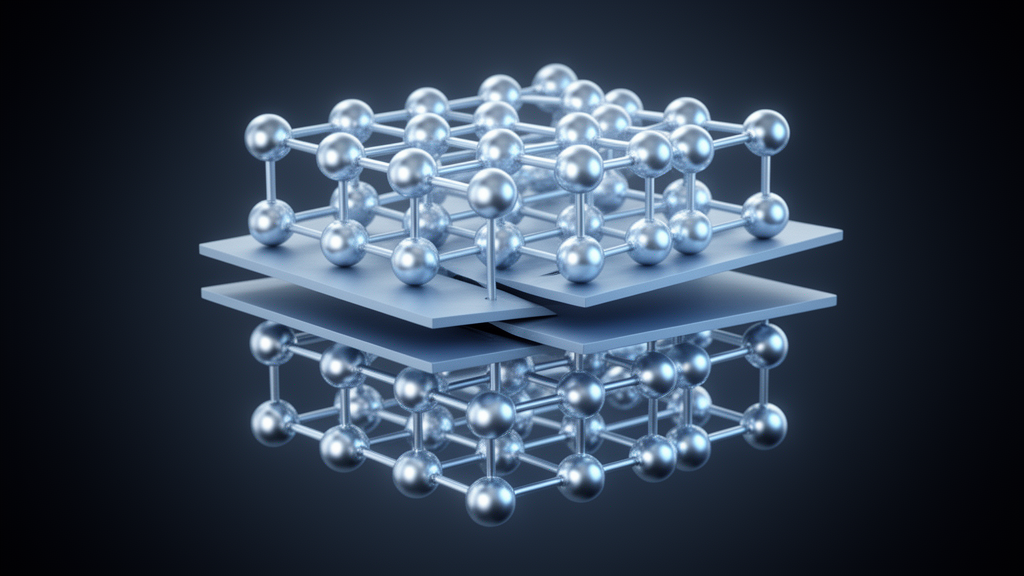
Stacking fault energy sits at the heart of how metals deform, governing whether crystals twin, transform, or slip in ways that make alloys strong and ductile. Yet the numbers scientists extract from experiments and simulations often disagree, sometimes dramatically. A new computational study published in the Journal of Materials Science by Chunguang Tang, Jiaojiao Yi and Matthew R. Barnett takes a fresh, systematic look at one of the most widely used routes to this quantity: the partial separation model. Using a unified set of interatomic potentials, the authors show exactly when this classic method can be trusted and, crucially, when it can be quietly undermined by the geometry of the specimen itself.
The partial separation approach rests on a simple physical picture. In a face-centered cubic crystal, a perfect dislocation splits into two Shockley partial dislocations bound together by a ribbon of stacking fault. The elastic repulsion between the partials pushes them apart, while the fault’s energy pulls them together, and the balance fixes their equilibrium spacing. By measuring that spacing in a transmission electron microscope and applying elasticity theory, researchers can infer the stacking fault energy without ever computing the fault energy directly. The formula is elegant: the energy scales inversely with the separation, weighted by the shear modulus, the partial Burgers vector and Poisson’s ratio.
The problem, the authors argue, is that the assumptions behind this formula are rarely satisfied in real materials or real simulations. Elasticity theory assumes an isotropic, infinite medium with no surfaces, no lattice friction and no dislocation core effects. To test how these idealizations hold up, the team built atomistic models of dissociated edge dislocations using embedded-atom method and modified embedded-atom method potentials, then compared the stacking fault energies inferred from partial separations against two planar-defect approaches: the Olson–Cohen model, which treats the fault as the energy of forming a two-layer hexagonal embryo in the cubic lattice, and the Ising model, which expresses the fault energy as a linear combination of stacking-sequence building-block energies.
For most of the pure face-centered cubic metals examined, the three approaches agree. Silver, gold, copper and nickel all show partial-separation-derived energies within about 10 millijoules per square metre of the Olson–Cohen and Ising values. But the agreement breaks down for aluminium, palladium and platinum, and the reasons are revealing. Aluminium and palladium have stationary partial separations of only 10 to 14 angstroms, comparable to their dislocation core widths of roughly 8 angstroms. When the partials sit that close together, the continuum assumption that the separation vastly exceeds the core width collapses, and the extracted energy deviates from the planar-defect values.
Palladium and platinum present a second, kinetic obstacle. The energy landscape of a dissociated dislocation is not a smooth curve but a series of Peierls wiggles superimposed on the continuum trend, and at low temperatures the system can become trapped in a local minimum. In energy minimization, platinum yielded a stacking fault energy roughly 130 millijoules per square metre higher than its molecular dynamics value, and palladium refused to dissociate at all. Running the simulations at 300 K allowed thermally activated motion of the partials and brought the results into line with the other models, a clear signature of kinetically hindered dislocation movement rather than a failure of the underlying physics.
The team then extended the comparison to concentrated alloys, examining Co20Cr20Ni60, a subsystem of the well-known Cantor alloy family prized for its strength and toughness, and Al20Co55Ni25, a model for nickel-based superalloys. For the cobalt-chromium-nickel alloy, both potentials tested produced partial separations and energies broadly consistent with the Olson–Cohen and Ising results, although the two potentials differed markedly in their predicted thermodynamics and in how quickly the partials reached their stationary separation, with one requiring temperatures of 700 kelvin or higher within accessible simulation times. The authors stress that such differences reflect the potentials themselves, not the modelling frameworks, since each potential constitutes a distinct atomistic representation of the same nominal composition.
Aluminium-cobalt-nickel proved the lone exception. Its partial-separation energy came out roughly 25 to 30 millijoules per square metre below the planar-defect values, and the discrepancy persisted even when the team used an averaged potential designed to suppress local chemical fluctuations. Notably, the alloy’s partial separation and core width resembled those of pure gold, which shows only a small model difference, ruling out simple core overlap as the cause. Because the partial separation method involves substantial distortion around the dislocation cores while the Ising model treats the fault as a sharp planar defect, the authors suspect the potential misrepresents that core distortion, though they caution that further work is needed to confirm this hypothesis.
The most striking findings concern materials with very low or negative stacking fault energies, where specimen geometry can completely masquerade as material physics. In an infinite crystal, a negative fault energy means the partials should separate without limit. The team demonstrated this with metastable face-centered cubic cobalt, for which the Olson–Cohen model predicts an energy near minus 36 millijoules per square metre. With free surfaces, the partials simply drifted apart and escaped through the specimen edges. With fixed surfaces along one direction, they stopped only when they hit the boundary. But fixing the surfaces perpendicular to the fault plane constrained the long-range shear of the widening fault ribbon, generating a restoring force that pinned the partials at a finite separation. Interpreted naively through the partial separation model, that apparent separation would imply a positive stacking fault energy despite the intrinsically negative one.
The authors frame this behaviour with a conceptual energy decomposition in which a constraint term, growing with separation in finite specimens, adds a restoring force absent from the classical model. They are careful to note that this term is not calibrated or predictive, and that the finite-size and boundary effects they identify are not new physics but established geometric effects acting directly on inferred energies. They also distinguish these extrinsic thermodynamic effects from intrinsic kinetic ones such as lattice friction and solute pinning, which delay equilibration without changing the equilibrium separation itself, citing prior molecular dynamics work suggesting solute pinning is too weak under typical experimental conditions to fix partials in place.
The practical message for both simulators and experimentalists is unambiguous. The partial separation model remains a practical and physically intuitive tool, and unlike the planar-defect approaches it reveals the structure and evolution of dissociated dislocations directly. But its validity demands sufficiently large partial separations for continuum elasticity, specimens large enough to avoid finite-size artifacts, and boundary conditions that do not secretly constrain the fault ribbon. Recent experimental observations that measured stacking fault energies vary with grain size reinforce the same caution. For low-fault-energy materials, where twinning and transformation mechanisms thrive and where alloy designers most need accurate numbers, the apparent energy read off from partial separations may reflect the specimen as much as the material.
Subject of Research: Testing the validity and limitations of the partial separation model for stacking fault energy using unified atomistic simulations
Article Title: A numerical re-look at the partial separation model for stacking fault energy
Article References: Tang, C., Yi, J., & Barnett, M. R. (2026). A numerical re-look at the partial separation model for stacking fault energy. Journal of Materials Science. https://doi.org/10.1007/s10853-026-13976-2
Image Credits: AI Generated
DOI: 10.1007/s10853-026-13976-2
Keywords: stacking fault energy, partial dislocations, dislocation dissociation, molecular dynamics, EAM potentials, high-entropy alloys, Olson-Cohen model, Ising model, finite-size effects, boundary conditions, metastable cobalt, Cantor alloy
Cite Scienmag News
Denise Maddox. (October 26, 2026). Atomistic simulations test when partial separation reliably measures stacking fault energy. Scienmag. https://scienmag.com/atomistic-simulations-test-when-partial-separation-reliably-measures-stacking-fault-energy/
Denise Maddox. "Atomistic simulations test when partial separation reliably measures stacking fault energy." Scienmag, 26 October 2026, https://scienmag.com/atomistic-simulations-test-when-partial-separation-reliably-measures-stacking-fault-energy/. Accessed 26 October 2026.
Denise Maddox. "Atomistic simulations test when partial separation reliably measures stacking fault energy." Scienmag. October 26, 2026. https://scienmag.com/atomistic-simulations-test-when-partial-separation-reliably-measures-stacking-fault-energy/


