


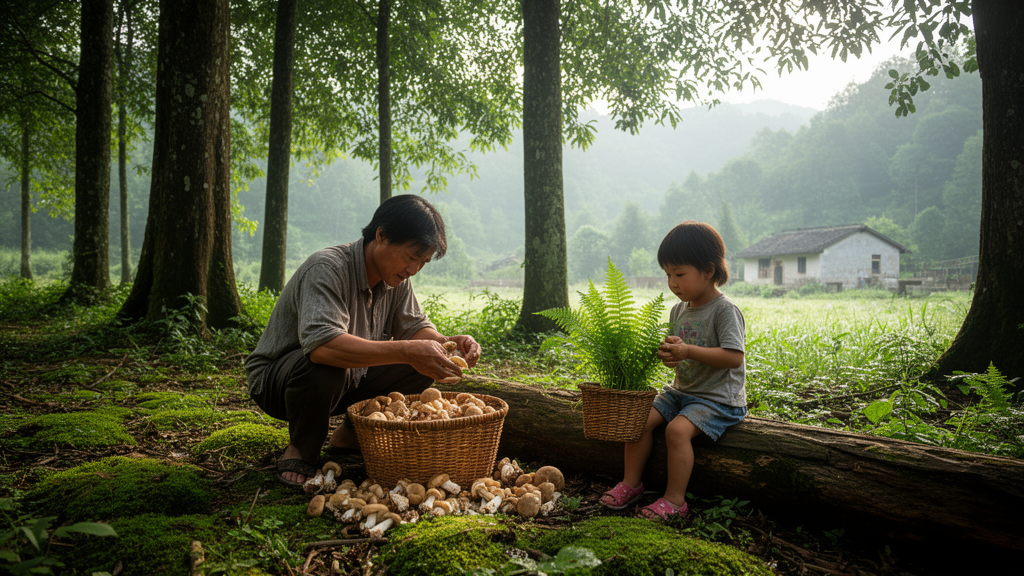
Families in China’s mountainous counties who earn income from activities beneath the forest canopy appear to raise children who fare better across education, health, emotional well-being, and daily care, according to a study accepted for publication in Frontiers in Forests and Global Change. Researchers Huilin Mao, Jing Li, and YuHui Li of the Hunan Institute of Engineering drew on a 2023 survey of 786 households with school-age children in five mountainous counties of Hunan Province to examine whether participation in what they call the underforest economy is associated with multidimensional child welfare. Rather than measuring welfare along a single axis such as income or schooling, the team constructed a composite index spanning five dimensions: education, physical health, mental well-being, care, and development opportunities.
The headline result is a statistical association. Households participating in the underforest economy scored, on average, 0.141 units higher on the welfare index — an effect equivalent to 0.383 standard deviations. When the researchers examined the index dimension by dimension, positive associations emerged for education, health, mental well-being, and care. The estimate for development opportunities was also positive but less precise, meaning the data could not rule out that this particular dimension shows no association. The study is observational, so the findings describe correlations rather than proven causal effects, although the authors deployed several techniques to strengthen the interpretation.
Robustness was tested extensively. The baseline association remained stable when the team substituted alternative welfare measures, specified participation as treatment intensity rather than a simple yes-or-no variable, trimmed the sample, and applied fixed effects at multiple administrative levels. Two quasi-experimental methods — propensity score matching and inverse probability weighted regression adjustment, which attempt to balance participating and non-participating households on observable characteristics — produced consistent estimates.
The authors also exploited a historical feature of rural development: the accessibility of forestry stations strongly predicts whether a household participates in the underforest economy today. Using this historical variable as an instrument in two-stage least squares estimation, the participation effect remained positive under both county and township fixed effects, further supporting the robustness of the baseline findings. Because the instrument relies on assumptions about how historical station placement influences child welfare only through participation, the estimates should still be read with the usual caution attached to instrumental-variable designs.
What accompanies the association? The survey data point to two patterns operating in the same direction. Participating households reported higher income and higher education spending, giving children greater material resources. These households also showed greater parental local employment and parental companionship, and lower parental migration. Underforest participation, in this reading, coincides with parents earning locally while remaining present in their children’s daily lives, alongside larger household budgets.
There is a trade-off. Children in participating households spent 0.576 additional hours per week on household work and help, a small but measurable shift of children’s time toward labor. The authors interpret the overall picture as improved child welfare operating through greater household resources and parental presence, alongside a potential time-allocation cost that deserves attention as forest livelihoods expand.
The scope of the evidence matters when weighing these results. The data come from a single 2023 survey covering five mountainous counties in one province, and the welfare index, however broad, captures only the dimensions the researchers chose to measure. Associations estimated from cross-sectional survey data can also be shaped by unobserved household characteristics — motivation, land endowments, or local market access — that the fixed effects, matching, and weighting procedures can address only partially. The instrumental-variable results narrow but do not eliminate this concern, and the authors themselves frame the findings as associations rather than established causal effects.
Within those limits, the study offers a detailed portrait of how forest-floor livelihoods intersect with family life in mountainous China. The same survey that produced the welfare index also documented the income, spending, employment, migration, and time-use patterns that travel together with participation, allowing the researchers to describe not just whether welfare differs but which household circumstances accompany the difference. The authors note that all claims expressed in the article are solely their own and do not necessarily represent their affiliated organizations, and that the final, formatted version will be published soon. As rural communities in forested mountain regions weigh the role of underforest activities in household livelihoods, the evidence adds child welfare — measured across education, health, mental well-being, care, and development opportunities — to the picture, provided the extra hours children spend helping at home are counted alongside the gains.
Subject of Research: The association between household participation in the underforest economy and multidimensional child welfare in mountainous rural China
Article Title: Underforest economy participation and multidimensional child welfare in rural China: evidence from mountainous household survey data
Article References: Mao, H., Li, J., & Li, Y. (2026). Underforest economy participation and multidimensional child welfare in rural China: evidence from mountainous household survey data. Frontiers in Forests and Global Change, 9, Article 1929842. https://doi.org/10.3389/ffgc.2026.1929842
Image Credits: AI Generated
DOI: 10.3389/ffgc.2026.1929842
Keywords: underforest economy, child welfare, rural China, Hunan Province, household survey, multidimensional welfare index, parental migration, forest livelihoods, child labor, mountainous regions, Underforest, economy
Cite Scienmag News
Glenn Wilkins. (October 26, 2026). Underforest Economy Linked to Better Child Welfare in Rural China. Scienmag. https://scienmag.com/underforest-economy-linked-to-better-child-welfare-in-rural-china/
Glenn Wilkins. "Underforest Economy Linked to Better Child Welfare in Rural China." Scienmag, 26 October 2026, https://scienmag.com/underforest-economy-linked-to-better-child-welfare-in-rural-china/. Accessed 26 October 2026.
Glenn Wilkins. "Underforest Economy Linked to Better Child Welfare in Rural China." Scienmag. October 26, 2026. https://scienmag.com/underforest-economy-linked-to-better-child-welfare-in-rural-china/


