


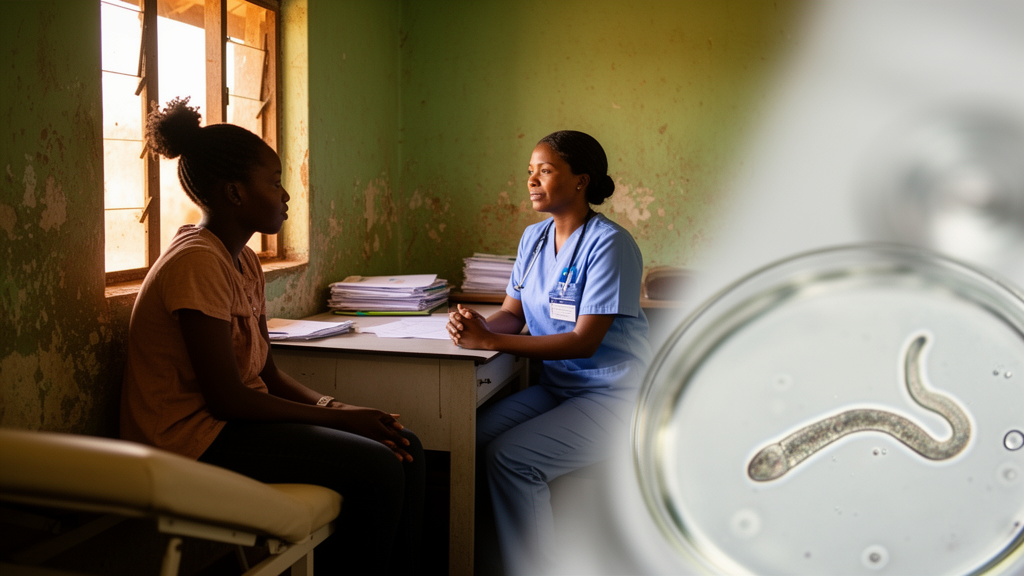
Female genital schistosomiasis, a condition that disproportionately affects women in sub-Saharan Africa and has been linked to adverse reproductive health outcomes and increased HIV susceptibility, remains severely overlooked within the field of neglected tropical diseases in South Africa. That is the central finding of a qualitative study by researchers at the University of KwaZulu-Natal, published in Frontiers in Tropical Diseases, which examined how the condition is recognised, prioritised, and rendered visible or invisible within the country's evolving neglected tropical disease policy and implementation processes. The researchers report that even when individual health system actors became aware of the disease, that recognition rarely translated into sustained institutional action.
The researchers mapped the institutional relations shaping neglected tropical disease activities and explored how frontline discretion influences the prioritisation of female genital schistosomiasis. Thirteen semi-structured interviews were conducted with stakeholders at the national, provincial, district, and facility levels of the health system. These interviews were complemented by non-participant observation during a Communicable Disease Control stakeholder meeting, allowing the team to compare what policy texts said with what happened in governance structures and everyday implementation practice.
Analysis followed a hybrid deductive-inductive approach to thematic analysis, examining how policy documents, governance arrangements, and routine practices collectively contributed to the marginal positioning of the disease within South Africa's neglected tropical disease Master Plan. Four interrelated themes emerged, showing how the condition's invisibility was produced across policy, programme, clinical, and data systems. Awareness among stakeholders was uneven and unsupported by pathways for diagnosis, referral, and routine care, meaning that knowledge of the disease did not connect to any operational route through which affected women could be identified and treated.
A particularly revealing pattern concerned how stakeholders themselves understood the disease's status. Some participants held the view that female genital schistosomiasis was already included within general schistosomiasis programming, yet they conceded that it was not explicitly named in the draft Master Plan. The condition lacked a defined mandate, programme ownership, operational guidance, and routine indicators, leaving no institutional actor accountable for addressing it and no data stream through which its burden could be tracked.
In practical terms, the researchers found that the disease existed in a gap between general schistosomiasis control activities and the specific clinical and programme structures needed to detect and manage a condition affecting the female genital tract. The study's theoretical framing helped explain why this gap persisted. The researchers observed that when the disease became visible to individual actors, recognition rarely generated sustained institutional action, because awareness was not embedded in a framework that required anyone to act.
The authors conclude that female genital schistosomiasis will become visible when awareness is embedded within a policy framework that mandates action, supported by clinical guidelines that define practice, equipped with approved diagnostic tools that enable identification, and anchored within an institutional home that has the authority and the resources to coordinate a response. Each of these elements addresses one of the systems through which the condition currently disappears: policy silence removes the mandate, absent guidelines leave clinical practice undefined, missing diagnostics prevent identification, and the lack of an institutional home means no actor owns the response. The findings carry weight beyond South Africa, given that the disease disproportionately affects women across sub-Saharan Africa while receiving minimal attention in research, policy, and clinical practice.
The researchers argue that understanding how a condition is or is not prioritised within policy implementation is critical for closing this gap, because a disease can be highly prevalent and clinically consequential yet remain absent from the documents, indicators, and mandates that determine what health systems actually do. The study suggests that addressing the condition requires more than awareness campaigns: it requires naming the disease in policy, assigning ownership, defining clinical pathways, and building the routine data systems that make its burden countable. As a qualitative study based on thirteen interviews and one observed stakeholder meeting, the research characterises how institutional processes shaped the disease's marginal position within South Africa's draft Master Plan rather than measuring the condition's prevalence or clinical burden.
The authors state that all claims expressed in the article are solely those of the authors and do not necessarily represent their affiliated organisations or the publisher. Within that scope, the study offers a systematic account of the institutional relations that keep a prevalent, HIV-relevant condition of women out of sight in national neglected tropical disease programming, and a concrete specification of the policy, guideline, diagnostic, and governance elements its authors say are needed to bring it into view.
Subject of Research: Institutional invisibility of female genital schistosomiasis in South African neglected tropical disease policy and health system implementation
Article Title: “We are just blind there”: institutional invisibility of female genital schistosomiasis in South Africa
Article References: Dlamini, N., Ginindza, T., Naidoo, S., & Hlongwana, K. (2026). “We are just blind there”: institutional invisibility of female genital schistosomiasis in South Africa. Frontiers in Tropical Diseases, 7, Article 1970431. https://doi.org/10.3389/fitd.2026.1970431
Image Credits: AI Generated
DOI: 10.3389/fitd.2026.1970431
Keywords: female genital schistosomiasis, neglected tropical diseases, health policy implementation, health systems, institutional visibility, South Africa, schistosomiasis, qualitative research, women's health, HIV susceptibility, just, blind
Cite Scienmag News
Timothy Lambert. (October 26, 2026). Female genital schistosomiasis remains institutionally invisible in South Africa’s health policy. Scienmag. https://scienmag.com/female-genital-schistosomiasis-remains-institutionally-invisible-in-south-africas-health-policy/
Timothy Lambert. "Female genital schistosomiasis remains institutionally invisible in South Africa’s health policy." Scienmag, 26 October 2026, https://scienmag.com/female-genital-schistosomiasis-remains-institutionally-invisible-in-south-africas-health-policy/. Accessed 26 October 2026.
Timothy Lambert. "Female genital schistosomiasis remains institutionally invisible in South Africa’s health policy." Scienmag. October 26, 2026. https://scienmag.com/female-genital-schistosomiasis-remains-institutionally-invisible-in-south-africas-health-policy/


