


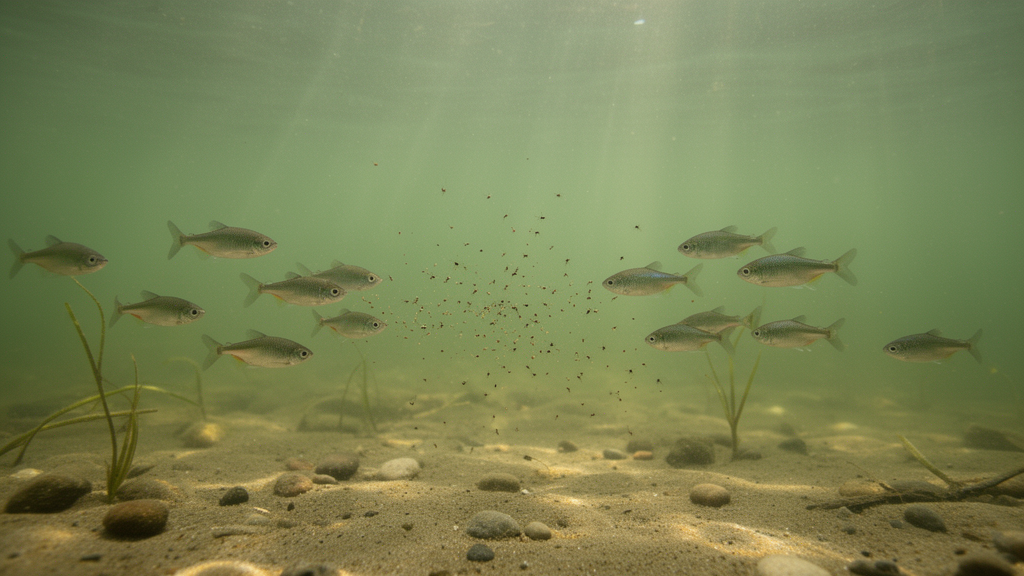
In the marginal zones of two neighbouring reservoirs on Brazil’s Lower Paranapanema River, small-bodied native and non-native fish are not simply coexisting — in one of them, they are increasingly eating from the same plate. A two-year dietary study of seven characoid species has found that where habitat structure is impoverished, non-native and native fish broaden their diets and overlap heavily in what they consume, especially during the dry season, while in a more structurally complex reservoir nearby the same species partition resources and respond in step with the annual flood pulse. The study, based on 416 fish collected quarterly between September 2018 and September 2020, offers one of the most detailed pictures yet of how the smallest members of a fish community — the tetras, characins and their relatives that dominate Brazilian ichthyofauna — negotiate food and space in heavily engineered rivers.
The research focused on the Rosana and Taquaruçu Reservoirs, the final two links in a cascade of eleven dams that fragments the Paranapanema River, a major left-bank tributary of the Upper Paraná Basin. Although the two impoundments share the same regional climate, with a pronounced wet season from October to March and a dry season from April to September, they could hardly be more different in structure. Rosana, impounded in 1986, follows a sinuous course of about 110 kilometres that mirrors the original floodplain, fostering marginal lagoons, dense beds of submerged and floating macrophytes such as Eichhornia, Elodea, Sagittaria and Salvinia, and forested margins protected by two conservation units. Taquaruçu, flooded in 1991, runs comparatively straight for 80 kilometres, lacks marginal lagoons, supports only sparse submerged macrophytes and is ringed largely by agriculture and pasture, with tributaries affected by deforestation, urbanisation and effluent discharge.
Against this backdrop, the team sampled seven sites across both reservoirs using trawls, sieves and cast nets deployed for two hours per site along 100-metre stretches of marginal vegetation and macrophyte beds. They analysed the stomach contents of twelve populations spanning seven species: three non-native to the Upper Paraná Basin — Aphyocharax dentatus, Megalamphodus eques and Roeboides descalvadensis — and four natives, Astyanax lacustris, Hemigrammus marginatus, Moenkhausia intermedia and Serrapinnus notomelas. Prey items, identified to the lowest practicable taxonomic level, were measured by volume and grouped into categories spanning aquatic insects, microcrustaceans, fish, algae, detritus, molluscs, terrestrial invertebrates and terrestrial plants, then classified as autochthonous or allochthonous according to their origin.
The contrast between the reservoirs was stark. In Rosana, stomach contents were dominated by terrestrial invertebrates — allochthonous resources washed in from the surrounding landscape — a pattern the authors attribute to the reservoir’s numerous large tributaries, forested margins and lagoonal habitats that strengthen the connection between land and water. In Taquaruçu, diets centred instead on aquatic insects, microcrustaceans and fish, all autochthonous resources produced within the water body itself. The authors link this to Taquaruçu’s small watershed, simplified channel and lack of riparian forest, features that limit the input of terrestrial material and leave fish dependent on in-reservoir production, a condition typical of reservoirs with low habitat heterogeneity.
Seasonality told a similar story of divergence. Fish populations in Rosana responded uniformly to the annual cycle: during the wet season they consumed more terrestrial insects, taking advantage of flooding that makes invertebrates and plant material available, while in the dry season they shifted towards aquatic insects, microcrustaceans and detritus. Permutational multivariate analysis of variance confirmed significant seasonal dietary differences for every species examined in Rosana. In Taquaruçu, by contrast, the seasonal patterns were uncoordinated across species and, for two of them — the native A. lacustris and the non-native R. descalvadensis — no significant seasonal shift was detected at all. The authors suggest this consistency reflects a year-round limitation in resource availability rather than a lack of dietary flexibility.
Niche breadth, measured with the Shannon-Wiener index, and dietary overlap, quantified with the Pianka index, sharpened the picture. In Rosana, the non-native A. dentatus held the narrowest niche in both seasons, with values of 0.66 in the wet season and 0.67 in the dry, indicating specialisation, while the non-native M. eques showed the broadest wet-season niche at 1.61 and the native A. lacustris the largest dry-season breadth at 1.37. In Taquaruçu, H. marginatus had the narrowest wet-season niche (0.63) and S. notomelas the broadest (1.38), whereas in the dry season A. lacustris contracted to 0.72 and M. intermedia expanded to 1.68. Overlap followed the opposite rhythm in each reservoir: it peaked in the wet season in Rosana and in the dry season in Taquaruçu.
The dry-season convergence in Taquaruçu is where the study’s warning signs cluster. The non-native A. dentatus overlapped almost completely with the native H. marginatus (a Pianka value of 0.99) and strongly with the native M. intermedia (0.68), while the non-native M. eques overlapped with M. intermedia at 0.75. Values above 0.60 are considered high overlap. The authors interpret these figures as suggesting potential interspecific competition, though they are careful to note that dietary overlap alone does not prove competition: spatial segregation, use of different microhabitats or feeding at different times of day can all soften direct interactions. Even so, they argue that non-native species with flexible, competitive feeding strategies are particularly concerning in resource-poor environments, where sustained overlap could eventually contribute to the displacement of native populations.
Individual species histories added nuance to the broad patterns. A. dentatus functioned mainly as an invertivore but switched from a narrow niche in Rosana to a broad one in Taquaruçu, adding algae and terrestrial plants when resources tightened. The native A. lacustris, often described as a generalist elsewhere, maintained a consistently narrow, largely insectivorous diet in both reservoirs, a pattern the authors suggest may reflect niche partitioning. The native H. marginatus stayed specialised on terrestrial insects and microcrustaceans in Rosana but broadened in Taquaruçu. R. descalvadensis proved a narrow specialist on fish scales, a lepidophagous habit whose nocturnal feeding may further reduce overlap with other species. The native S. notomelas, unexpectedly, was dominated by detritus in Rosana — possibly an artefact of rapid digestion of soft prey and incidental sediment ingestion — while feeding more broadly in Taquaruçu. The authors also note that a previous study reported good body condition among these populations in both reservoirs, suggesting that food resources are, for now, sufficient to support co-occurrence.
The wider significance lies in what these small fish represent. Small-bodied species make up the largest share of the Brazilian fish fauna yet remain largely invisible to the public, poorly studied and highly threatened, despite playing critical roles in energy flow and nutrient cycling and serving as early indicators of ecosystem degradation and biotic homogenisation. By showing that the ecological consequences of non-native introductions depend on local environmental filters — with trophic segregation in a heterogeneous reservoir and resource convergence in a simplified one — the study supports calls for process-based assessments of invasion impacts in the ongoing freshwater biodiversity crisis. The authors acknowledge limitations, including the absence of direct prey-abundance measurements and sample sizes too small to include H. marginatus in Rosana’s seasonal analyses or M. intermedia and R. descalvadensis outside Taquaruçu. Even so, they conclude, the marginal zones of reservoirs deserve sustained monitoring, because subtle shifts at these lower trophic levels can propagate through food webs and alter ecosystem stability.
Subject of Research: Trophic interactions between native and non-native small-bodied characoid fishes in the marginal zones of two Neotropical reservoirs on the Lower Paranapanema River, Brazil
Article Title: The Small War: Trophic interactions between small-bodied non-native and native characoids in the marginal zones of Neotropical reservoirs
Article References: Ferraz, J. D., Casimiro, A. C. R., Garcia, D. A. Z., Vidotto-Magnoni, A. P., de Magalhães, A. L. B., Tarkan, A. S., Britton, J. R., & Orsi, M. L. (2025). The Small War: Trophic interactions between small-bodied non-native and native characoids in the marginal zones of Neotropical reservoirs. NeoBiota, 104, 179-201. https://doi.org/10.3897/neobiota.104.167161
Image Credits: AI Generated
DOI: 10.3897/neobiota.104.167161
Keywords: biological invasions, dietary overlap, trophic ecology, Neotropical reservoirs, small-bodied fish, characiformes, Paranapanema River, niche breadth, seasonal diet shifts, habitat heterogeneity, freshwater biodiversity, biotic homogenisation
Cite Scienmag News
Violet Maxwell. (October 26, 2026). In simplified reservoirs, invasive and native tetras converge on the same scarce menu. Scienmag. https://scienmag.com/in-simplified-reservoirs-invasive-and-native-tetras-converge-on-the-same-scarce-menu/
Violet Maxwell. "In simplified reservoirs, invasive and native tetras converge on the same scarce menu." Scienmag, 26 October 2026, https://scienmag.com/in-simplified-reservoirs-invasive-and-native-tetras-converge-on-the-same-scarce-menu/. Accessed 26 October 2026.
Violet Maxwell. "In simplified reservoirs, invasive and native tetras converge on the same scarce menu." Scienmag. October 26, 2026. https://scienmag.com/in-simplified-reservoirs-invasive-and-native-tetras-converge-on-the-same-scarce-menu/


