


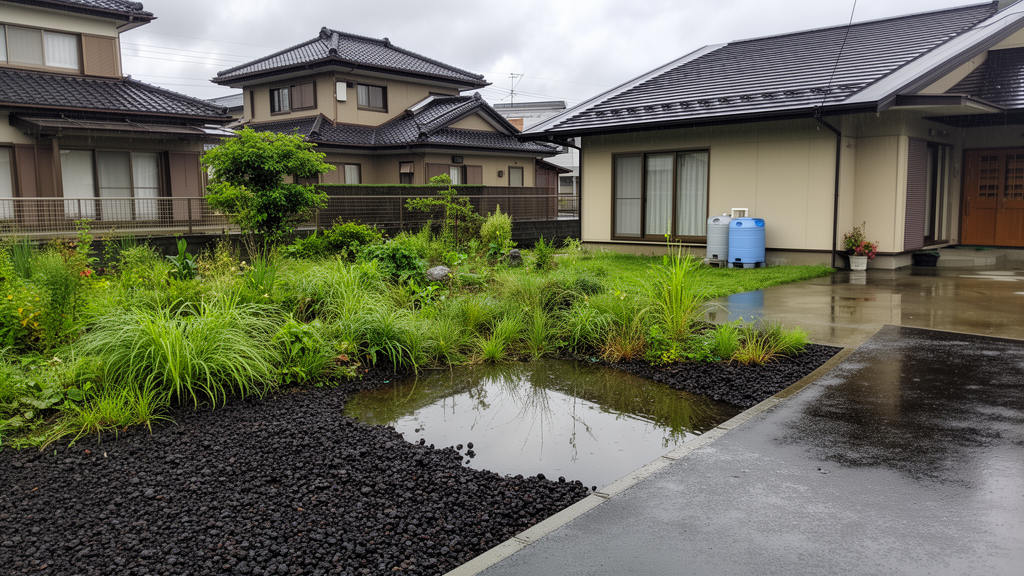
Urban neighborhoods paved over with concrete and asphalt face a stubborn problem when heavy rain arrives: water that once soaked into the ground now races across rooftops, driveways, and streets, overwhelming drains and pooling in low-lying areas. In densely built residential districts near Tokyo, where space is scarce and paved surfaces limit infiltration, the search for practical stormwater solutions is a pressing planning question. A new study from researchers in Japan suggests that one of the most effective answers may also be one of the simplest to picture: a small, planted depression in the ground that catches rain where it falls and lets the soil do the work that concrete prevents.
The research, led by doctoral student Jiajing Lin of the Regional Environment Systems course in the Graduate School of Engineering and Science at Shibaura Institute of Technology (SIT), together with Mr. Hiroyuki Taguchi and Professor Hitoshi Nakamura of the College of Systems Engineering and Science at SIT, set out to answer a question that has long frustrated urban planners: when flood control, cost, and environmental benefit are all weighed together, which decentralized stormwater measure actually comes out ahead? The team compared two widely used Low Impact Development measures, rain barrels and rain gardens, along with their combined installation, across three flood-prone residential catchments in Saitama City near Tokyo: Miyahara, Higashimiyashita, and Motobuto. The findings were made available online on September 24, 2026, and will appear in Volume 32 of the journal City and Environment Interactions on December 1, 2026.
The two measures work in fundamentally different ways, and that difference shaped the study’s design. Rain barrels collect rooftop runoff and store it for later non-potable uses, effectively holding water back from the drainage network during a storm. Rain gardens, by contrast, are vegetated depressions that use soil to encourage water to infiltrate into the ground rather than flow into sewers. Both approaches reduce runoff, but their performance and costs vary with local conditions, and previous studies have typically assessed flood control, costs, and environmental benefits separately, making direct comparisons difficult. The SIT team’s contribution was to bring all three dimensions into a single, integrated evaluation framework.
Technically, the study combined four analytical tools. The researchers used the United States Environmental Protection Agency’s Storm Water Management Model, a widely applied hydrological simulation package, to model how each measure altered runoff in the three catchments. They paired this with a life-cycle cost assessment to capture the full economic burden of installation and maintenance over time. To quantify environmental and social benefits that do not show up on a balance sheet, they applied the Benefit Estimation Tool, known as B£ST, which assesses aesthetic, educational, biodiversity, and carbon-related benefits. Finally, they used the Analytic Hierarchy Process, a structured decision-making method in which seven experts weighted criteria including runoff reduction, costs, service life, and ecosystem benefits, allowing the team to aggregate all indicators into comprehensive scores for each measure in each catchment.
The simulation results revealed that the most effective measure depended partly on the characteristics of the catchment itself. In Miyahara, rain gardens reduced peak runoff by 35.78 percent and delayed the arrival of the peak by 20 minutes, a substantial improvement given that delaying and flattening the peak is often what prevents sewers from overflowing. The combined approach of rain barrels plus rain gardens delivered the largest total runoff reduction in that catchment, at 30 percent. In Higashimiyashita, the combined scenario reduced peak runoff by 3.46 percent, cut total runoff volume by 10.89 percent, and delayed the peak by 20 minutes. In Motobuto, the combined approach reduced peak runoff by 7.95 percent and total runoff volume by 8.95 percent, with a 10-minute peak delay. Across all three sites, combined measures generally reduced total runoff the most, reflecting the complementary logic of storing water in barrels while also encouraging infiltration through planted soil.
Yet hydrological performance was only part of the story. The B£ST assessment of aesthetic, educational, biodiversity, and carbon benefits found that the combined scenario generally produced the highest social and environmental scores, while rain barrels alone offered more limited ecosystem-service benefits. Stored water in a barrel does not provide the vegetation-related benefits that a planted rain garden can. As Ms. Lin put it, “RG can offer more than runoff control because their vegetation also supports neighborhood amenity and other ecosystem services.” This distinction matters for planners who must justify investments not only in terms of flood statistics but also in terms of the amenity and ecosystem services that residents experience day to day.
The economic picture, however, told a different tale. The life-cycle cost assessment favored rain gardens, whose comprehensive economic scores ranged from 0.401 to 0.427, compared with 0.375 to 0.406 for rain barrels. Installing both measures together increased costs and produced the lowest economic scores for the combined scenario. In other words, the option that performed best on total runoff reduction and ecosystem services was also the most expensive, while the option that performed best economically was the rain garden on its own. This tension between performance and affordability is precisely the kind of trade-off that fragmented, single-criteria studies tend to obscure, and it is the tension the integrated framework was designed to expose.
When flood-control, economic, and social criteria were considered together, rain gardens achieved the highest comprehensive scores in all three catchments: 0.416 in Miyahara, 0.400 in Higashimiyashita, and 0.395 in Motobuto. Rain barrels alone ranked lowest overall, while the combined approach remained competitive in situations where runoff-volume reduction was the overriding priority. The conclusion, the researchers emphasize, is not that rain gardens are universally superior, but that the preferred measure depends on local conditions. “There is no single solution that will suit every neighborhood; the preferred measure depends on local hydrology, available space, costs, and planning goals,” said Ms. Lin. For a city like Saitama, where residential blocks are tightly packed and space is limited, that nuance could shape which measures are chosen for a given district.
The study’s broader significance lies in the transparency of its method. By combining hydrological simulation, life-cycle costing, ecosystem-service valuation, and expert-weighted multi-criteria analysis within one framework, the researchers have given urban planners a replicable way to compare decentralized stormwater measures before committing to them. Because Low Impact Development measures manage stormwater close to where it falls, they can be evaluated at the scale of individual residential catchments, which is where the study’s comparisons were made. The framework’s structure, in which each criterion is scored and weighted explicitly, also makes the reasoning behind a recommendation visible, allowing different stakeholders to see how changing the weights would change the ranking of options.
The authors are careful to note the limits of their analysis. The simulations used a single design rainfall event, the Analytic Hierarchy Process relied on expert-selected weights, and adapting the B£ST tool to the Japanese context required assumptions that could influence the results. The study also covered only three catchments, all within Saitama City, so the specific scores should not be generalized to other cities without further testing. The researchers recommend that future studies examine multiple storm events, conduct sensitivity analyses on the weighting assumptions, and extend the framework to additional locations. Within those boundaries, however, the message for flood-prone residential districts near Tokyo is clear: when flood control, cost, and community benefit are weighed on the same scale, the rain garden earned the highest comprehensive score in every catchment studied, while the combined barrel-and-garden approach remains the strongest option where total runoff reduction is the priority.
Subject of Research: Comparative evaluation of rain barrels and rain gardens for urban stormwater management in residential catchments near Tokyo
Article Title: Rain gardens offer a balanced solution for managing urban stormwater near Tokyo
Article References: Rain gardens offer a balanced solution for managing urban stormwater near Tokyo. Original publication (Bibliographic details unavailable.)
Image Credits: AI Generated
DOI: Not provided
Keywords: rain gardens, rain barrels, stormwater management, urban flooding, Low Impact Development, SWMM, life-cycle cost, B£ST, Analytic Hierarchy Process, Saitama City, green infrastructure, Shibaura Institute of Technology
Cite Scienmag News
Violet Maxwell. (October 26, 2026). Rain gardens outperform rain barrels in flood-prone neighborhoods near Tokyo. Scienmag. https://scienmag.com/rain-gardens-outperform-rain-barrels-in-flood-prone-neighborhoods-near-tokyo/
Violet Maxwell. "Rain gardens outperform rain barrels in flood-prone neighborhoods near Tokyo." Scienmag, 26 October 2026, https://scienmag.com/rain-gardens-outperform-rain-barrels-in-flood-prone-neighborhoods-near-tokyo/. Accessed 26 October 2026.
Violet Maxwell. "Rain gardens outperform rain barrels in flood-prone neighborhoods near Tokyo." Scienmag. October 26, 2026. https://scienmag.com/rain-gardens-outperform-rain-barrels-in-flood-prone-neighborhoods-near-tokyo/


