


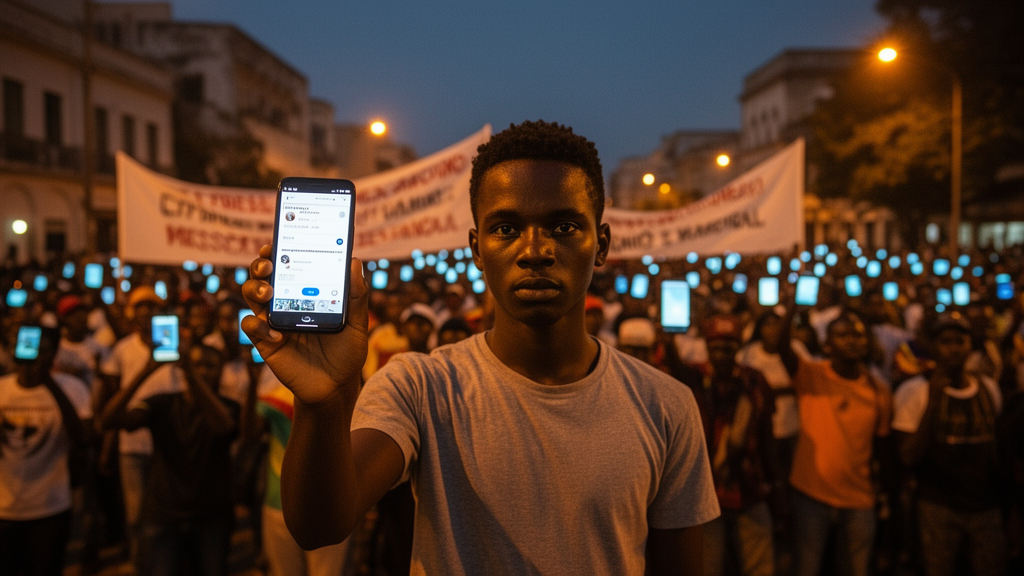
Social media platforms are often celebrated as spontaneous "liberation tools" that can crack open authoritarian control over civic space. A new study of Mozambique's 2024–2025 post-electoral crisis argues that this celebration misses the point: in the hands of a skilled opposition politician, it was not the platforms themselves but a well-coordinated digital campaign that mobilized mass dissent. The research, conducted by Armando Nhantumbo of the Rhodes University School of Journalism and Media Studies and published in Frontiers in Political Science, examines how Venâncio Mondlane, the country's leading opposition figure, used digital networks to confront the ruling regime and foster space for dissenting political participation during one of the most turbulent periods in the country's recent history.
The study arrives amid a wave of digitally driven movements across the Global South. The Arab Spring uprisings in North Africa, the "Must Fall" campaigns in South Africa, Kenya's #RejectFinanceBill protests and Madagascar's "Gen Z" movement have all been cited as evidence that digital tools can reshape political participation, offering the disempowered new avenues to challenge state hegemony. Yet Nhantumbo identifies a gap in the scholarly literature, particularly for Africa: comparatively little attention has been paid to how opposition politicians, as distinct from grassroots movements, leverage technology to challenge authoritarian regimes and expand civic space.
The Mozambican case offers a detailed answer. Methodologically, the research rests on digital ethnography, observation and content analysis of Mondlane's online activity during the crisis. Rather than treating posts as isolated artifacts, the study traces how digital messaging translated into physical mobilization, connecting online rhetoric with the large-scale protests that disrupted Mozambique between October 2024 and January 2025.
From this material, the author identifies what the study terms a "strategic utilization" of social media networks for political participation, built from six identifiable strategies. The six strategies named in the study are "informational flooding", "crowdsourced amplification", "affective rhetoric", "staging", "branding" and "tactical diversification". Together, the study argues, these strategies were pivotal in driving the massive engagement seen in the protests that convulsed the country in the final months of 2024 and the opening weeks of 2025.
The framing matters analytically: rather than merely hailing social media networks as "liberation tools", Nhantumbo emphasizes the importance of a "well-coordinated digital campaign" in enabling these platforms to shape political participation. In this reading, the platforms are infrastructure, but coordination is the engine. The study's account of Mondlane's online activity therefore treats each named strategy as a component of a broader campaign architecture, rather than as isolated communication choices whose effects could be assessed independently.
The study's broader contribution is a framework for examining political participation in similar authoritarian contexts. By specifying the component strategies of digital mobilization, it offers researchers a transferable analytical toolkit: future studies can ask whether comparable opposition figures elsewhere deploy informational flooding, affective rhetoric or tactical diversification, and with what effects on civic space. As digitally mediated protests continue to surface across the Global South, the Mozambican case suggests that the decisive variable may be less the technology than the strategy behind it.
The findings are drawn from a single national case during a specific post-electoral crisis, and the author presents them as a proposed framework for further research rather than as a general law of digital politics.
Subject of Research: Digital strategies of opposition political participation under authoritarianism in Mozambique
Article Title: Mozambique’s politics in the digital age: Venâncio Mondlane and a framework for participation under authoritarianism
Article References: Nhantumbo, A. (2026). Mozambique’s politics in the digital age: Venâncio Mondlane and a framework for participation under authoritarianism. Frontiers in Political Science, 8, Article 1952645. https://doi.org/10.3389/fpos.2026.1952645
Image Credits: AI Generated
DOI: 10.3389/fpos.2026.1952645
Keywords: Mozambique, Venâncio Mondlane, social media, authoritarianism, political participation, digital ethnography, post-electoral crisis, opposition politics, digital citizenship, protests, mediatization, Frontiers in Political Science
Cite Scienmag News
Eleanor Graham. (October 26, 2026). Coordinated Digital Campaign, Not Platforms Alone, Drove Mozambique’s Protest Wave, Study Finds. Scienmag. https://scienmag.com/coordinated-digital-campaign-not-platforms-alone-drove-mozambiques-protest-wave-study-finds/
Eleanor Graham. "Coordinated Digital Campaign, Not Platforms Alone, Drove Mozambique’s Protest Wave, Study Finds." Scienmag, 26 October 2026, https://scienmag.com/coordinated-digital-campaign-not-platforms-alone-drove-mozambiques-protest-wave-study-finds/. Accessed 26 October 2026.
Eleanor Graham. "Coordinated Digital Campaign, Not Platforms Alone, Drove Mozambique’s Protest Wave, Study Finds." Scienmag. October 26, 2026. https://scienmag.com/coordinated-digital-campaign-not-platforms-alone-drove-mozambiques-protest-wave-study-finds/


