


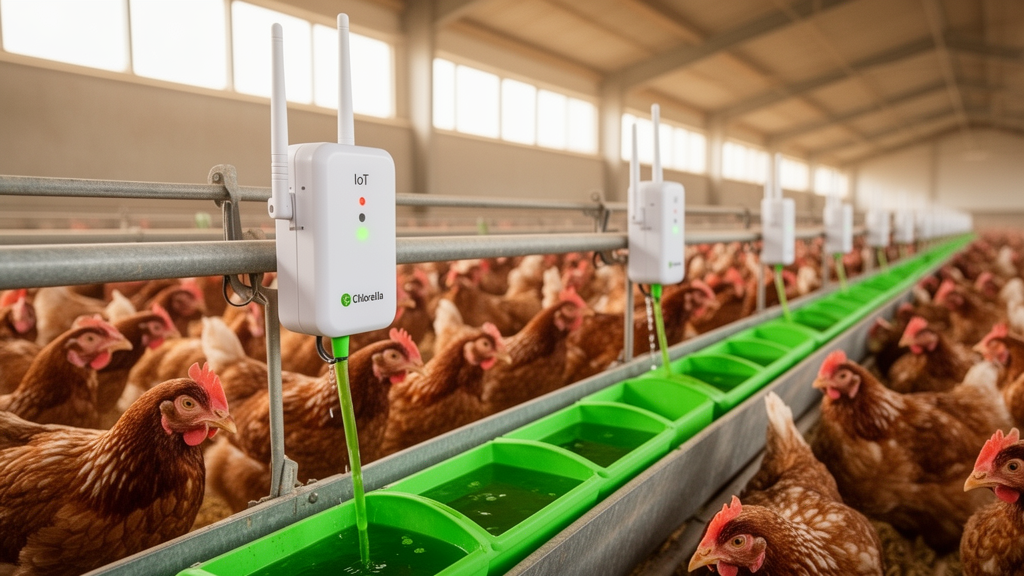
A team of researchers at Prairie View A&M University has built a low-cost Internet of Things sensing platform that continuously sniffed the air inside occupied laying-hen pens, and used it to detect a striking pattern: hens fed tiny amounts of the microalga Chlorella appeared to live in pens with generally lower sensor-derived concentrations of ammonia, methane, and carbon dioxide than hens on a control diet. The study, published in Frontiers in Animal Science, combines a nutritional intervention with an edge-computing gas monitoring system built from commodity hardware, and it offers a glimpse of how precision livestock farming might scale real-time environmental surveillance across commercial-style cage-free housing.
The motivation is rooted in a structural shift in the egg industry. World hen-egg production reached roughly 91 million tonnes, about 1.7 trillion eggs, in 2023, having risen approximately 150% over the preceding three decades, with Asia accounting for close to two-thirds of output. In the United States, welfare legislation and corporate commitments have pushed the cage-free share of the laying flock to nearly 47% by 2025, in an industry valued at over $21 billion annually. Cage-free systems improve hen welfare and support a wider range of natural behaviors, but they also concentrate manure on the litter floor, within the birds’ own airspace, which complicates environmental control and makes indoor air quality a critical determinant of bird health, productivity, and economic sustainability.
The three gases the platform tracks each have distinct origins in a layer house. Carbon dioxide arises primarily from bird respiration. Ammonia is generated through microbial breakdown of uric acid in manure, and sustained exposure to elevated concentrations has been associated with respiratory-tract lesions, keratoconjunctivitis, increased susceptibility to infection, reduced feed intake, and impaired production performance in birds, as well as occupational risk for workers. Methane can result from anaerobic decomposition of organic matter in litter. All three are temporally dynamic, varying with ventilation, temperature, manure conditions, and flock activity over daily and seasonal cycles, which is precisely why periodic manual sampling, the conventional approach, captures only snapshots of an environment that moves on the scale of hours.
The sensing units themselves are technically simple but carefully engineered. Each of the three deployed units consisted of a Raspberry Pi 5 single-board computer, an ADS1115 16-bit analog-to-digital converter, and four gas-sensing modules: an MQ137 for ammonia, an MQ4 for methane, an MG811 for carbon dioxide, and an MQ135 as a general air-quality channel. Because the Raspberry Pi GPIO pins accept only digital signals, the analog sensor outputs were digitized by the ADS1115 and transmitted over the I2C interface. In each acquisition cycle, the Pi selected a channel by writing the converter’s configuration register, triggered a single-shot conversion, and read the result, completing a full four-channel sweep every 15 seconds. Each assembly was mounted approximately 0.30 meters above the wood-shaving litter, centered on the side wall of each pen at the same height and position in all three pens, near the hens’ breathing zone but out of pecking range. A custom Python service timestamped each reading and published it to a pen-specific ThingSpeak cloud channel, buffering data locally during barn network outages so that intermittent connectivity did not create gaps in the record.
The metrological heart of the study is its calibration workflow. Low-cost metal-oxide sensors exhibit unit-to-unit variability, temperature and humidity cross-sensitivity, and baseline drift, so parts-per-million values reported from them are not comparable across units unless the units have been shown to agree in a shared environment. Before deployment, the researchers operated all three assemblies side by side in the same laboratory air for 48 hours, the first 24 hours serving as sensor warm-up, establishing per-unit clean-air baselines and quantifying mutual agreement. The co-location run also functioned as a hardware screen, identifying two faults, incorrect sensor module wiring and voltages outside the converter’s usable input range, which were corrected before the pens were instrumented. Raw voltages were subsequently converted to sensor-derived concentration estimates using gas-specific relationships: a power-law resistance-ratio model for the MQ-series sensors and an approximately logarithmic model for the MG811 carbon dioxide channel. The researchers are explicit that the resulting values are sensor-derived estimates rather than reference-grade measurements, and that absolute magnitudes should be interpreted with caution.
The experiment was conducted at the university’s Poultry Center during May through July 2026, within a larger laying-hen feeding trial. Seventy-two-week-old hens, of similar age and body weight at 1691 plus or minus 22.53 grams, received their respective experimental diets, a basal control diet or diets supplemented with 0.25% or 0.50% Chlorella, for six weeks before gas monitoring began. Following the supplementation period, one pen from each of the three dietary groups was instrumented with a dedicated sensing unit, and measurements were recorded continuously for eight consecutive days. The monitoring window was organized into four 48-hour analysis periods. Tarpaulin barriers were installed between the adjacent monitored pens after preliminary trials indicated that unrestricted air movement between neighboring pens could affect the separation of treatment-specific gas measurements, although pen fronts and access areas remained open to the naturally ventilated barn.
The results show a consistent treatment-associated ordering that emerged after the initial monitoring phase. During the first 48-hour period, carbon dioxide and ammonia concentrations did not differ among treatments. From the second period onward, however, both Chlorella-supplemented pens generally exhibited lower sensor-derived concentrations of all three gases than the control pen. The 0.25% inclusion level showed the most consistent reduction in carbon dioxide, whereas the 0.50% treatment generally showed the greatest reduction in methane, which separated most clearly and persistently of the three channels, with the control pen highest in every period. For ammonia, differences became apparent after the first 48 hours, with both supplemented groups maintaining lower concentrations during the latter periods. The researchers note that the absence of treatment differences during the first period is consistent either with the sensing units settling to a stable operating point or with a genuine lag in the litter response, and the present design cannot separate the two.
The biological interpretation leans on prior mechanistic work. Yu and colleagues previously fed a compound microalgal preparation to laying hens and measured ammonia release from the resulting manure, finding that a 0.50% inclusion level reduced cumulative 24-hour ammonia production by roughly 40 to 78% relative to control, attributed to shifts in manure microbial communities that suppressed ammonia-producing bacteria and retained nitrogen in non-ammonia forms. That study used a static 24-hour manure assay rather than measurements inside occupied housing. The present work asks whether a change of that kind remains detectable in the air the birds actually breathe once ventilation, bird activity, and litter disturbance are acting on it. Observing a consistent treatment ordering in ammonia under conditions far noisier than a sealed assay is, the authors argue, the substantive finding, and it aligns with broader reviews identifying dietary manipulation among the practical levers on ammonia in poultry housing.
Continuous monitoring also revealed within-day variation that period-level summaries could not carry. Using hourly profiles normalized to each period’s median concentration, the researchers showed that ammonia and carbon dioxide fluctuated substantially across the daily cycle in all three pens, with the supplemented pens exhibiting larger temporal excursions than the control pen and with peak timing differing between the 0.25% and 0.50% groups. The control pen remained comparatively stable throughout the day, whereas the 0.50% treatment showed higher relative carbon dioxide levels overnight and in the early morning followed by a gradual daytime decline. Because these profiles are expressed as deviation from a local median, they are insensitive to the offsets between sensing units that limit absolute comparisons, and they demonstrate that a multi-day mean summarizes a signal with real internal structure, a point prior work with a single rotated sensor could not establish because pens were observed at different times rather than concurrently.
The authors are careful to frame the findings as exploratory treatment-associated patterns rather than definitive treatment effects. Only one pen was instrumented per dietary treatment, so treatment is fully confounded with pen, meaning any fixed difference in position within the barn, local airflow, litter condition, or the individual sensing unit itself is indistinguishable from a dietary effect. Pen isolation was incomplete, ventilation rate, temperature, relative humidity, and oxygen were not logged alongside the gas channels, and the eight-day window covered only part of the six-week supplementation period. Carbon dioxide, in particular, is the channel the researchers weight least, since it is dominated by bird respiration and diluted by ventilation, and documented within-barn carbon dioxide ranges far exceed any plausible dietary contrast. Still, the study demonstrates a practical framework: concurrent multi-pen monitoring with co-location calibration, cloud logging, and automated preprocessing, built from hardware cheap enough to replicate. The researchers suggest that such systems could support early detection of environmental deviations, evaluation of nutritional interventions, and continuous assessment of housing conditions, and they call for replicated monitoring studies incorporating reference-grade instrumentation and environmental covariates as the next step toward scalable, data-driven air quality management in cage-free poultry production.
Subject of Research: A low-cost IoT-based multi-gas monitoring platform for assessing air quality dynamics in laying hens receiving dietary Chlorella supplementation
Article Title: A low-cost IoT-based multi-gas monitoring platform for assessing air quality dynamics in laying hens receiving dietary Chlorella supplementation
Article References: Ogbuigwe, D., Rahman, F., Afugu Ntoo, J. O., Ahmed, A. A., Abdel-Wareth, A. A. A., & Lohakare, J. (2026). A low-cost IoT-based multi-gas monitoring platform for assessing air quality dynamics in laying hens receiving dietary Chlorella supplementation. Frontiers in Animal Science, 7, 2006378. https://doi.org/10.3389/fanim.2026.2006378
Image Credits: AI Generated
DOI: 10.3389/fanim.2026.2006378
Keywords: low-cost, IoT-based, multi-gas, monitoring, platform, assessing, quality, dynamics, laying, hens, receiving, dietary
Cite Scienmag News
William Thompson. (October 26, 2026). Cheap IoT sensors track lower gas levels in Chlorella-fed hen pens. Scienmag. https://scienmag.com/cheap-iot-sensors-track-lower-gas-levels-in-chlorella-fed-hen-pens/
William Thompson. "Cheap IoT sensors track lower gas levels in Chlorella-fed hen pens." Scienmag, 26 October 2026, https://scienmag.com/cheap-iot-sensors-track-lower-gas-levels-in-chlorella-fed-hen-pens/. Accessed 26 October 2026.
William Thompson. "Cheap IoT sensors track lower gas levels in Chlorella-fed hen pens." Scienmag. October 26, 2026. https://scienmag.com/cheap-iot-sensors-track-lower-gas-levels-in-chlorella-fed-hen-pens/


