


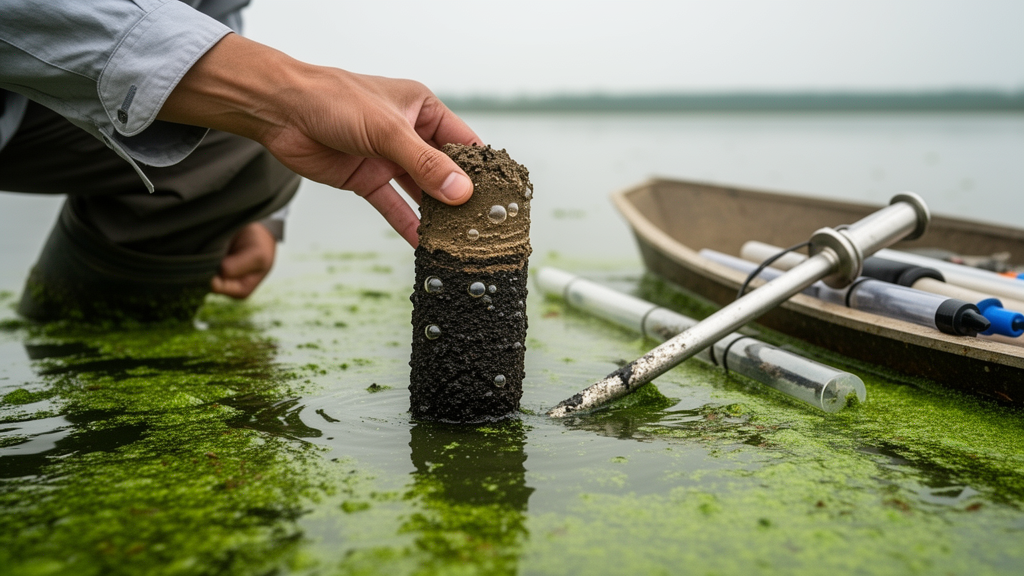
Researchers from the Nanjing Institute of Geography and Limnology and Nanjing University have published a comprehensive study in Biogeosciences detailing how macro-environmental constraints and local eutrophication shape sediment nitrogen removal in the Eastern China Plain lakes. The investigation, led by Jiahao Wei and colleagues, utilized 15N stable isotope tracing, 16S rRNA amplicon sequencing, and metagenomics profiling to quantify the contributions of denitrification and anaerobic ammonium oxidation, known as anammox, to the nitrogen budget of seventeen representative lakes. The findings reveal that while denitrification remains the dominant process across all studied systems, anammox makes a substantial and environmentally dependent contribution, reaching up to 34.3 percent in specific locations.
This study provides critical insights into the intrinsic purification capacity of these ecosystems, which are vital for regional water security and the regulation of global biogeochemical cycles. The Eastern China Plain lakes region encompasses the middle and lower reaches of the Yangtze River, the lower Yellow River, and the Huai River, covering a surface area exceeding 20,000 square kilometers. This area accounts for approximately 25.9 percent of China's total lake area and provides essential ecosystem services, including potable water supply, flood control, and fisheries.
However, rapid socioeconomic development has led to significant ecological degradation, with approximately 69.5 percent of lakes in China facing eutrophication. In the densely populated Eastern Plain Region, this phenomenon is particularly pronounced, causing annual economic losses exceeding ten billion US dollars. The study aimed to address the lack of systematic assessment of anammox in this region, which has previously been overlooked in favor of denitrification or dissimilatory nitrate reduction to ammonium.
Field surveys were conducted from August to October 2024, with 81 sampling sites established across the seventeen lakes. The researchers collected composite water samples and surface sediment for physicochemical analysis and microbial sequencing. Measurements based on the 15N isotope pairing technique revealed substantial spatial heterogeneity in sediment nitrogen removal rates.
Mean denitrification rates ranged from 26.58 to 117.54 nmol N g−1 h−1, with lakes situated along the Eastern Route of the South-to-North Water Diversion Project exhibiting elevated activities. In contrast, Lake Dongting and certain reservoir-type lakes displayed significantly lower rates. The spatial distribution of anammox rates was highly congruent with that of denitrification, ranging from 2.50 to 34.54 nmol N g−1 h−1, indicating that while denitrification predominates, anammox is a ubiquitous and significant process in these sediments.
Comparative analysis between eutrophic and mesotrophic sites demonstrated that denitrification rates, anammox rates, and the relative contribution of anammox were all significantly higher in eutrophic sites. This amplification is likely driven by prolonged exogenous nutrient loading, which sustains high substrate availability in the form of nitrogen and dissolved organic carbon. These substrates serve as critical metabolic resources for nitrogen-removing microorganisms, enhancing microbial substrate utilization efficiency and stimulating nitrogen cycling processes.
The study highlights that under specific substrate concentrations and redox conditions, anammox can form a synergistic relationship with denitrification, ultimately enhancing the magnitude and stability of nitrogen removal in lake ecosystems. Metagenomic analysis revealed that key functional genes mediating denitrification and anammox were ubiquitous across all studied lakes, yet their abundances varied substantially. Denitrification genes overwhelmingly dominated the functional gene pool, with a mean abundance approximately three orders of magnitude higher than anammox genes.
However, the study identified a pronounced decoupling among microbial community structure, functional gene abundance, and actual nitrogen removal rates. This discrepancy suggests that the presence of genes at the DNA level represents only genetic potential and does not guarantee their transcription into active proteins. The superior environmental adaptability of functionally redundant denitrifying bacteria, compared to the narrow ecological niche of anammox bacteria, further explains this divergence in process rates.
Statistical analyses, including Partial Least Squares Path Modeling, indicated that macro-scale factors such as spatial, climatic, and anthropogenic variables do not act as direct determinants of nitrogen removal rates. Instead, these factors indirectly drive the processes by reshaping local water-sediment physicochemical properties. Latitude showed significant positive correlations with both denitrification and anammox rates, with anammox exhibiting stricter latitudinal constraints.
Human Activity Intensity, quantified using construction land equivalent conversion coefficients, showed no direct significant effect on nitrogen removal rates across different spatial scales. This decoupling suggests that anthropogenic influences undergo environmental filtering, where human activities alter trophic states and sediment characteristics, which in turn regulate microbial metabolism through local substrate availability and redox conditions. The microbial community structure in the study area was primarily dominated by the phyla Chloroflexi and Proteobacteria, each exceeding 20 percent in relative abundance.
Beta-diversity analysis revealed highly significant differences in community structure among lakes, driven by regional environmental factors. Lakes along the Eastern Route of the South-to-North Water Diversion Project grouped together, reflecting high community similarity, while Lakes Poyang and Dongting formed distinct branches. This spatial structuring underscores the critical role of regional environmental heterogeneity in driving microbial community composition.
The high microbial diversity observed implies a high level of functional redundancy, allowing distinct taxa to perform similar metabolic functions and enabling denitrifying communities to occupy broader ecological niches. The study concludes that eutrophication significantly amplifies both the overall nitrogen removal capacity and the relative contribution of anammox in the Eastern China Plain lakes. Local physicochemical properties and microbial communities demonstrate a pronounced joint driving effect on these processes, while macro-scale factors operate indirectly through environmental reshaping.
The observed decoupling between genetic potential and active expression highlights the complexity of microbial responses to environmental perturbations. These findings enrich the fundamental understanding of nitrogen removal mechanisms and their multidimensional drivers, providing a scientific basis for future lake management strategies that must account for the overarching constraints imposed by trophic status, spatial gradients, and climatic variability to ensure the sustainability of nitrogen purification ecosystem services. By integrating stable isotope tracing with advanced genomic and statistical tools, this research offers a robust framework for assessing the self-purification mechanisms of eutrophic lakes.
The identification of anammox as a critical complementary process challenges previous assumptions that denitrification is the sole dominant pathway in such environments.
Subject of Research: Sediment nitrogen removal processes and microbial drivers in eutrophic lakes of the Eastern China Plain
Article Title: Macro constraints and local eutrophication shape sediment nitrogen removal in the Eastern China Plain lakes
Article References: Wei, J., Yang, K., Liu, Y., Yin, Y., Wang, L., Zhang, E., Gong, Z., & Cai, Y. (2026). Macro constraints and local eutrophication shape sediment nitrogen removal in the Eastern China Plain lakes. Biogeosciences, 23(20), 7545-7558. https://doi.org/10.5194/bg-23-7545-2026
Image Credits: AI Generated
Keywords: nitrogen removal, anammox, denitrification, eutrophication, lake sediments, Eastern China Plain, biogeosciences, microbial ecology, stable isotope tracing, water security, Macro, constraints
Cite Scienmag News
Violet Maxwell. (October 26, 2026). Eutrophication Boosts Anammox in Eastern China Plain Lake Sediments. Scienmag. https://scienmag.com/eutrophication-boosts-anammox-in-eastern-china-plain-lake-sediments/
Violet Maxwell. "Eutrophication Boosts Anammox in Eastern China Plain Lake Sediments." Scienmag, 26 October 2026, https://scienmag.com/eutrophication-boosts-anammox-in-eastern-china-plain-lake-sediments/. Accessed 26 October 2026.
Violet Maxwell. "Eutrophication Boosts Anammox in Eastern China Plain Lake Sediments." Scienmag. October 26, 2026. https://scienmag.com/eutrophication-boosts-anammox-in-eastern-china-plain-lake-sediments/


