

A small observational study of 15 Military Police officer trainees in Brazil found that most participants judged their body dimensions reasonably accurately, but the group as a whole tended to underestimate its size. Sixty-six percent of the trainees fell within the study’s range for adequate perception, 26 percent underestimated their bodies and 8 percent overestimated them. The clearest discrepancy involved shoulder width: participants estimated it at an average of 77.70 percent of its measured value, compared with 92.86 percent for waist width. The researchers found no statistically significant relationships between body-perception indices and anthropometric measurements, physical-activity time or mood state. Because the sample was small, predominantly male and drawn from a single training program, the results offer a focused snapshot rather than evidence about police officers generally.
Body dimension perception includes not only how people feel about their appearance but also their neurological and spatial representation of their own bodies. The researchers described this representation as a guide for motor planning and for understanding how the body relates to surrounding spaces and objects. The military police profession places unusual demands on such capacities, with officers expected to perform in environments involving violence, long working hours and other high-stress conditions. The study therefore examined students in the Officer Training Course of the Military Police of Espírito Santo, asking whether they perceived their own body dimensions accurately and whether those perceptions were associated with physical characteristics, habitual activity or emotional state. It also focused on a military setting in which uniforms, physical standards and group expectations may shape how trainees understand their bodies.
The participants were active-duty officers enrolled in the initial three-year course for entry into the combatant-officer career. The program, held full time at the Military Police Academy of Espírito Santo, combines academic, legal, operational, managerial and ethical instruction with physical and practical training, supervised internships and institutional activities. Volunteers were assessed at the academy during working days in the final month of the course. After providing written informed consent, they completed anthropometric measurements, handgrip strength tests, self-report questionnaires addressing perceived stress and habitual physical activity, and a tactile procedure for estimating body dimensions. Officers on leave, temporarily removed from duty for medical or psychological reasons, or who did not complete all study procedures were excluded. The final sample comprised 4 women and 11 men.
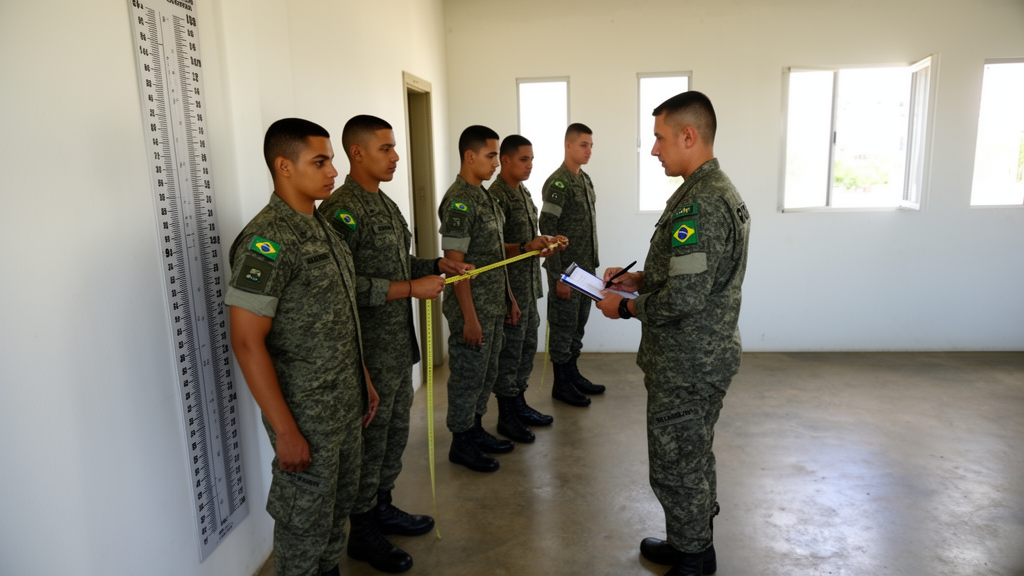
Perception was measured with an Image Marking Procedure. Investigators marked the participants’ acromioclavicular joints, waist curves and greater trochanters on both sides with colored adhesive labels. Each participant stood beside a wall fitted with a vertical measuring tape. After the researcher touched a marked point, the participant indicated its orthogonal projection on the wall, where it was labeled. The sequence covered the top of the head, right shoulder, waist and hip, followed by the left shoulder, waist and hip. The procedure was repeated three times, with participants unable to see previous markings. Their actual heights and widths were then measured while they stood near the wall with their sight obscured and their foot alignment maintained. Photographs of the labels and wall tape were later analyzed to calculate the distances between perceived and actual positions in both height and horizontal width.
The resulting Body Perception Index, or BPI, was calculated as the ratio between perceived and actual measurements multiplied by 100, with an overall index obtained by averaging the regional values. Scores from 99.4 to 112.3 percent were classified as adequate, values above 112.3 percent as overestimation, or hyper-schematism, and values below 99.4 percent as underestimation, or hypo-schematism. The overall mean BPI was 88.73 percent, with a standard deviation of 14.77 and a 95 percent confidence interval of 80.55 to 96.91. Although 10 participants were classified as having adequate overall perception, the group mean fell below the lower limit of the adequate range, indicating an overall tendency toward underestimation rather than a contradiction in the data.
Regional results showed that waist width received the highest mean BPI, at 92.86 percent with a standard deviation of 21.36, while shoulder width received the lowest, at 77.70 percent with a standard deviation of 13.88. Head perception averaged 92.58 percent and hip perception 91.78 percent. The shoulders therefore stood out as the body region most strongly underestimated. The authors noted that broad shoulders are often culturally associated with masculinity, strength and an idealized military physique. A slimmer waist, by contrast, is emphasized as a marker of physical conditioning and can be more directly addressed through training routines. The contrast between relatively closer waist estimates and substantially smaller shoulder estimates may therefore reflect different expectations attached to those body regions, although the study did not directly test that explanation or establish what caused it.
The trainees’ physical measurements also illustrated why body mass alone cannot characterize their condition. Mean body mass was 80.45 kilograms, height was 1.76 meters and BMI was 25.93 kilograms per square meter, a value categorized as overweight. Estimated body fat averaged 12.29 percent, which the study classified as normal, while mean waist circumference was 83.67 centimeters. The authors argued that assessing overweight status or obesity in military personnel should not rely solely on BMI. Combining body mass, BMI and estimated fat percentage may provide a more consistent assessment in this population. The data are descriptive measures from one small sample, however, and do not establish the health status of individual officers or support conclusions about military personnel as a whole.
Self-reported activity was high: participants accumulated an average of 586.3 minutes of physical activity per week across light, moderate and intense domains, with 243.3 minutes classified as light, 154.3 as moderate and 188.7 as intense. Their mood profile was characterized by mean vigor of 5.86 and fatigue of 5.40, while tension averaged 2.60, anger 2.86, depression 1.26 and mental confusion 0.73. The investigators observed that vigor and fatigue were similar in magnitude, limiting the profile in which vigor exceeds each negative mood factor. They suggested that end-of-course demands, including academic evaluations, project presentations and operational internships, could have contributed to fatigue. These are interpretations offered by the authors; the study did not directly test whether course demands caused fatigue or whether mood altered body estimates.
The most notable statistical result was the absence of significant correlations between regional or overall BPI values and the other measured variables. Pearson tests showed no significant relationships with BMI, body-fat percentage, other anthropometric indicators, physical-activity time or any mood dimension at the prespecified threshold of p less than 0.05. In statistical terms, the data did not provide evidence of a linear association between those variables and the measured perception indices. The authors suggested that the standardized military environment, including discipline, physical ideals and professional identity, may make body perception more closely connected with group expectations than with individual physical characteristics. That remains a proposed interpretation, because the study did not directly measure group expectations as an explanatory variable.
The study’s scope imposes substantial limits. Fifteen participants, 11 of them male, were recruited from one course at one Brazilian academy, and the researchers explicitly warned against broad generalization. Physical activity and mood were assessed through questionnaires, which may have introduced reporting variability, while the sample comprised trainees rather than officers primarily engaged in operational duties. The study also did not measure performance in tactical planning, movement in confined spaces or firearm tasks, so it cannot establish whether perception differences affect operational effectiveness or safety. Its clearest contribution is a description of how a particular group of future officers estimated their own dimensions: most met the study’s adequacy threshold, a substantial minority underestimated their bodies, and shoulder width was the least accurately judged region. Larger and more diverse studies with direct performance measures would be needed to determine whether those perceptual patterns have practical consequences in police work.
Subject of Research: Body-size perception among Brazilian Military Police officer trainees
Article Title: Body dimension perception: a study among students of the military police officer training course
Article References: Rica, R. L., Gama, E. F., Oliveira, G. S., de Deus, M. F., Bullo, V., Bergamin, M., Gobbo, S., & Bocalini, D. S. (2026). Body dimension perception: a study among students of the military police officer training course. Frontiers in Psychology, 17, Article 1791464. https://doi.org/10.3389/fpsyg.2026.1791464
Image Credits: AI Generated
DOI: 10.3389/fpsyg.2026.1791464
Keywords: body-size perception, Military Police, officer training, shoulder width, body composition, physical activity, mood state, anthropometry, Brazil, Body, dimension, perception
Cite Scienmag News
Scienmag. (October 26, 2026). Military Police Trainees Underestimate Body Size in Small Brazilian Study. https://scienmag.com/military-police-trainees-underestimate-body-size-in-small-brazilian-study/
Scienmag. "Military Police Trainees Underestimate Body Size in Small Brazilian Study." Scienmag, 26 October 2026, https://scienmag.com/military-police-trainees-underestimate-body-size-in-small-brazilian-study/. Accessed 26 October 2026.
Scienmag. "Military Police Trainees Underestimate Body Size in Small Brazilian Study." Scienmag. October 26, 2026. https://scienmag.com/military-police-trainees-underestimate-body-size-in-small-brazilian-study/


