


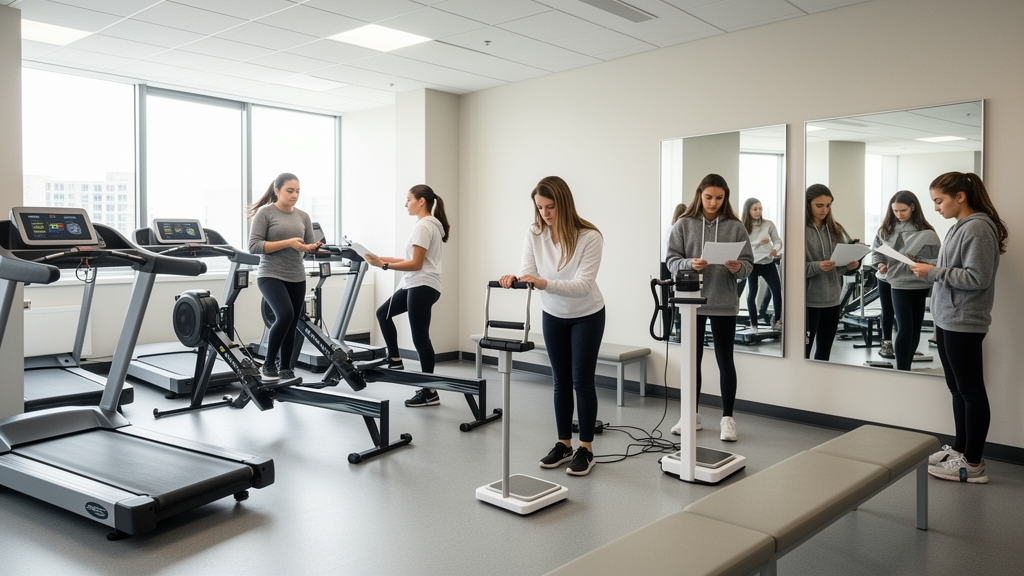
A 16-week study of 54 female undergraduates found that objectively measured changes in balance, flexibility and cardiorespiratory response generally did not track changes in how participants perceived their physical abilities. In contrast, physical self-perception moved closely with depression, anxiety and stress. The quasi-experimental study assessed women enrolled in dancesport, aerobics or continued habitual activity at baseline and at weeks 8 and 16. Of 24 within-person associations linking four measured capacities with six physical self-perception scores, only one reached nominal significance—fewer than would be expected by chance. Equivalence testing found that 21 were statistically compatible with zero relative to the study’s prespecified smallest effect of interest of 0.30, providing a tighter constraint than ordinary failure to reject a null hypothesis.
The investigators designed the analysis around a key distinction in the Exercise and Self-Esteem Model. The model proposes that exercise improves physical competence, which raises physical self-perception, which in turn raises global self-esteem. Much of the previous evidence has compared different people at a single moment, although the model describes a process unfolding within an individual. The researchers therefore separated changes within each participant from stable differences between participants. They also included a linear session term to account for shared passage of time. That adjustment proved important: without it, an apparent association between improvement in right-leg balance and sports competence, with a coefficient of 0.274, fell to 0.126 and lost statistical significance once secular change was modeled. The same pattern appeared for balance and total physical self-perception.
Participants were purposively recruited at Fuyang Institute of Technology in China. All were 18–22 years old, had no current injury or hypertension and had no previous formal training in dancesport or aerobics. The dancesport and aerobics groups each attended one supervised 90-minute class per week for 16 weeks, receiving 24 hours of structured instruction. The comparison group received no organized program and logged its habitual recreational activity, principally basketball, badminton and football, averaging 1.1 sessions of 88 minutes per week. All 54 participants completed all three assessments, producing 162 observations and no missing outcome data. Because students selected their courses rather than being randomly assigned, the design cannot establish that one activity caused better outcomes than another.
Physical changes occurred over the semester in all three conditions. Balance showed the largest session effect, including a partial eta squared of 0.287 for the right-leg stork-stand test, while flexibility, resting systolic pressure and total physical self-perception also changed. These improvements could not be attributed confidently to course content. Baseline scores were inversely correlated with subsequent change for every outcome examined, with correlations from about −0.44 to −0.69, indicating strong regression to the mean. Repeated testing and familiarization may also have contributed. The comparison group improved at least as much as the taught groups on most physical and self-perception outcomes: right-leg balance increased by a standardized 1.24 in the comparison group, compared with 0.60 in dancesport, while total physical self-perception rose by 0.84 and 0.60 standardized units, respectively.
Objective capacity showed little within-person connection to physical self-perception. Right-leg balance, which changed most over the semester, was unrelated to sports competence and total physical self-perception. Sit-and-reach was unrelated to all six self-perception outcomes, and all 12 within-person associations between the four capacity measures and psychological distress were statistically equivalent to zero against the 0.30 bound. The single nominally significant capacity-perception result concerned post-exercise recovery heart rate and perceived body attractiveness, with a small coefficient of −0.180 and a p-value of 0.049. The researchers did not apply a formal multiplicity correction, instead interpreting the count of nominally significant findings in light of the number expected by chance. Even with the one apparent exception, the overall pattern did not support a measurable coupling between objective change and perceived physical change.
The clearest positive finding involved two self-reported constructs. Within participants, higher total physical self-perception was associated with lower depression, anxiety and stress, with coefficients of −0.288, −0.279 and −0.252, respectively. Negative associations also appeared across most individual self-perception subscales. These results should not be interpreted as proof that improved perceptions cause lower distress: both measures were collected by self-report at the same assessment, creating the possibility of shared method effects. Nor was the pooled association evenly distributed. It was substantially dependent on the aerobics group, whose within-person depression coefficient was −0.706; removing that group changed the pooled depression estimate from −0.288 to 0.037 and reversed its sign. The aerobics group also had more than twice the within-person variability in depression as the dancesport group, raising the possibility that greater fluctuation helped produce the stronger association.
Measurement timing may also have contributed to the apparent moderation. At weeks 8 and 16, participants in both taught groups completed questionnaires after class and 10–15 minutes of seated rest, while the comparison group completed them without a preceding exercise bout. Because acute exercise can temporarily improve state body image, self-reports in the taught groups were obtained inside an acute post-exercise window. The session term could absorb the average effect of this timing difference but could not distinguish it from a durable change. In the capacity analyses, the timing imbalance did not create evidence of condition-specific coupling between balance and sports competence. The distress result, however, should be regarded as heterogeneous and in need of replication with assessment timing matched across groups.
Several measurement and design limitations constrain what the null capacity findings mean. Single-leg balance has relatively low test–retest reliability, while sit-and-reach is a field index of trunk and hamstring extensibility with weak criterion validity against goniometric measurement. Unreliable or invalid predictors can attenuate observed associations, so the results cannot conclusively show that the model’s capacity-to-perception link is absent. The study also lacked a global self-esteem measure and therefore tested only one link in the proposed four-tier pathway. With 18 participants per condition, the analysis had 80% power to detect a standardized within-person slope of 0.265 and 90% power for 0.303, meaning smaller effects could not be estimated reliably. Psychometric validation of the Chinese Physical Self-Perception Profile has addressed factor structure, internal consistency and cross-cultural invariance, but its responsiveness to measured physical change remains unestablished.
The practical lesson for interpreting the results is that perceived physical change and measured physical change are not interchangeable. Across 16 weeks, field-measured balance, flexibility and cardiorespiratory response improved in ways that did not reliably accompany changes in physical self-perception, while self-perception covaried with distress. The authors recommend treating self-report scales and field tests as complementary rather than substitutable, noting that a course evaluated only through perceived competence could appear successful without measurable physical adaptation, just as a course showing objective improvement might not shift students’ views of themselves. A more informative follow-up would combine matched questionnaire timing, task-specific measures of perceived competence and intensive longitudinal assessment. Such a design could better determine whether a pathway from measured capacity to physical self-perception operates in adults but was obscured here by measurement limitations, shared trends or a self-selected sample.
Subject of Research: A 16-week within-person test of links among measured physical capacity, physical self-perception and psychological distress in female undergraduates
Article Title: A 16-week within-person test of the Exercise and Self-Esteem Model in female undergraduates
Article References: Lulu, W., Yingxue, W., & Sut Txi, M. R. (2026). A 16-week within-person test of the Exercise and Self-Esteem Model in female undergraduates. Frontiers in Psychology, 17, Article 1973095. https://doi.org/10.3389/fpsyg.2026.1973095
Image Credits: AI Generated
DOI: 10.3389/fpsyg.2026.1973095
Keywords: exercise psychology, physical self-perception, objective fitness, psychological distress, within-person analysis, female undergraduates, multilevel modeling, dancesport, aerobics, quasi-experimental study, week, within-person
Cite Scienmag News
Glenn Wilkins. (October 25, 2026). Objective fitness gains did not track self-perception in female undergraduates. Scienmag. https://scienmag.com/objective-fitness-gains-did-not-track-self-perception-in-female-undergraduates/
Glenn Wilkins. "Objective fitness gains did not track self-perception in female undergraduates." Scienmag, 25 October 2026, https://scienmag.com/objective-fitness-gains-did-not-track-self-perception-in-female-undergraduates/. Accessed 25 October 2026.
Glenn Wilkins. "Objective fitness gains did not track self-perception in female undergraduates." Scienmag. October 25, 2026. https://scienmag.com/objective-fitness-gains-did-not-track-self-perception-in-female-undergraduates/


