


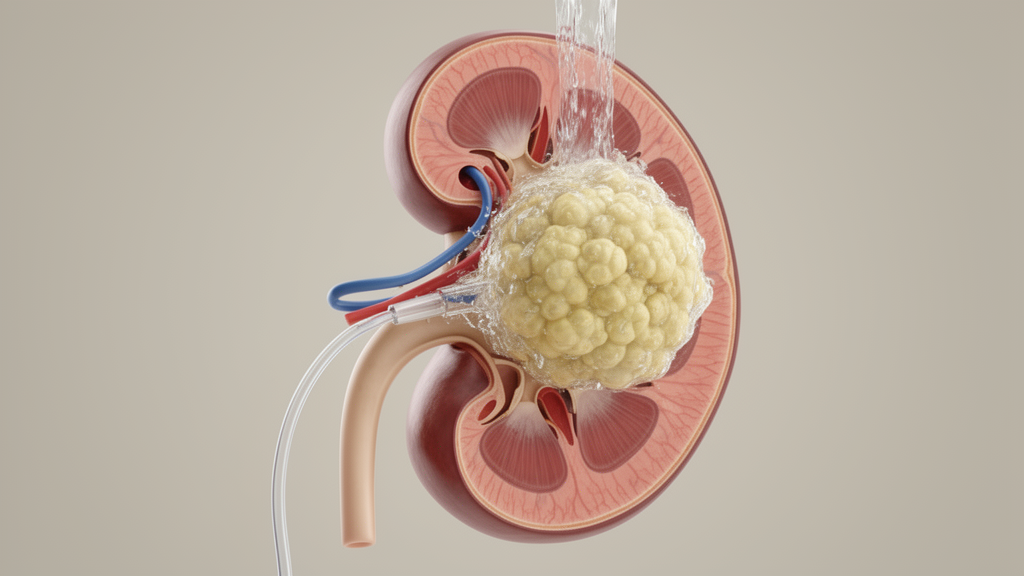
A 26-year-old woman with spina bifida arrived at a Beirut hospital in April 2026 with septic shock and what imaging suggested was a branching staghorn calculus lodged in her right kidney. Surgeons who finally reached the mass with an endoscope found something no scan had predicted: there was no stone at all. The branching density was a fungal bezoar, a solid mass of Candida hyphae, inflammatory debris and biofilm that had grown large enough to obstruct the renal pelvis. When systemic antifungal drugs and laser fragmentation both failed to dent it, her urology, infectious diseases and clinical pharmacy teams tried an approach with almost no published adult precedent: six days of continuous irrigation with liposomal amphotericin B, delivered antegrade through a nephrostomy tube directly onto the fungal mass. The case, published as a case report in Frontiers in Medicine on 23 October 2026, describes how the previously rock-firm bezoar turned markedly softer and less adherent, allowing complete endoscopic removal.
Fungal bezoars of the upper urinary tract are rare but potentially serious complications of complicated candidiasis, and they are among the most stubborn problems in urological infectious disease. They are most commonly caused by Candida species and typically arise in patients with predisposing factors such as urinary tract obstruction, indwelling catheters or stents, nephrostomy tubes, diabetes mellitus, prolonged antibiotic exposure, immunosuppression, or structural abnormalities of the urinary tract. Unlike kidney stones, which are crystalline mineral, bezoars are composed of fungal hyphae, necrotic tissue, inflammatory debris and biofilm. They can cause persistent obstruction, hydronephrosis, recurrent infection and acute kidney injury, and they often respond poorly to systemic antifungal therapy alone because of the enormous fungal burden and the limited penetration of drugs into the densely organized mass. That combination of infection and mechanical obstruction is what makes source control, through urinary decompression and endoscopic or surgical removal, so central to their management.
The patient in this report carried nearly every risk factor for such a mass. Her medical history included spina bifida, a ventriculoperitoneal shunt, epilepsy treated with valproic acid, an atrophic left kidney with a baseline creatinine of 0.50 to 0.60 mg/dL, and a neurogenic bladder managed with intermittent catheterization three times daily. She initially presented on 2 April 2026 with obstructive urosepsis associated with a right renal pelvic density presumed to represent a staghorn calculus. Her white blood cell count was 19,400 per cubic millimeter, C-reactive protein was 304.0 mg/L, and creatinine had climbed to 2.4 mg/dL. Her temperature reached 39 degrees Celsius and her blood pressure fell to 91/48 mmHg. She required urgent right double-J ureteral stent insertion, followed by right and left nephrostomy placement, because of recurrent sepsis and persistent bilateral hydronephrosis. A left nephrostomy placed on 20 April drained purulent material, after which her fever finally resolved.
Once clinically stabilized, she underwent right flexible ureteroscopy with stent exchange on 24 April 2026 for the presumed staghorn calculus. Intraoperative evaluation unexpectedly demonstrated a large white fungal bezoar occupying the right renal pelvis and causing obstruction, with no calculus present. Surgeons attempted to fragment and remove the mass using a holmium:YAG laser at a maximum power of 20 watts, but the effort was unsuccessful. Fungal culture from the right renal pelvis subsequently grew Candida lusitaniae, supporting the diagnosis of an obstructing renal fungal bezoar. Systemic fluconazole at 400 mg once daily was administered for two weeks. Despite that antifungal treatment, follow-up imaging continued to demonstrate a persistent right renal pelvic filling defect consistent with the bezoar, and the mass remained a potential source of ongoing infection and obstruction.
On 7 May 2026 the patient was readmitted with fever reaching 39.8 degrees Celsius and decreased output from the left nephrostomy tube. Computed tomography demonstrated dislodgement of the left nephrostomy tube with pyelitis, persistent right renal pelvic density suspicious for the known bezoar, and bilateral urinary tract inflammatory changes. Broad-spectrum antimicrobial therapy with meropenem, vancomycin and fluconazole was initiated, and emergency left double-J ureteral stent insertion was performed for decompression, with two stents placed because of a duplicated left collecting system. Because the obstructing right renal bezoar persisted despite systemic antifungal therapy, a multidisciplinary team comprising urology, infectious diseases and clinical pharmacy elected to add continuous local antifungal therapy through the existing right 8-Fr nephrostomy tube, which had originally been placed for persistent hydronephrosis despite ureteral stenting.
The irrigation regimen was precisely specified. Liposomal amphotericin B was prepared as 100 mg in 500 mL of 5 percent dextrose, corresponding to a concentration of 0.2 mg/mL, and administered continuously through the right nephrostomy tube at 20 mL per hour, equivalent to approximately 4 mg per hour, for six consecutive days before the planned definitive endoscopic intervention. The total administered dose was approximately 550 mg. The continuous low-rate administration was selected to provide prolonged direct exposure of the fungal mass to amphotericin B while maintaining continuous drainage through the pre-existing ureteral stent and Foley catheter, and minimizing systemic toxicity. Because nephrostomy administration of liposomal amphotericin B is off-label, treatment was undertaken with multidisciplinary oversight from all three teams. During the irrigation period the patient was monitored for changes in vital signs, urine output, nephrostomy patency and drainage, flank pain, hematuria and treatment-related symptoms, and her renal function, serum potassium and magnesium, liver function and hematologic parameters were checked. No treatment-related clinical abnormalities or catheter-associated complications were documented.
Following the local antifungal therapy, the patient underwent right percutaneous nephrolithotomy on 14 May 2026. Follow-up CT demonstrated an interval reduction in the bezoar from 2.3 cm to 1.6 cm. Through the established percutaneous tract, the nephroscope was introduced and the fungal mass was completely fragmented and removed using an ultrasonic LithoClast probe. Retrograde pyelography confirmed satisfactory drainage, and a right nephrostomy tube was left in place. Compared with the initial ureteroscopic findings, the surgeons noted intraoperatively that the bezoar was significantly softer and less adherent, facilitating complete removal without complications. The postoperative course was uneventful: the nephrostomy tube was clamped on postoperative day one after confirmation of adequate drainage, the patient remained afebrile and hemodynamically stable throughout, and she was discharged in excellent clinical condition on oral fluconazole 300 mg daily with a Foley catheter in situ. At two-month follow-up, CT demonstrated no residual right renal pelvic fungal bezoar, and urine cultures grew no organisms.
The choice of the liposomal formulation was driven by both biology and logistics. Amphotericin B is a large polyene antifungal medication existing in multiple forms, including amphotericin B deoxycholate and later lipid-based formulations. At the molecular level, amphotericin B deoxycholate is organized in a micellar distribution, binding directly to the fungal cell membrane through ergosterol. The liposomal form instead releases the amphotericin B molecule from its liposome carrier once it contacts the fungal cell membrane; the molecule then binds ergosterol, leading to the formation of pores in the membrane. The 2016 Infectious Diseases Society of America guidelines recommend urinary tract decompression, surgical or endoscopic removal when feasible, systemic antifungal therapy, and adjunctive nephrostomy irrigation with amphotericin B deoxycholate at 25 to 50 mg in 200 to 500 mL of sterile water when a nephrostomy tube is present. But amphotericin B deoxycholate was unavailable in the country, and the IDSA guidelines do not recommend liposomal amphotericin B for local urinary irrigation or provide a dosing regimen for that formulation. The regimen used therefore represented an individualized, off-label strategy informed by limited published experience and multidisciplinary assessment, and its safety, efficacy and optimal dosing remain uncertain.
Published experience with continuous antegrade nephrostomy irrigation remains scarce, and existing recommendations are based almost exclusively on the deoxycholate form. To date, only one published report, by Lee and colleagues, has described continuous antegrade liposomal amphotericin B nephrostomy irrigation, as part of a multimodal strategy for refractory upper urinary tract fungal infection in an infant. The present case adds an adult observation on the feasibility of the approach. The authors also note that liposomal amphotericin B has been shown to be safer than deoxycholate given the reported nephrotoxicity profile of the older formulation in adults and children, although that evidence comes from systemic administration rather than nephrostomy irrigation. On the endoscopic side, the case aligns with a growing sense that large, organized pelvicalyceal bezoars require a percutaneous approach: small mobile masses have been managed with flexible ureteroscopy and basket extraction, whereas larger masses often require percutaneous clearance. A similar strategy was reported by Zhang and colleagues, who successfully treated a giant renal fungal bezoar using percutaneous nephroscopy with an ultrasonic lithotripsy system that combined fragmentation with continuous aspiration, underscoring the importance of complete mechanical evacuation as part of multimodal therapy. In this patient, the ultrasonic lithotripter enabled simultaneous suction and evacuation of friable fungal debris, facilitating efficient clearance of the collecting system.
The authors are careful about what the case can and cannot show. As a single-case report, it does not permit conclusions regarding the efficacy or comparative effectiveness of continuous antegrade liposomal amphotericin B irrigation. The patient received concurrent systemic antifungal therapy, urinary decompression and sequential endoscopic interventions, which collectively contributed to the clinical and operative evolution, so the independent causal effect of local irrigation cannot be determined. The change in bezoar consistency should be interpreted as a temporal observation occurring after local irrigation rather than evidence of an independent treatment effect. Still, the marked softening observed at repeat surgery after six days of continuous irrigation is a noteworthy clinical finding that may suggest a beneficial adjunctive role, and the treatment was well tolerated with no documented evidence of amphotericin-associated toxicity. Further case reports, prospective studies and multicenter collaborations are needed to establish the optimal formulation, dosing regimen, duration of therapy, safety profile and clinical efficacy of local liposomal amphotericin B irrigation, and to determine whether it offers meaningful advantages over the currently recommended amphotericin B deoxycholate for local urinary tract administration. For now, the case stands as a proof of feasibility for selected patients whose obstructing renal fungal bezoars are refractory to systemic therapy and resistant to conventional surgery alone.
Subject of Research: Infectious Diseases and Urology
Article Title: Case Report: Continuous antegrade liposomal amphotericin B irrigation as an adjunct to endoscopic management of a refractory renal fungal bezoar
Article References: Ghaziri, D., Balaghi, A., Al Awar, G., Hamawi, J., & Abdessater, M. (2026). Case Report: Continuous antegrade liposomal amphotericin B irrigation as an adjunct to endoscopic management of a refractory renal fungal bezoar. Frontiers in Medicine, 13, Article 1965455. https://doi.org/10.3389/fmed.2026.1965455
Image Credits: AI Generated
DOI: 10.3389/fmed.2026.1965455
Keywords: fungal bezoar, Candida lusitaniae, liposomal amphotericin B, nephrostomy irrigation, urology, infectious diseases, case report, Case, Report, Continuous, antegrade, liposomal
Cite Scienmag News
Ophelia Keating. (October 25, 2026). Continuous antifungal irrigation softened a refractory kidney fungal bezoar. Scienmag. https://scienmag.com/continuous-antifungal-irrigation-softened-a-refractory-kidney-fungal-bezoar/
Ophelia Keating. "Continuous antifungal irrigation softened a refractory kidney fungal bezoar." Scienmag, 25 October 2026, https://scienmag.com/continuous-antifungal-irrigation-softened-a-refractory-kidney-fungal-bezoar/. Accessed 25 October 2026.
Ophelia Keating. "Continuous antifungal irrigation softened a refractory kidney fungal bezoar." Scienmag. October 25, 2026. https://scienmag.com/continuous-antifungal-irrigation-softened-a-refractory-kidney-fungal-bezoar/


