


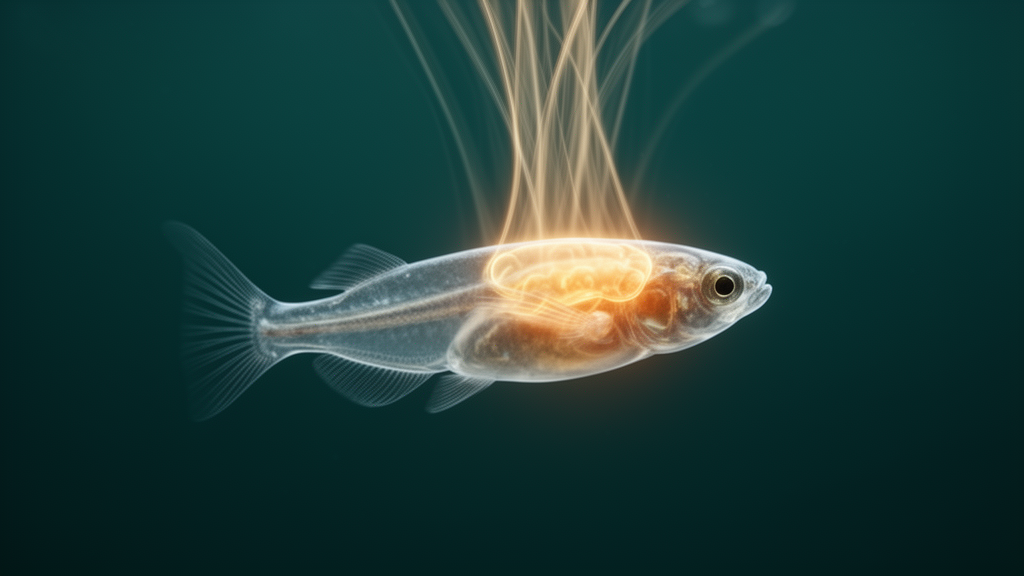
A new study in larval zebrafish shows that the optic tectum, the brain region long associated with detecting approaching predators and triggering escape, does more than process sight. Researchers found that when a brief auditory cue coincides with the end of a visual expansion, tectal neurons respond more strongly than to either stimulus alone, and this neural enhancement was paralleled by a higher probability of escape in behavioral trials. The team presented freely swimming larvae with visual looming stimuli of varying contrast and single-frequency auditory tones, delivered so that the sound arrived at the end of the visual expansion.
Across behavioral trials, escape probability rose above what either modality produced on its own. This inverse relationship is consistent with the principle of inverse effectiveness described in the mammalian superior colliculus. Using calcium imaging at single-cell resolution, the researchers then examined how these stimuli are represented inside the tectum.
Auditory tones alone produced robust activation in the tectal neuropil, the layer containing dendrites and afferent inputs, with the response concentrated in the deeper regions of the neuropil closer to the medial edge of the tectum. Visual looming stimuli, by contrast, activated neurons and neuropil regions associated with the superficial layers receiving retinal input. On average, auditory stimulation raised the fraction of simultaneously active tectal neurons from a basal level of around 3 percent to roughly 8 percent.
Single-cell analysis revealed several distinct response classes within the tectal neuron population. About 29 percent of neurons responded exclusively to visual looming stimuli and never to sound, while roughly 19 percent responded only to auditory tones. Strikingly, about 19 percent of tectal neurons responded to both modalities when presented separately, a proportion far exceeding previous reports for non-threat audiovisual cues in zebrafish.
Most remarkably, approximately 12 percent of neurons never responded to either stimulus alone yet fired reliably when both arrived together, suggesting that these cells receive convergent visual and auditory inputs that alone remain below their activation threshold. The spatial organization of these responses carried functional meaning. Auditory-evoked activity in the neuropil clustered toward the medial edge at a measured average distance of 26.78 ± 10.18 micrometers, significantly closer than expected from random spatial distributions.
This spatial pattern suggests auditory inputs may reach the tectum in layers distinct from those contacted by retinal afferents. When the researchers quantified the degree of multisensory enhancement per experiment, they found that experiments with weaker visual responses showed larger audiovisual gains, a pattern consistent with inverse effectiveness at the level of individual imaging planes. To examine whether tectal enhancement relates to motor output, the researchers identified hindbrain neurons whose activity correlated with movement events.
These neurons, distributed across rhombomeres 1 through 7, responded to visual, auditory, and combined stimuli in a pattern that paralleled the behavioral escape probabilities. Multisensory stimuli recruited a higher proportion of these movement-correlated neurons than either unisensory stimulus. Across experiments, about 30 percent (standard deviation 22 percent) of movement-correlated neurons in the anterior hindbrain showed positive correlations with the degree of multisensory integration measured in the tectum.
The authors note that this evidence is correlational and does not establish that tectal integration causes hindbrain recruitment. This work adds to previous studies of the zebrafish tectum in multisensory processing. Earlier work had reported that few tectal neurons responded to more than one modality when cues were not threat signals.
The current results show that the nature of the stimuli matters: when cues are ecologically relevant danger signals rather than arbitrary pairings, the tectum exhibits strong integrative responses consistent with its role in predator detection across vertebrates. The study provides a framework for examining how multisensory circuits relate sensory convergence to behavioral decisions. By combining calcium imaging with quantitative stimulus design and movement-correlated neuron identification, the researchers showed that the tectum operates as an integrative hub rather than a purely visual relay in this context.
The convergence of spatially distinct auditory and visual representations onto shared tectal circuits, and the correlation between tectal multisensory integration and activity in hindbrain movement-related neurons, link sensory combination with escape behavior in a genetically tractable vertebrate model, while leaving the causal chain between these levels an open question.
Subject of Research: Integration of audiovisual danger stimuli in the zebrafish tectum is linked with premotor and behavioral enhancements
Article Title: Integration of audiovisual danger stimuli in the zebrafish tectum is linked with premotor and behavioral enhancements
Article References: Martorell, N., & Medan, V. (2026). Integration of audiovisual danger stimuli in the zebrafish tectum is linked with premotor and behavioral enhancements. iScience, 29(11), Article 118007. https://doi.org/10.1016/j.isci.2026.118007
Image Credits: AI Generated
DOI: 10.1016/j.isci.2026.118007
Keywords: Integration, audiovisual, danger, stimuli, zebrafish, tectum, linked, premotor, behavioral, enhancements, scientific research
Cite Scienmag News
Cassandra Pierce. (October 25, 2026). Zebrafish Tectum Integrates Visual and Auditory Threat Cues to Sharpen Escape Decisions. Scienmag. https://scienmag.com/zebrafish-tectum-integrates-visual-and-auditory-threat-cues-to-sharpen-escape-decisions/
Cassandra Pierce. "Zebrafish Tectum Integrates Visual and Auditory Threat Cues to Sharpen Escape Decisions." Scienmag, 25 October 2026, https://scienmag.com/zebrafish-tectum-integrates-visual-and-auditory-threat-cues-to-sharpen-escape-decisions/. Accessed 25 October 2026.
Cassandra Pierce. "Zebrafish Tectum Integrates Visual and Auditory Threat Cues to Sharpen Escape Decisions." Scienmag. October 25, 2026. https://scienmag.com/zebrafish-tectum-integrates-visual-and-auditory-threat-cues-to-sharpen-escape-decisions/


