


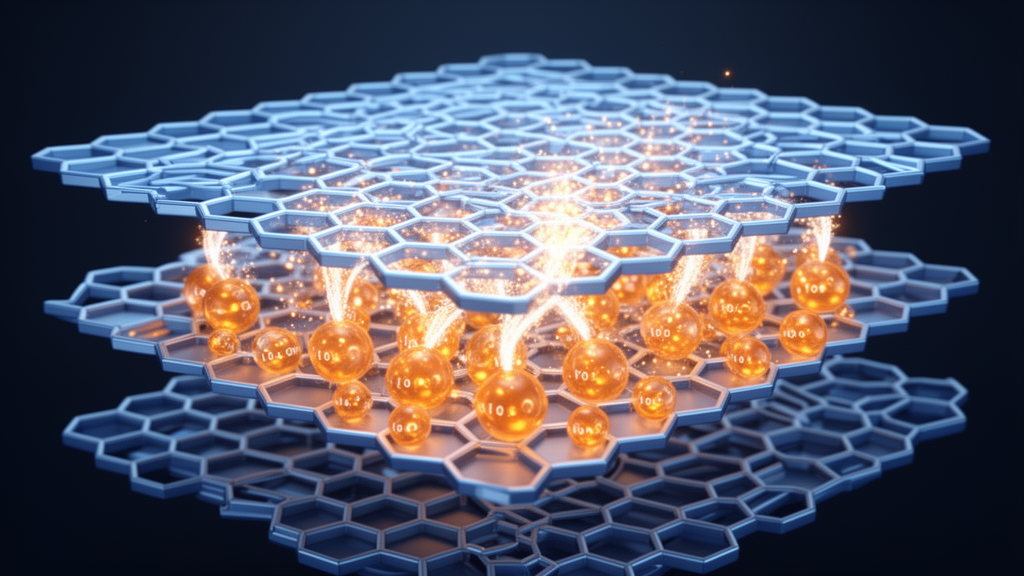
Researchers have demonstrated that the catalytic efficiency of graphene for the iodide oxidation reaction can be significantly enhanced by engineering its electronic structure through two distinct mechanisms: electrostatic gating in monolayer graphene and twist-angle control in bilayer graphene. By utilizing scanning electrochemical cell microscopy, the study maps local electrochemical activity with a lateral resolution of approximately 100 nanometers, revealing how modifications to the Dirac cones of graphene directly influence interfacial charge transfer. The findings indicate that magic-angle twisted bilayer graphene exhibits the strongest catalytic response, offering a promising metal-free alternative for anodic reactions in electrochemical energy conversion systems.
The iodide oxidation reaction presents a kinetically and energetically favorable alternative to the oxygen evolution reaction, which is often the performance-limiting step in water splitting due to its complex four-electron transfer process. In contrast, the oxidation of iodide to triiodide or iodine proceeds through a two-electron pathway with faster kinetics and a lower overpotential. The theoretical standard redox potential of the iodide-triiodide couple is +0.54 V versus the standard hydrogen electrode, significantly lower than the +1.23 V required for oxygen evolution. This lower potential enables operation at reduced cell voltages, making iodide oxidation attractive for hydrogen production and the generation of high-value iodine products used in pharmaceuticals, chemical synthesis, and energy storage.
Graphene, a two-dimensional material composed of a single layer of sp2-hybridized carbon atoms, possesses exceptional electronic properties arising from its linear energy dispersion and high carrier mobility, features described by Dirac cones. The study compared two experimentally distinct approaches for manipulating this electronic structure. Electrostatic gating allows for the continuous tuning of the Fermi level and carrier density in monolayer graphene, while twist-angle control in bilayer graphene creates a moiré superlattice that structurally reconfigures the electronic landscape. Both methods aim to optimize the alignment between the graphene’s electronic states and the redox potential of the iodide species to facilitate more efficient electron transfer.
The experimental platform employed scanning electrochemical cell microscopy, where a scanning nanopipette probe containing 50 millimolar sulfuric acid and 0.1 molar sodium iodide forms a localized electrochemical cell upon contact with the graphene surface. A palladium wire within the pipette serves as a quasi-reference counter electrode, completing the local circuit and providing the potential reference for voltammetric measurements. The researchers used high-quality monolayer graphene synthesized via chemical vapor deposition and transferred onto n-type silicon substrates. Characterization through Raman spectroscopy and atomic force microscopy confirmed the high quality and continuity of the graphene film, with a thickness of approximately 0.83 nanometers and negligible defect-related D-band intensity.
Initial measurements established the intrinsic catalytic advantage of graphene over conventional materials. Spatially resolved current maps showed strong iodide oxidation currents on graphene-covered regions, while bare silicon exhibited no detectable response. Linear sweep voltammetry revealed that graphene has an onset potential of approximately 0.75 V versus the palladium wire, which is lower than the roughly 0.82 V measured for platinum under similar conditions. Tafel analysis further indicated that monolayer graphene exhibits a slope of 59.6 millivolts per decade, smaller than platinum’s 70.0 millivolts per decade, consistent with more facile local reaction kinetics. The authors noted that while the responses are not fully iR-corrected due to the confined geometry, the consistent comparison across samples allows for reliable assessment of relative catalytic trends.
To investigate gate-controlled catalysis, the team integrated an electrostatically back-gated graphene field-effect transistor into the microscopy platform. Applying gate voltages between minus 5 and plus 5 volts tuned the carrier density from approximately minus 1.25 times ten to the twelfth per square centimeter to plus 1.14 times ten to the twelfth per square centimeter. Negative gate bias, which induces hole doping, lowered the onset potential to 0.69 V at minus 5 volts and increased the reaction current. Conversely, positive gate bias, which induces electron doping, shifted the onset potential upward to 0.81 V at plus 5 volts and suppressed the current. This behavior aligns with the energetic requirements of iodide oxidation, where shifting the Fermi level downward toward the redox potential lowers the barrier for electron extraction from iodide ions.
The second strategy involved the structural engineering of magic-angle twisted bilayer graphene, where two graphene sheets are stacked with a twist angle of approximately 1.1 degrees. This configuration creates a moiré superlattice with a periodicity of about 13 nanometers, featuring spatially varying AA, AB, and BA stacking environments. Near the magic angle, interlayer hybridization flattens the low-energy bands, resulting in a strong enhancement of the density of states near the Fermi level. Continuum model calculations confirmed that these flat-band states are predominantly localized in AA-stacked regions, which contribute disproportionately to the local electronic weight compared to AB regions. This spatial heterogeneity creates a unique interfacial environment that may influence the adsorption and desorption kinetics of iodine-related species.
Measurements on magic-angle twisted bilayer graphene revealed the strongest iodide oxidation response among the tested materials, with the lowest onset potential of 0.66 V versus the palladium wire. This performance surpassed that of Bernal-stacked bilayer graphene, which had an onset potential of 0.71 V, and monolayer graphene, which exhibited an onset potential of approximately 0.75 V. The enhanced activity is attributed to the combined effects of increased electronic-state density near the Fermi level and a more favorable interfacial environment for iodine-related adsorption and charge transfer. The moiré-engineered interface increases the number of states available for interfacial charge transfer while creating heterogeneous local environments that modify the electronic coupling between graphene and iodine redox species.
The study highlights the potential of graphene-based quantum and moiré engineering as a route toward efficient metal-free catalysts for value-added anodic reactions. By linking nanoscale electrochemical behavior with tunable electronic structures, the research provides a coherent framework for understanding how Dirac-cone engineering can regulate iodine electrochemistry. Although the specific contributions of flat-band density of states and moiré-scale heterogeneity cannot be quantitatively separated in this study, the consistent enhancement observed in magic-angle twisted bilayer graphene suggests that these coupled effects act together to promote efficient iodide oxidation. This work opens new avenues for designing catalysts that leverage the unique electronic properties of two-dimensional materials to improve the efficiency of electrochemical energy conversion systems.
Subject of Research: Electronic structure engineering of graphene for iodide oxidation catalysis
Article Title: Engineering Dirac Cones in Graphene for Efficient Iodide Catalysis: Insights by Nanoscale Electrochemistry
Article References: Lu, Y.-S., Chang, K.-E., Chou, T.-L., Garcia‐Ruiz, A., Lin, T.-H., Liu, Y.-T., Kumatani, A., Liu, M.-H., Watanabe, K., Taniguchi, T., Chu, M.-W., Chen, T.-M., Chen, C.-W., & Li, S.-S. (2026). Engineering Dirac Cones in Graphene for Efficient Iodide Catalysis: Insights by Nanoscale Electrochemistry. Advanced Science, 13(59), Article e76835. https://doi.org/10.1002/advs.76835
Image Credits: AI Generated
DOI: 10.1002/advs.76835
Keywords: graphene, iodide oxidation, magic-angle twisted bilayer graphene, electrocatalysis, scanning electrochemical cell microscopy, Dirac cones, moiré superlattice, electrostatic gating, metal-free catalysts, hydrogen production, Engineering, Dirac
Cite Scienmag News
Denise Maddox. (October 25, 2026). Magic-Angle Graphene Boosts Iodide Oxidation via Moiré Engineering. Scienmag. https://scienmag.com/magic-angle-graphene-boosts-iodide-oxidation-via-moire-engineering/
Denise Maddox. "Magic-Angle Graphene Boosts Iodide Oxidation via Moiré Engineering." Scienmag, 25 October 2026, https://scienmag.com/magic-angle-graphene-boosts-iodide-oxidation-via-moire-engineering/. Accessed 25 October 2026.
Denise Maddox. "Magic-Angle Graphene Boosts Iodide Oxidation via Moiré Engineering." Scienmag. October 25, 2026. https://scienmag.com/magic-angle-graphene-boosts-iodide-oxidation-via-moire-engineering/


