


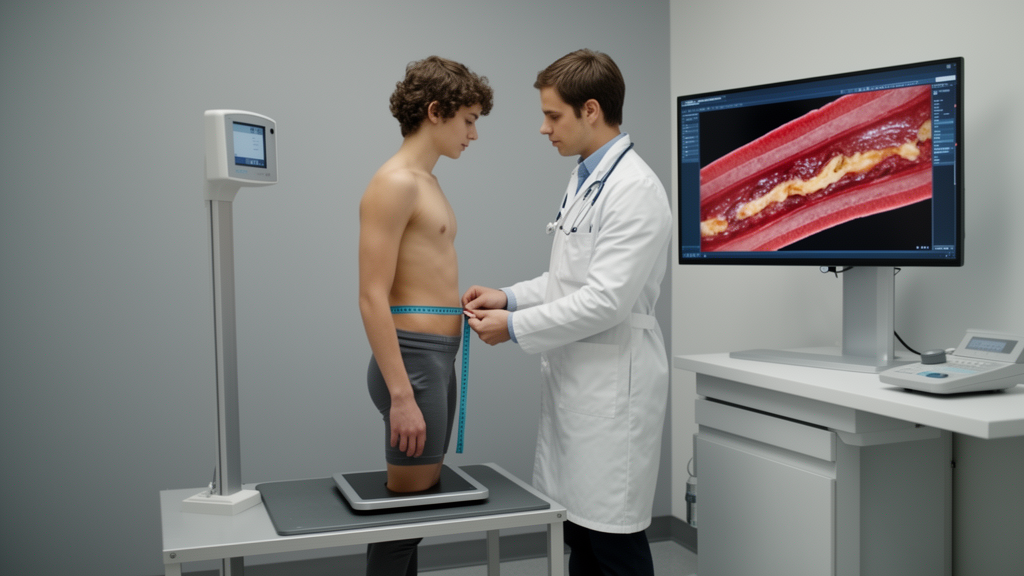
For decades, doctors have leaned on a handful of simple tape-measure numbers to gauge who carries dangerous amounts of fat. Now, one of the most detailed looks yet at young, healthy adults suggests that none of them — not the familiar body mass index, not waist circumference, and not the trendy new indices hyped as upgrades — can reliably flag the earliest structural signs of atherosclerosis in the carotid arteries. In a cross-sectional analysis nested within the Tehran Lipid and Glucose Study, researchers examined 572 adults aged 20 to 40 and found that no traditional or emerging anthropometric index showed meaningful ability to distinguish people with elevated carotid intima-media thickness, a well-validated ultrasound marker of subclinical atherosclerosis, from their peers.
The study, published as part of the long-running community-based TLGS cohort, focused on a group that cardiovascular medicine often overlooks. Atherosclerosis begins silently in youth, and standard risk algorithms perform poorly for people under 40, making sensitive early markers especially valuable in this age range. The researchers selected carotid intima-media thickness, or cIMT, as their primary outcome because it independently predicts future cardiovascular events and has established normative data in young adults. Unlike pulse wave velocity, which captures the functional stiffness of arteries, cIMT reflects the structural burden of early atherosclerotic change — a distinction the authors stress is critical when comparing their results with earlier work.
Participants were drawn from the TLGS, a multistage random-sample cohort in Tehran’s 13th district that has followed residents with triennial assessments since 1999. From 1,455 individuals who attended cIMT measurement during the study’s sixth phase (2016–2019), the team applied strict exclusion criteria: anyone with cancer, reduced kidney function, chronic diuretic or corticosteroid use, diabetes, hypertension, dyslipidemia, pregnancy, or a BMI outside the 18.5 to 35 kg/m² range was removed. The final sample comprised 308 men and 264 women with a mean age of 28.55 years. The narrow BMI window was deliberate — underweight people may carry illness or malnutrition rather than true leanness, while severe obesity involves distinct pathophysiology that could distort the association under study.
Measurement rigor was a central feature of the protocol. Trained professionals recorded weight to the nearest 0.1 kilogram on a digital scale and height, waist and hip circumference to the nearest 0.1 centimeter, with waist measured at the narrowest point between the lowest rib and the iliac crest following the World Health Organization protocol. From these, the team computed five indices: BMI, waist circumference, waist-to-height ratio, the Body Roundness Index (BRI), and A Body Shape Index (ABSI). BRI, introduced by Thomas and colleagues, models the torso as an ellipse and converts its eccentricity into a risk scale; ABSI, from Krakauer and colleagues, adjusts waist circumference for height and weight to isolate body shape from overall size. Fasting glucose, lipid fractions and blood pressure were measured under standardized laboratory conditions, and physical activity was quantified in MET-minutes per week using a validated questionnaire.
The cIMT assessment itself was technically demanding. Using a Samsung Medison SonoAce R3 ultrasound with a 7.5–10 MHz linear transducer, two radiologists blinded to participant information scanned both carotid arteries with participants supine and the neck extended. The analysis focused on the left common carotid artery, averaging three plaque-free measurements on the distal wall, with careful attention to image depth, focal zone and anechoic lumen visibility. Reliability testing in a 30-person subsample yielded an intraclass correlation coefficient of 0.79 — within the 0.75 to 0.90 band considered good — and the authors note this may actually underestimate reliability in younger participants, whose superior image quality reduces measurement error.
The results were strikingly null. In bivariate correlations, cIMT correlated positively with BRI (r = 0.103) and waist-to-height ratio (r = 0.103), but not with BMI, waist circumference or ABSI. In regression models, waist-to-height ratio and BRI showed unadjusted associations with cIMT, and waist circumference remained significant after adjusting for age and sex and again after adding education, smoking and physical activity — but every association vanished once blood pressure, lipids, fasting glucose and kidney function entered the model. Receiver operating characteristic analysis delivered the clearest verdict: area under the curve values ranged from 0.457 to 0.549 across all indices, statistically indistinguishable from the 0.5 of a coin flip. Even the numerically best performers, waist-to-height ratio and BRI at 0.549, offered no real discrimination.
One of the most revealing findings was mathematical rather than clinical: BRI and waist-to-height ratio correlated at r = 0.997 in this dataset. That is no coincidence. BRI is a one-to-one nonlinear transformation of waist divided by height, meaning the two indices rank individuals identically and, within a restricted BMI range, perform near-identically. The authors argue this means the study effectively compared four constructs, not five, and that BRI adds complexity without adding information — waist-to-height ratio is simpler, more intuitive, and carries a universal cutoff of 0.50. Their identical AUC values in the ROC analysis confirmed the point in practice.
ABSI behaved in the opposite direction, and the pattern is instructive. Participants with cIMT above the 75th percentile had significantly lower ABSI (p < 0.0001), yet the bivariate correlation was near zero and the AUC fell below 0.5, pointing to a directional inversion rather than mere noise. The most plausible explanation, the authors write, is confounding by sex — a textbook Simpson’s paradox. Men predominated in the low-cIMT group (57.3% versus 34.8%, p < 0.0001) while also tending to have higher ABSI, whereas women showed lower ABSI but higher cIMT. With only 31 male and 58 female cases above the threshold, formal testing of sex as an effect modifier was impossible, but the authors argue future studies should treat sex as a potential modifier rather than a mere confounder. The sex gap itself ran opposite to patterns seen in older adults, possibly reflecting greater lean mass in men or selective participation.
The authors are careful about what these null results do and do not mean. The 75th-percentile threshold for ‘high’ cIMT was derived internally rather than validated clinically, and published normative data suggest cIMT values around 0.5 millimeters are normal in young adults — so the analysis may have been trying to discriminate within a healthy range. The study also lacked ECG gating during ultrasound, even though cIMT varies by 0.04 to 0.09 millimeters across the cardiac cycle, comparable to the differences being sought, which would bias associations toward the null. With only 89 participants in the high-cIMT group, statistical power to detect modest AUC differences was low, and the authors explicitly frame the findings as inconclusive rather than definitive.
Still, the broader message resonates with prior evidence. In the most directly comparable study, Geraci and colleagues found BMI and BRI predicted vascular injury in hypertensive adults — but their patients had established hypertension, wider age and adiposity variance, and no exclusions for dyslipidemia or diabetes, precisely the conditions under which the adiposity–cIMT link is strongest. ABSI was not associated with cIMT in either study, and separate work in 9,555 Iranian adults and 550 young British adults likewise found ABSI the weakest performer. The authors suggest future research explore allometric combinations of BMI and ABSI, or composite indices such as TyG-ABSI that merge body shape with metabolic markers. For now, the takeaway for young, healthy adults is sobering: if early atherosclerotic change is present, no tape-measure formula yet devised can reliably see it, and any true association between body composition and early vascular disease in this group is likely too small for current single-index screening to catch.
Subject of Research: Anthropometric indices and subclinical carotid atherosclerosis in young healthy adults
Article Title: Association of Traditional and Emerging Anthropometric Indices With Subclinical Carotid Atherosclerosis in Young Healthy Adults: Insights From the Tehran Lipid and Glucose Study
Article References: Abiri, B., Ahmadi, A. R., Hosseinpanah, F., Dehghan, P., Ramezankhani, A., Mataji‐Amirroud, M., Farsinajad, N., Azizi, F., & Valizadeh, M. (2026). Association of Traditional and Emerging Anthropometric Indices With Subclinical Carotid Atherosclerosis in Young Healthy Adults: Insights From the Tehran Lipid and Glucose Study. Endocrinology, Diabetes & Metabolism, 9(6), Article e70369. https://doi.org/10.1002/edm2.70369
Image Credits: AI Generated
DOI: 10.1002/edm2.70369
Keywords: carotid intima-media thickness, body mass index, waist circumference, waist-to-height ratio, body roundness index, A Body Shape Index, subclinical atherosclerosis, young adults, Tehran Lipid and Glucose Study, obesity indices, cardiovascular risk, cross-sectional study
Cite Scienmag News
Ophelia Keating. (October 25, 2026). Body Shape Scores Fail to Spot Early Artery Disease in Young Adults, Study Finds. Scienmag. https://scienmag.com/body-shape-scores-fail-to-spot-early-artery-disease-in-young-adults-study-finds/
Ophelia Keating. "Body Shape Scores Fail to Spot Early Artery Disease in Young Adults, Study Finds." Scienmag, 25 October 2026, https://scienmag.com/body-shape-scores-fail-to-spot-early-artery-disease-in-young-adults-study-finds/. Accessed 25 October 2026.
Ophelia Keating. "Body Shape Scores Fail to Spot Early Artery Disease in Young Adults, Study Finds." Scienmag. October 25, 2026. https://scienmag.com/body-shape-scores-fail-to-spot-early-artery-disease-in-young-adults-study-finds/


