


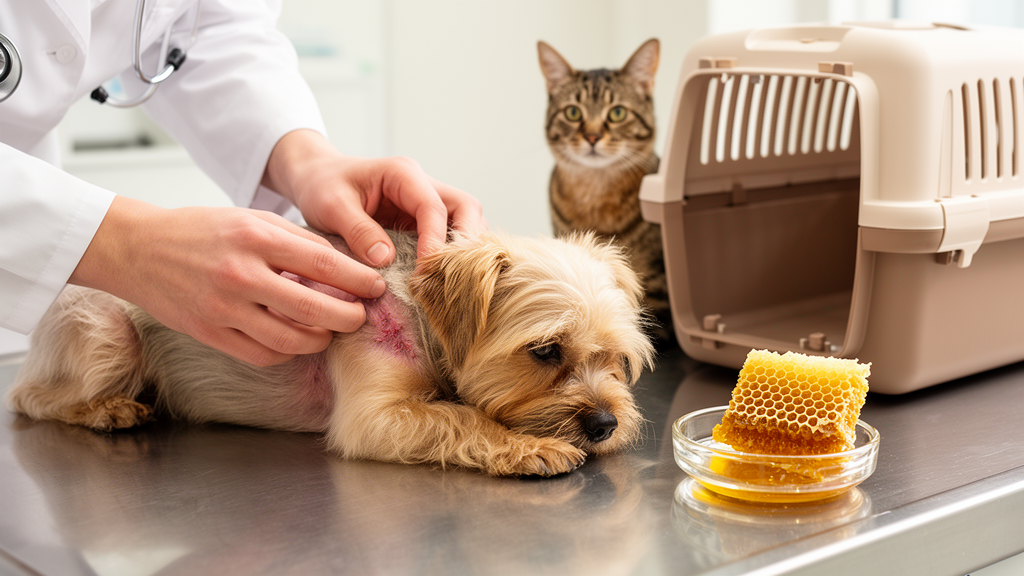
Propolis, a resinous mixture produced by bees, inhibited several bacteria and fungi associated with companion-animal skin infections in laboratory studies, but a structured narrative review finds that the evidence does not yet establish it as an effective clinical replacement for antibiotics. The authors identified 18 studies evaluating propolis for dermatologic infections in companion animals, most involving dogs and most based on in vitro testing. Propolis showed antimicrobial activity against Staphylococcus species, Pseudomonas aeruginosa, Malassezia species and dermatophytes, while only a few small clinical studies assessed infected animals.
No controlled clinical trial has specifically investigated propolis for canine pyoderma, a common bacterial skin infection, so its effectiveness and clinical value remain unproven. The need for alternatives is driven by the scale of antimicrobial use in companion-animal medicine. In a survey of 52 veterinary practices that included 2,599 dogs and cats, 29.2% of animals were prescribed antibiotics and 24.6% received systemic antibiotics.
A separate analysis covering 281,543 canine consultations and 111,139 feline consultations found systemic antimicrobial prescribing during 25.7% of dog consultations and 32.9% of cat consultations. Many practices also use empirical prescribing, meaning treatment begins without confirmation through culture or susceptibility testing. Although this can provide initial relief, it may select for resistant bacterial strains and exacerbate antimicrobial resistance.
The review places these prescribing patterns within the One Health framework, under which animal, human and environmental health are interconnected. Companion animals can act as reservoirs or vectors for resistant organisms, including Staphylococcus pseudintermedius and Escherichia coli, that may reach people through direct contact or contaminated environments. Resistance is already a major feature of common skin diseases.
S. pseudintermedius is the predominant pathogen in canine pyoderma, accounting for 92% of cases in one analysis cited by the review. Up to 60% of S. pseudintermedius strains isolated from canine pyoderma have been reported as methicillin resistant. A 2022 study of 114 Staphylococcus isolates found penicillin resistance in 76–90%, macrolide resistance in 27%, methicillin resistance in 25%, fluoroquinolone resistance in 21% and tetracycline resistance in 19.3%.
These resistance patterns overlap with drug classes routinely used in veterinary dermatology, including beta-lactams, lincosamides, tetracyclines and fluoroquinolones. High rates of empirical antimicrobial prescribing compound the concern: one analysis of 54,600 dogs at 73 practices found that 97% of recorded pyoderma cases received antimicrobials and 92% received systemic therapy. External otitis presents a related challenge.
In a diagnostic dataset covering 604 cases of canine external otitis from 2020 to 2022, P. aeruginosa accounted for 30.7% of isolates, Proteus mirabilis for 29.4%, S. pseudintermedius for 25.1% and E. coli for 19%; 47% of isolates presented multidrug-resistant phenotypes. P. aeruginosa is especially difficult to treat because it has intrinsic resistance mechanisms, can acquire additional resistance and can form biofilms. These microbial communities were detected in 40–95% of P. aeruginosa cases of otitis externa and can protect bacteria from host immune responses and antimicrobial penetration.
Chromosomal AmpC beta-lactamase, increased efflux through the MexAB–OprM and MexXY systems, and loss of the OprD porin can reduce the activity of beta-lactams, aminoglycosides and fluoroquinolones. Biofilm-associated treatment failure and chronic or recurrent infection therefore remain important concerns. Propolis is commonly known as bee glue and is used by bees to construct, seal, repair and protect their hives.
It contains plant resins, beeswax, essential oils, pollen and other organic substances, including bee salivary enzymes. More than 500 chemical compounds have been identified in propolis, including polyphenols, fatty acids, terpenoids, flavonoids, steroids, aromatic alcohols and aldehydes. Its composition varies substantially with geography and the plant sources visited by bees, meaning that material from Romania, Brazil, Argentina, the Baltic region, Portugal, Turkey and Iraq cannot be treated as an interchangeable product.
Extraction methods also affect antimicrobial potency. In one comparison, a deep-eutectic-solvent extract was more active against pathogens isolated from small animals than the corresponding ethanolic extract, with the former producing minimum inhibitory concentrations of 100–1,000 micrograms per millilitre and the latter requiring 500–5,000 micrograms per millilitre. The antimicrobial effects attributed to propolis arise from several compounds acting through potentially complementary mechanisms.
Flavonoids, phenolic acids, esters and terpenoids can disturb bacterial membranes, interfere with metabolism and inhibit efflux pumps. Pinocembrin increased membrane permeability and affected protein and DNA metabolism in Aeromonas hydrophila, while caffeic-acid esters from Egyptian propolis showed bactericidal effects associated with membrane disruption and oxidative stress. Propolis fractions rich in cinnamic acid derivatives have also inhibited ATPase activity, cell division and biofilm formation.
Flavonoid-rich extracts have inhibited bacterial DNA gyrase and topoisomerase IV, enzymes important for DNA replication and transcription. One quercetin-containing example specifically reported inhibition of the ATPase activity of E. coli DNA gyrase. Propolis may also suppress efflux systems: an ethidium-bromide accumulation assay found activity against the S. aureus pump system, while Brazilian brown propolis fractions enhanced norfloxacin in a study attributed to efflux-pump inhibition.
Laboratory findings were broadly consistent across bacterial groups, although activity was generally stronger against Gram-positive organisms, which lack the protective outer membrane found in Gram-negative bacteria. Romanian propolis inhibited S. aureus strains from dogs with superficial pyoderma, including methicillin-resistant strains, at minimum inhibitory concentrations of 6–10 micrograms per millilitre. Brazilian green propolis inhibited S. pseudintermedius at 156 micrograms per millilitre and killed it at a minimum bactericidal concentration of 312 micrograms per millilitre.
By contrast, Baltic deep-eutectic-solvent extracts produced minimum inhibitory concentrations of 1,000 micrograms per millilitre against both P. aeruginosa and E. coli. Other results varied substantially according to formulation and organism. An Argentine ear-drop formulation showed activity against S. aureus, Enterococcus faecalis, P. aeruginosa and P. mirabilis isolated from canine cases, while Portuguese propolis required 500–1,000 micrograms per millilitre against Staphylococcus species and 8,000 micrograms per millilitre against E. coli and Klebsiella oxytoca.
Evidence for antifungal activity was similarly based mainly on laboratory testing but included a few preliminary animal observations. Propolis inhibited Microsporum canis and M. gypseum in vitro, and three dogs with canine dermatophytosis reportedly improved after topical treatment with propolis soap baths or ointment. However, the case series included only one animal per infection, no untreated or placebo control, and no reported randomisation or blinding.
Two cases were treated for approximately three weeks and the third for eight weeks, with outcomes including lesion resolution, reduced pruritus, hair regrowth and negative fungal cultures. A propolis ear formulation for canine otitis reported a 71% recovery rate, but that finding came from a very limited clinical study. Formulation experiments also included a bioadhesive thermoresponsive gel containing 16% propolis, which reduced dermatophyte viability and disrupted fungal biofilms in vitro.
Propolis may also influence the performance of conventional antibiotics. These observations suggest a possible adjunctive role, but they do not demonstrate reduced resistance emergence in animals or superior clinical treatment outcomes. The review notes that propolis can affect membrane integrity, nucleic-acid synthesis, efflux activity and biofilm formation simultaneously, potentially making it harder for a single genetic change to confer resistance.
That advantage, however, has not been confirmed in longitudinal resistance studies. Available safety evidence is also limited. Propolis showed no adverse effects in a Galleria mellonella toxicity model, no genotoxic effects in mice in one study and no significant clinical changes during an eight-week administration study in beagle dogs.
Contact dermatitis and allergic reactions remain possible, particularly in people repeatedly exposed to raw propolis. The review identifies clinical testing, standardisation and formulation as priorities for turning propolis into a reliable veterinary therapy. Any preparation should disclose its botanical and geographical origin, the producing bee species, extraction solvent, processing conditions, chemical fingerprint, total phenolic and flavonoid content, marker compounds and batch-to-batch consistency.
Candidate markers include caffeic acid phenethyl ester, artepillin C, galangin and pinocembrin, selected according to the type of propolis. Until those steps are completed, propolis remains a promising experimental antimicrobial candidate for companion-animal skin infections rather than a proven antibiotic alternative.
Subject of Research: Antimicrobial activity and clinical evidence for propolis in companion-animal skin infections
Article Title: Propolis as an alternative treatment for companion animal skin infections: addressing antimicrobial resistance
Article References: Adra, C., Olsson, M. A., Horn, R., & Tran, T. D. (2026). Propolis as an alternative treatment for companion animal skin infections: addressing antimicrobial resistance. Frontiers in Veterinary Science, 13, Article 1880076. https://doi.org/10.3389/fvets.2026.1880076
Image Credits: AI Generated
DOI: 10.3389/fvets.2026.1880076
Keywords: propolis, companion animals, veterinary dermatology, skin infections, antimicrobial resistance, Staphylococcus pseudintermedius, Pseudomonas aeruginosa, antifungal activity, One Health, antibiotic alternatives, alternative, treatment
Cite Scienmag News
Kristina Jarvis. (October 24, 2026). Propolis Shows Antimicrobial Promise for Companion-Animal Skin Infections. Scienmag. https://scienmag.com/propolis-shows-antimicrobial-promise-for-companion-animal-skin-infections/
Kristina Jarvis. "Propolis Shows Antimicrobial Promise for Companion-Animal Skin Infections." Scienmag, 24 October 2026, https://scienmag.com/propolis-shows-antimicrobial-promise-for-companion-animal-skin-infections/. Accessed 24 October 2026.
Kristina Jarvis. "Propolis Shows Antimicrobial Promise for Companion-Animal Skin Infections." Scienmag. October 24, 2026. https://scienmag.com/propolis-shows-antimicrobial-promise-for-companion-animal-skin-infections/


