


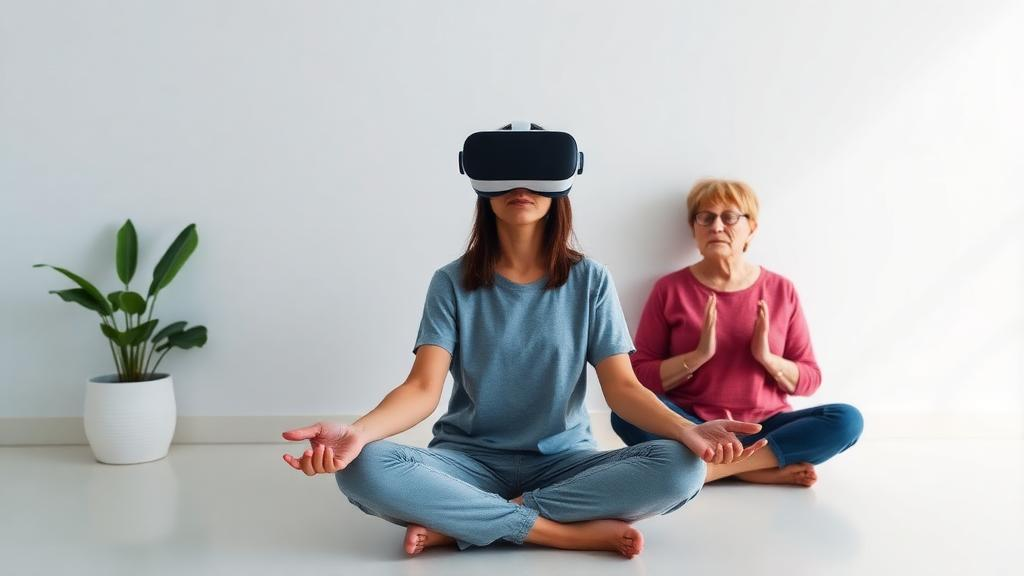
Virtual reality-based meditative and mind-body interventions were associated with lower anxiety and depressive symptom scores in middle-aged and older adults, according to a systematic review and meta-analysis published in BMC Psychology. The review, registered on PROSPERO, pooled data from randomized controlled trials that evaluated VR-based meditative or mind-body interventions in samples recruited explicitly at age 45 or above, with a mean or median age of at least 45, or in which at least 70 percent of participants were aged 45 or older. The authors searched eight bibliographic databases from inception and reran the refined strategy on August 29, 2026, with supplementary searches completed through September 4, 2026.
They ultimately included 21 eligible randomized controlled trials, of which 16 contributed to the quantitative synthesis and five to a structured narrative synthesis. The researchers pooled standardized mean differences, expressed as Hedges' g, using random-effects models fitted with restricted maximum-likelihood estimation and applying Knapp-Hartung inference. Risk of bias was assessed with the Cochrane Risk of Bias 2 tool, and certainty in the evidence was graded with the GRADE framework.
Under the primary pooled analyses, VR-based interventions were associated with lower anxiety scores, with a pooled effect size of g = -0.39 (95 percent confidence interval -0.64 to -0.15; P = 0.004), and lower depressive symptom scores, with g = -0.33 (95 percent confidence interval -0.66 to -0.002; P = 0.049). The authors note, however, that the clinical importance of these standardized differences remains uncertain. The picture was less clear for the remaining outcomes.
Primary pooled estimates for stress, mindfulness, positive affect, negative affect, well-being, and pain were not statistically significant. Exploratory subgroup analyses for anxiety yielded nominal between-subgroup P values below 0.05 for intervention type (P = 0.033) and comparator type (P = 0.006), but the authors treated these results as hypothesis-generating rather than confirmatory. Sensitivity analyses told a mixed story: the anxiety finding was generally robust across alternative analytical choices, whereas the depressive-symptom result was less stable.
Certainty in the evidence was rated as low for anxiety, depressive symptoms, mindfulness, positive affect, and well-being, and very low for stress, negative affect, and pain. In post hoc analyses restricted to studies meeting study-level criteria of 60 years or above, confidence intervals excluded the null for anxiety and depressive symptoms, but estimates were imprecise for the other outcomes. Because these post hoc analyses were not pre-specified, they should be interpreted with caution.
The authors conclude that VR-based meditative and mind-body interventions were associated with lower anxiety and depressive symptom scores in middle-aged and older adults, while evidence for the other psychological, well-being, and pain-related outcomes was inconclusive. They call for larger, well-designed randomized controlled trials with rigorous comparators and longer follow-up to establish whether the observed effects are reliable and clinically meaningful.
Subject of Research: A meta-analysis of randomized controlled trials examining the effects of virtual reality-based meditative and mind-body interventions on psychological and well-being outcomes in middle-aged and older adults.
Article Title: Effects of virtual reality-based meditative and mind-body interventions on psychological and well-being outcomes in middle-aged and older adults: a systematic review and meta-analysis
Article References: Gu, J., Yue, Y., Tong, M., Luo, Q., Fu, J., Liu, R., Yang, F., & Han, Y. (2026). Effects of virtual reality-based meditative and mind-body interventions on psychological and well-being outcomes in middle-aged and older adults: a systematic review and meta-analysis. BMC Psychology. https://doi.org/10.1186/s40359-026-05796-5
Image Credits: AI Generated
DOI: 10.1186/s40359-026-05796-5
Keywords: virtual reality, meditation, mind-body interventions, anxiety, depression, older adults, meta-analysis, systematic review, psychological well-being, randomized controlled trials, Effects, virtual
Cite Scienmag News
Glenn Wilkins. (October 24, 2026). VR Meditation Linked to Lower Anxiety and Depressive Symptoms in Middle-Aged and Older Adults. Scienmag. https://scienmag.com/vr-meditation-linked-to-lower-anxiety-and-depressive-symptoms-in-middle-aged-and-older-adults/
Glenn Wilkins. "VR Meditation Linked to Lower Anxiety and Depressive Symptoms in Middle-Aged and Older Adults." Scienmag, 24 October 2026, https://scienmag.com/vr-meditation-linked-to-lower-anxiety-and-depressive-symptoms-in-middle-aged-and-older-adults/. Accessed 24 October 2026.
Glenn Wilkins. "VR Meditation Linked to Lower Anxiety and Depressive Symptoms in Middle-Aged and Older Adults." Scienmag. October 24, 2026. https://scienmag.com/vr-meditation-linked-to-lower-anxiety-and-depressive-symptoms-in-middle-aged-and-older-adults/


