


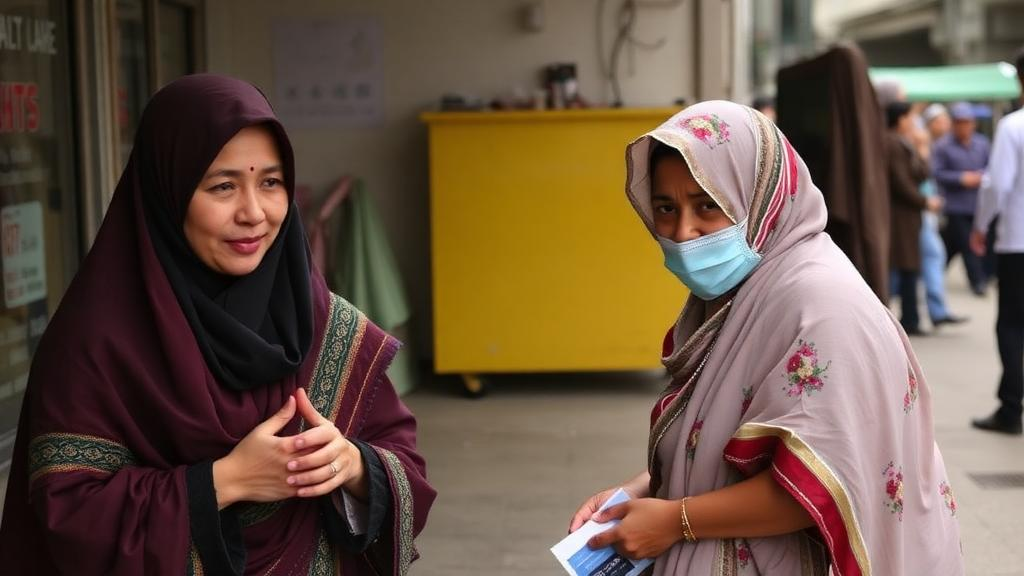
A participatory qualitative study conducted with Pakistani women in Hong Kong has mapped how overlapping identities and social conditions shape the health inequities they experience, according to research published in the International Journal for Equity in Health. The study, led by Saba Asim and colleagues, engaged 72 self-identified Pakistani women as research partners across a two-year Community-Based Participatory Action Research process, and reports on its initial Listening phase, which consisted of focus group discussions designed as safe communicative spaces. The authors argue that Pakistani women in Hong Kong experience intersecting social and structural disadvantages and disproportionate health burdens while remaining largely invisible in the health literature, in part because South Asian communities are often treated as a homogeneous group in research and policy.
Methodologically, the researchers conducted twelve face-to-face focus group discussions, each involving five to eight participants, in English and Urdu. Participants were recruited through multiple channels using maximum variation and snowball sampling, an approach intended to capture diversity within the community rather than treating it as a single group. The data were analyzed using an intersectionality-informed thematic analysis, with ongoing feedback from community partners throughout the research process. The community-based participatory approach positioned Pakistani women as equal partners rather than solely as research subjects, which the authors present as a method for more equitable engagement in health equity research.
The findings indicate that gender, marital status, migration, education, income, language, religion, and ethnic minority status intersect with social determinants of health at the individual, community, institutional, and structural levels to produce inequities in healthcare access and well-being. The authors organize these mechanisms into five interconnected themes. The first concerns gendered expectations of care in the context of migration, describing how caregiving responsibilities and gender roles interact with migrants’ circumstances. The second links housing conditions, social isolation, and community support, situating everyday living environments as part of the health picture. The third addresses health communication inequities and unmet healthcare needs, pointing to language and communication as barriers within the health system. The fourth identifies inequalities in education and employment opportunities, and the fifth examines the COVID-19 pandemic, racialization, and what the authors describe as a deepening of health insecurities.
Because this is a qualitative study reporting on participants’ discussions rather than a measurement of clinical outcomes, the findings describe how the women themselves articulated these intersecting influences, and the authors frame them as mechanisms producing inequities rather than as quantified causal effects. The study was also conducted in a specific setting and with a specific community, and the authors note that while the framework is grounded in Pakistani women’s experiences in Hong Kong, it is offered as guidance that can be adapted for equity work with other ethnic minority and migrant women in Hong Kong and analogous contexts. The paper is published as an open-access article, and the version shared at publication on 24 October 2026 is an accepted manuscript subject to further edits before the final version of record.
On the basis of these findings, the authors conclude that addressing the inequities requires direct community engagement, disaggregated data and monitoring, a multilevel approach with tailored community-driven interventions, and structural policy reforms across education, employment, and the health system. They present the integration of community-based participatory action research with intersectionality as a way to advance a more just and inclusive framework for health equity research with Pakistani women in Hong Kong. The study’s stated contribution is twofold: it explores how intersecting identities and multilevel social determinants of health shape health inequities across family, community, institutional, and structural contexts, and it documents the participatory methods used to engage the community equitably, offering a documented approach that other researchers and policymakers working with marginalized migrant populations may draw upon.
Subject of Research: Intersectionality-informed participatory research on health inequities among Pakistani women in Hong Kong
Article Title: Intersections of identity and multilevel social determinants of health in Hong Kong: a participatory qualitative study of health inequities among Pakistani women
Article References: Asim, S., Nichini, E., Dong, D., & Yeoh, E.-K. (2026). Intersections of identity and multilevel social determinants of health in Hong Kong: a participatory qualitative study of health inequities among Pakistani women. International Journal for Equity in Health. https://doi.org/10.1186/s12939-026-03076-7
Image Credits: AI Generated
DOI: 10.1186/s12939-026-03076-7
Keywords: health inequities, Pakistani women, Hong Kong, intersectionality, social determinants of health, community-based participatory research, migrant health, ethnic minorities, qualitative research, healthcare access, Intersections, identity
Cite Scienmag News
Courtney Benton. (October 24, 2026). Pakistani Women in Hong Kong Face Intersecting Barriers to Health, Study Finds. Scienmag. https://scienmag.com/pakistani-women-in-hong-kong-face-intersecting-barriers-to-health-study-finds/
Courtney Benton. "Pakistani Women in Hong Kong Face Intersecting Barriers to Health, Study Finds." Scienmag, 24 October 2026, https://scienmag.com/pakistani-women-in-hong-kong-face-intersecting-barriers-to-health-study-finds/. Accessed 24 October 2026.
Courtney Benton. "Pakistani Women in Hong Kong Face Intersecting Barriers to Health, Study Finds." Scienmag. October 24, 2026. https://scienmag.com/pakistani-women-in-hong-kong-face-intersecting-barriers-to-health-study-finds/


