


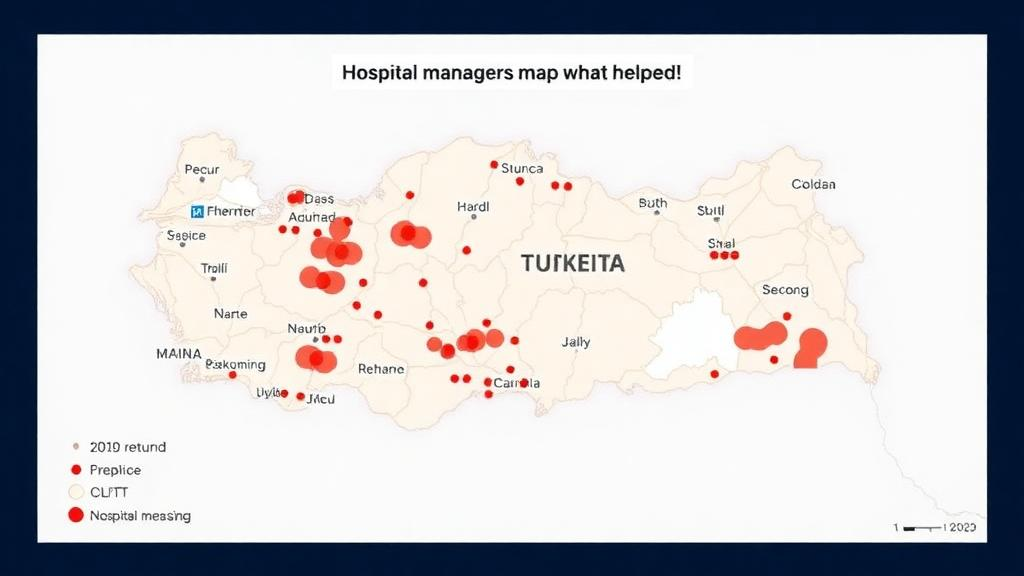
A qualitative study now published in BMC Public Health has analysed their firsthand accounts, using a SWOT framework to organise what strengthened hospital service delivery during the disaster and what undermined it. The research, conducted by Hamdi Öztürk and Deniz Akyıldız, offers one of the few systematic evaluations of hospital-level disaster response drawn directly from the managers who ran medical services on the ground. The study used a phenomenological design, collecting data through semi-structured individual interviews with purposively selected hospital medical service managers who were actively serving during the earthquake.
The researchers then applied thematic analysis and categorised the resulting themes under the four SWOT headings: strengths, weaknesses, opportunities and threats. Because the study is qualitative and based on the experiences of a purposively selected group of managers, its findings describe perceived factors affecting service delivery rather than measured outcomes across the affected health system. Under strengths, participants identified effective leadership and coordination, workforce capacity and resilience, operational capacity, and prior training and drills.
These accounts suggest that hospitals with prepared staff and functioning command structures were better positioned to keep services running when the earthquakes disrupted normal operations. The authors report that these internal capabilities formed the backbone of the response as described by the managers themselves. The weaknesses theme painted a more strained picture.
Managers reported psychosocial strain among staff, deficiencies in institutional preparedness and management, structural and logistical disruptions, hygiene and infection-control inadequacies, and coordination challenges. These findings point to gaps that persisted despite the strengths observed, indicating that workforce resilience and leadership alone did not fully compensate for shortfalls in planning, infrastructure and infection prevention during the emergency. External factors were also mapped.
Opportunities included developments in communication technologies, inter-institutional collaboration and external support networks, social solidarity and volunteer support, and disaster-driven professional and institutional learning. In other words, the disaster itself generated conditions, such as widespread volunteer mobilisation and cooperation between institutions, that managers viewed as resources for maintaining and improving service delivery. The threats theme captured hazards beyond hospitals' control.
These included the severity of the disaster and infrastructure limitations, ongoing seismic activity, extreme winter conditions, infectious disease risks, disruption of communication infrastructure, and social pressure and security concerns. The authors present these external pressures as a distinct category, listed separately from the internal weaknesses reported by participants. From these findings, the study concludes that effective leadership, adaptive coordination and institutional preparedness appear to be important factors in supporting hospital service delivery during large-scale earthquakes.
The authors argue that strengthening disaster preparedness, inter-institutional collaboration, resilient communication systems and psychosocial support for healthcare workers should be treated as priorities for enhancing health system resilience and sustaining care in future disasters. The study's contribution lies in shifting attention from the immediate response phase, which has dominated much of the existing disaster research, toward a comprehensive evaluation of strengths, weaknesses and areas for improvement in service delivery. By grounding the SWOT categories in the lived experiences of medical service managers, the analysis connects abstract resilience concepts to concrete operational realities, from drill-based training to the psychosocial toll on staff who worked through the disaster.
The authors caution that the findings are drawn from a qualitative phenomenological study with purposively selected participants, so they reflect the experiences of managers who served during the disaster rather than a statistically representative sample of the health system. The published version is an early-release article that remains subject to further editorial edits before the final version of record. Even so, the analysis provides a structured evidence base for health planners seeking to prepare hospitals for large-scale earthquakes, identifying which capabilities to reinforce and which vulnerabilities to address before the next seismic event.
Subject of Research: A qualitative SWOT analysis of hospital medical service managers’ experiences during the 2023 Kahramanmaraş earthquakes
Article Title: A qualitative SWOT analysis of hospital medical service managers’ experiences during the 2023 Kahramanmaraş earthquakes
Article References: Öztürk, H., & Akyıldız, D. (2026). A qualitative SWOT analysis of hospital medical service managers’ experiences during the 2023 Kahramanmaraş earthquakes. BMC Public Health. https://doi.org/10.1186/s12889-026-30074-9
Image Credits: AI Generated
DOI: 10.1186/s12889-026-30074-9
Keywords: qualitative, SWOT, analysis, hospital, medical, service, managers, experiences, during, Kahramanmara, earthquakes, scientific research
Cite Scienmag News
Ophelia Keating. (October 24, 2026). Hospital managers map what helped and what failed in Turkey’s 2023 earthquakes. Scienmag. https://scienmag.com/hospital-managers-map-what-helped-and-what-failed-in-turkeys-2023-earthquakes/
Ophelia Keating. "Hospital managers map what helped and what failed in Turkey’s 2023 earthquakes." Scienmag, 24 October 2026, https://scienmag.com/hospital-managers-map-what-helped-and-what-failed-in-turkeys-2023-earthquakes/. Accessed 24 October 2026.
Ophelia Keating. "Hospital managers map what helped and what failed in Turkey’s 2023 earthquakes." Scienmag. October 24, 2026. https://scienmag.com/hospital-managers-map-what-helped-and-what-failed-in-turkeys-2023-earthquakes/


