

Saturday, October 24, 2026
Science
No Result
View All Result
  • Login
  • HOME
  • SCIENCE NEWS
  • CONTACT US
  • HOME
  • SCIENCE NEWS
  • CONTACT US
No Result
View All Result
Scienmag
No Result
View All Result
Home Science News Technology and Engineering

Pressure insoles show fair-to-excellent repeatability for on-ice skating measurements

October 24, 2026
in Technology and Engineering
Denise Maddox
By Denise Maddox Scienmag Editorial Profile - Mechanical Engineering
Reading Time: 3 mins read
0
Pressure insoles show fair-to-excellent repeatability for on-ice skating measurements

Pressure insoles show fair-to-excellent repeatability for on-ice skating measurements

65
SHARES
587
VIEWS
Share on FacebookShare on Twitter
ADVERTISEMENT

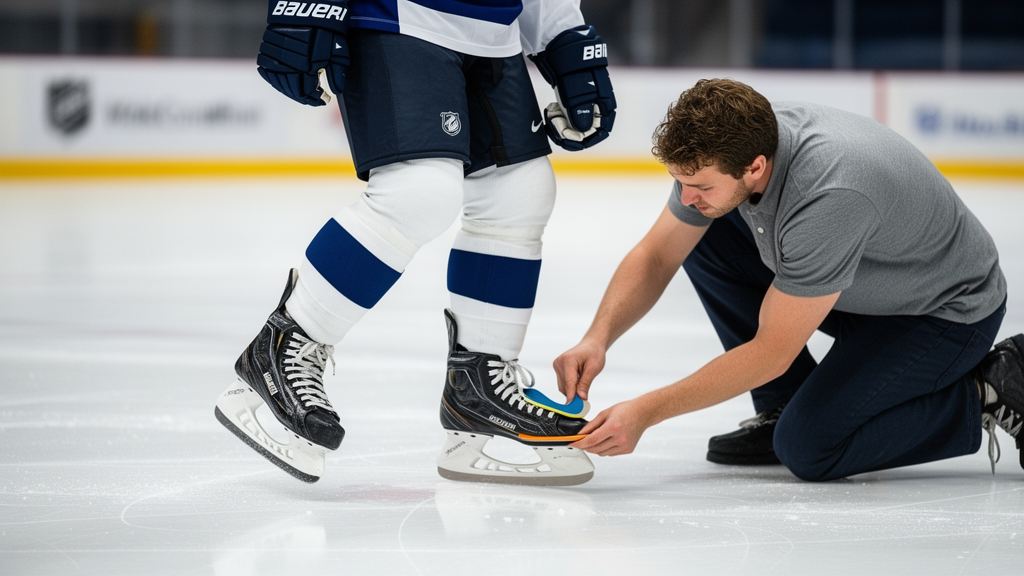
Short-track speed skating places unusual biomechanical demands on athletes, who repeatedly transition between straightaways and tight curves at high speed. Plantar pressure insoles offer a non-intrusive way to assess the loading patterns generated during these maneuvers, but how repeatable such measurements are under real on-ice conditions has remained poorly documented. A methodology study published in Sports Engineering on 24 October 2026 tested whether pressure insoles, worn inside skating boots during actual short-track sessions, produce consistent measurements from one trial to the next within a single session.

Ten competitive short-track speed skaters, five women and five men with an average age of 18.8 years, an average height of 171.2 centimeters and an average mass of 68.8 kilograms, took part in the study. Each athlete performed repeated on-ice trials while equipped with pressure insoles and triaxial accelerometers, with a wearable camera serving as a reference. A pressure-based algorithm automatically segmented the recorded signals into half-laps.

The team assessed the intra-session repeatability of three types of signals: plantar pressure, the position of the center of pressure under the foot, and acceleration. Repeatability was quantified using intraclass correlation coefficients, standard error of measurement, and statistical parametric mapping with repeated-measures analysis of variance. In addition, the researchers used the root mean square error to quantify variability within a single trial and variability between different trials.

The analysis of variance found no significant trial effects, indicating that the skaters maintained consistent movement patterns across repeated trials within the session. Plantar pressure and center-of-pressure measurements demonstrated fair-to-excellent repeatability, with intraclass correlation coefficients greater than 0.70 for the mediolateral center-of-pressure. In contrast, the acceleration signals showed poor repeatability, with intraclass correlation coefficients below 0.30.

A key technical finding emerged from the root mean square error comparison. Across all variables, the between-trial root mean square error values were lower than the within-trial root mean square error values. This pattern suggests that removing and repositioning the insoles between trials did not substantially increase measurement variability, an important consideration for any protocol that requires athletes to put the equipment back on during a session.

For coaches and sport scientists, the results support the repeatability of pressure insole measurements of plantar loading and center-of-pressure trajectories during genuine short-track skating, rather than only in laboratory simulations. The poor repeatability of the accelerometer signals, however, indicates that wearable acceleration data collected under these high-speed on-ice conditions showed low consistency across trials in this study.

The study’s methodology also combined pressure insoles with a wearable camera for reference and an automatic pressure-based segmentation algorithm for analyzing half-laps. The authors report that these findings support the repeatability of plantar pressure and center-of-pressure measurements obtained with pressure insoles under real on-ice short-track speed skating conditions.

The study was limited to ten athletes tested within a single session, so longer-term reliability across sessions and larger populations remains to be established. Within that scope, the results indicate that pressure and center-of-pressure signals from insoles can be measured consistently in short-track speed skating, while acceleration-based wearable signals were considerably less repeatable in the same setting.

Subject of Research: Intra-session reliability of plantar pressure and center-of-pressure measurements with pressure insoles in competitive short-track speed skating

Article Title: Intra-session reliability of plantar pressure measurements in short-track speed skating

Article References: Hoerter, B., Bost, S., Wagnac, É., & Clément, J. (2026). Intra-session reliability of plantar pressure measurements in short-track speed skating. Sports Engineering, 29(2), Article 41. https://doi.org/10.1007/s12283-026-00576-1

Image Credits: AI Generated

DOI: 10.1007/s12283-026-00576-1

Keywords: short-track speed skating, plantar pressure insoles, center-of-pressure, wearable accelerometers, intra-session reliability, sports engineering, biomechanics, on-ice measurement, wearable sensors, repeatability, Intra-session, reliability

Cite Scienmag News

Denise Maddox. (October 24, 2026). Pressure insoles show fair-to-excellent repeatability for on-ice skating measurements. Scienmag. https://scienmag.com/pressure-insoles-show-fair-to-excellent-repeatability-for-on-ice-skating-measurements/


Denise Maddox. "Pressure insoles show fair-to-excellent repeatability for on-ice skating measurements." Scienmag, 24 October 2026, https://scienmag.com/pressure-insoles-show-fair-to-excellent-repeatability-for-on-ice-skating-measurements/. Accessed 24 October 2026.

Denise Maddox. "Pressure insoles show fair-to-excellent repeatability for on-ice skating measurements." Scienmag. October 24, 2026. https://scienmag.com/pressure-insoles-show-fair-to-excellent-repeatability-for-on-ice-skating-measurements/

Tags: biomechanical assessment in short-track speed skatingbiomechanical demands of short-track speed skatingbiomechanicscenter of pressureimpact of pressure insoles on athlete performance monitoringIntra-sessionintra-session consistency of pressure and acceleration signalsintra-session reliabilitynon-intrusive skate load analysison-ice measurementplantar pressure insolesplantar pressure measurement reliabilityPressure insoles for on-ice skatingreliabilityrepeatabilityrepeatability of pressure insoles during skatingshort-track speed skatingsports engineeringstatistical analysis of pressure insoles datause of triaxial accelerometers in skating biomechanicsvalidation of pressure-based algorithms in sportswearable accelerometerswearable sensorswearable technology for on
Share26Tweet16
Previous Post

Virtual Students, Real Theory: Digital Twin Simulation Puts Metacognition to the Test

Next Post

Synthetic Holograms With Known Phase Truth Set a Reproducible Benchmark for Reconstruction Algorithms

Related Posts

Self-healing waterborne polyurethane coatings combine UV curing with antibacterial ZnO
Technology and Engineering

Self-healing waterborne polyurethane coatings combine UV curing with antibacterial ZnO

October 24, 2026
Hazardous Drinking Linked to Higher Psychotropic Prescriptions in Depression
Technology and Engineering

Hazardous Drinking Linked to Higher Psychotropic Prescriptions in Depression

October 24, 2026
BERT neural network maps regional synergy in China’s ice-snow economy
Technology and Engineering

BERT neural network maps regional synergy in China’s ice-snow economy

October 24, 2026
Brain waves reveal cybersickness in real time, UMD study finds
Technology and Engineering

Brain waves reveal cybersickness in real time, UMD study finds

October 24, 2026
Hybrid Optimizer Lifts AraBERT Accuracy in Arabic Sentiment Analysis
Technology and Engineering

Hybrid Optimizer Lifts AraBERT Accuracy in Arabic Sentiment Analysis

October 24, 2026
Cold Sintering Tunes Nanoparticle Spacing to Unlock Dielectric Resonance for Radar-Absorbing Materials
Technology and Engineering

Cold Sintering Tunes Nanoparticle Spacing to Unlock Dielectric Resonance for Radar-Absorbing Materials

October 24, 2026
Next Post
Synthetic Holograms With Known Phase Truth Set a Reproducible Benchmark for Reconstruction Algorithms

Synthetic Holograms With Known Phase Truth Set a Reproducible Benchmark for Reconstruction Algorithms

  • Mothers who receive childcare support from maternal grandparents show more optimized

    Mothers who receive childcare support from maternal grandparents show more parental warmth, finds NTU Singapore study

    27656 shares
    Share 11059 Tweet 6912
  • University of Seville Breaks 120-Year-Old Mystery, Revises a Key Einstein Concept

    1061 shares
    Share 424 Tweet 265
  • Bee body mass, pathogens and local climate influence heat tolerance

    682 shares
    Share 273 Tweet 171
  • Researchers record first-ever images and data of a shark experiencing a boat strike

    546 shares
    Share 218 Tweet 137
  • Groundbreaking Clinical Trial Reveals Lubiprostone Enhances Kidney Function

    531 shares
    Share 212 Tweet 133
Science

Embark on a thrilling journey of discovery with Scienmag.com—your ultimate source for cutting-edge breakthroughs. Immerse yourself in a world where curiosity knows no limits and tomorrow’s possibilities become today’s reality!

RECENT NEWS

  • Synthetic Holograms With Known Phase Truth Set a Reproducible Benchmark for Reconstruction Algorithms
  • Pressure insoles show fair-to-excellent repeatability for on-ice skating measurements
  • Virtual Students, Real Theory: Digital Twin Simulation Puts Metacognition to the Test
  • Self-healing waterborne polyurethane coatings combine UV curing with antibacterial ZnO

Categories

  • Agriculture
  • Anthropology
  • Archaeology
  • Athmospheric
  • Biology
  • Biotechnology
  • Blog
  • Bussines
  • Cancer
  • Chemistry
  • Climate
  • Earth Science
  • Editorial Policy
  • Marine
  • Mathematics
  • Medicine
  • Pediatry
  • Policy
  • Psychology & Psychiatry
  • Science Education
  • Science News
  • Social Science
  • Space
  • Technology and Engineering

Subscribe to Blog via Email

Enter your email address to subscribe to this blog and receive notifications of new posts by email.

Join 5,152 other subscribers

© 2025 Scienmag - Science Magazine

Welcome Back!

Login to your account below

Forgotten Password?

Retrieve your password

Please enter your username or email address to reset your password.

Log In
No Result
View All Result
  • HOME
  • SCIENCE NEWS
  • CONTACT US

© 2025 Scienmag - Science Magazine

Discover more from Science

Subscribe now to keep reading and get access to the full archive.

Continue reading