


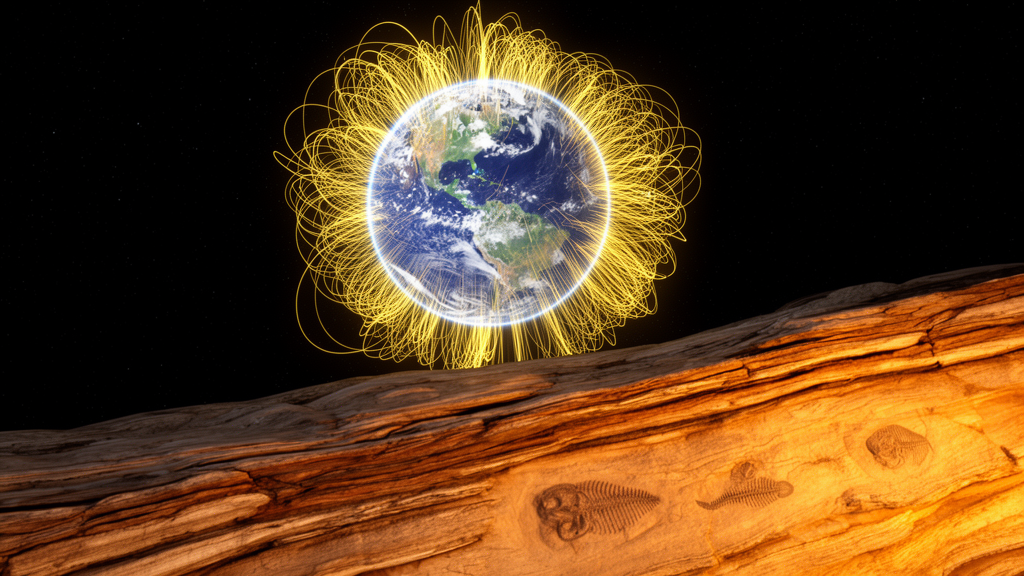
Earth’s magnetic field was flipping at an extraordinary rate around the time of a severe mass extinction about 261 million years ago, according to a new high-resolution magnetostratigraphic study of the Fengshan section in South China, published in National Science Review. The research, led by scientists at the Institute of Geology and Geophysics, Chinese Academy of Sciences, with collaborators from Utrecht University, BOKU University, Nanjing University and other institutions, documents one of the most restless stretches of geomagnetic behavior yet measured and ties it closely to the end-Guadalupian extinction horizon.
The record comes from continuous shallow-water limestones deposited near the paleo-equator. Of more than 870 oriented specimens collected from the section, 309 yielded stable, dual-polarity magnetic directions that survived rigorous demagnetization and reliability testing. By combining biostratigraphy, cyclostratigraphy and radiometric age anchors, the team established a precise timeline for a 3.75-million-year interval spanning roughly 262.5 to 258.75 million years ago, in which they recovered 29 distinct magnetic polarity zones. In the approximately 1.7 million years immediately before the end-Guadalupian extinction, the reversal rate climbed to about 11 reversals per million years—an order of magnitude higher than the long-term average in the geologic record. After the extinction, the field settled into a quieter pattern for a few million years.
The hyperactive interval followed the end of the Kiaman Superchron, a remarkable stretch of tens of millions of years during the late Carboniferous and much of the Permian when the field held a single reversed polarity. That long quiet period ended near 265 million years ago. Reversal frequency is not constant through geologic time, and variations in the rate are thought to reflect changes in heat flow across the core-mantle boundary, where the liquid-iron outer core generates the geodynamo. The authors interpret the post-Kiaman instability as a possible surface expression of deep-Earth change: descending lithospheric slabs associated with the final assembly of the supercontinent Pangea may have reached the core-mantle boundary, locally increasing heat extraction from the core and introducing lateral variations in heat flux. Geodynamo simulations indicate that such heterogeneity can promote frequent reversals, although the models operate far from fully Earth-like conditions and remain sensitive to parameter choices.
The extinction in question, the end-Guadalupian event, is often overshadowed by the larger end-Permian mass extinction that followed roughly ten million years later, but it was already severe: reef systems collapsed, many marine invertebrate groups declined sharply, and terrestrial ecosystems showed clear disruption. Conventional explanations center on the Emeishan large igneous province, global sea-level fall linked to Pangea’s assembly, and the resulting ocean and climate stress. The new polarity sequence raises the possibility that an unstable geodynamo added another, less familiar pressure during this already turbulent interval, when sea levels were unusually low and massive volcanism was releasing gases that warmed the climate and disrupted ocean chemistry.
A more disordered or weaker field would have reduced the magnetosphere’s ability to deflect galactic cosmic rays and solar particles. Increased ionization in the upper atmosphere can erode ozone and raise surface ultraviolet flux—effects that have been documented, through pollen malformations and UV-protective compounds in the fossil record, at the later end-Permian crisis. Whether similar processes operated around 261 million years ago is not yet clear. The authors note that direct evidence for ozone loss at the end-Guadalupian remains limited, and that halogens derived from large igneous province volcanism remain a plausible alternative or complementary driver of any ozone depletion.
Importantly, the study does not claim that magnetic-field chaos caused the extinction. It documents a striking temporal coincidence and outlines a physically plausible pathway by which deep-Earth processes could have amplified surface environmental stress. Testing that pathway will require better paleointensity records across the same interval, tighter age constraints, and coupled atmospheric modeling. In the meantime, the Fengshan polarity sequence supplies one of the clearest windows yet into how the planet’s magnetic shield behaved during a critical chapter of the late Paleozoic, and a reminder that the geodynamo’s rhythms may be entangled with some of life’s worst crises.
Subject of Research: Rapid geomagnetic polarity reversals coinciding with the end-Guadalupian mass extinction about 261 million years ago
Article Title: Earth’s magnetic field flipped rapidly across a mass extinction about 261 million years ago
Article References: Earth’s magnetic field flipped rapidly across a mass extinction about 261 million years ago. Original publication (Bibliographic details unavailable.)
Image Credits: AI Generated
DOI: Not provided
Keywords: geomagnetic reversals, end-Guadalupian extinction, Permian, paleomagnetism, geodynamo, Kiaman Superchron, core-mantle boundary, South China, ozone depletion, large igneous provinces, Pangea, magnetostratigraphy
Cite Scienmag News
Grant Pearson. (October 24, 2026). Earth’s magnetic field flipped rapidly across a mass extinction about 261 million years ago. Scienmag. https://scienmag.com/earths-magnetic-field-flipped-rapidly-across-a-mass-extinction-about-261-million-years-ago/
Grant Pearson. "Earth’s magnetic field flipped rapidly across a mass extinction about 261 million years ago." Scienmag, 24 October 2026, https://scienmag.com/earths-magnetic-field-flipped-rapidly-across-a-mass-extinction-about-261-million-years-ago/. Accessed 24 October 2026.
Grant Pearson. "Earth’s magnetic field flipped rapidly across a mass extinction about 261 million years ago." Scienmag. October 24, 2026. https://scienmag.com/earths-magnetic-field-flipped-rapidly-across-a-mass-extinction-about-261-million-years-ago/


